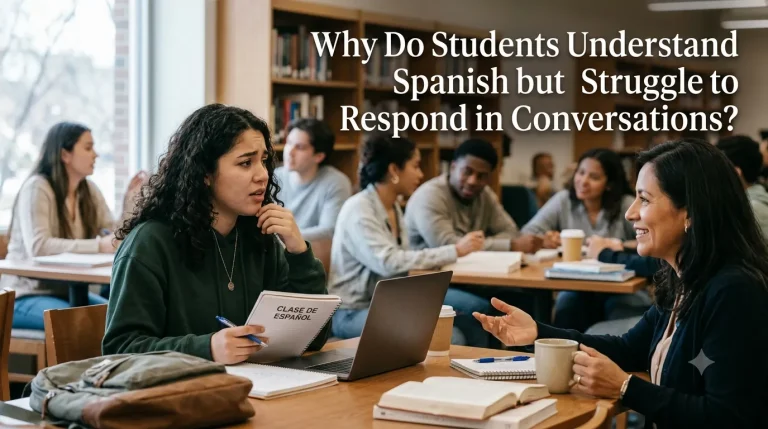
Have you ever listened to someone speaking Spanish and understood almost everything they said, but when it was your turn to respond, the right words suddenly disappeared? You are not alone. This is one of the most common challenges faced by students learning Spanish, especially those who study through textbooks, apps, or traditional classroom lessons.
Many learners can read Spanish, understand grammar rules, and follow conversations but still struggle to speak confidently. The reason is simple: understanding Spanish and producing Spanish are two different skills.
The good news is that this problem can be overcome with the right practice and regular exposure. For students who want to learn to speak Spanish in Mexico, participating in Spanish immersion programs in Mexico can provide the consistent speaking practice needed to turn passive knowledge into active communication.
In this article, we will explore why this happens, what prevents students from responding naturally, and how Spanish language immersion programs can help learners become more confident speakers.
Quick Answer: Why Can You Understand Spanish but Not Speak It?
Students often understand Spanish but struggle to respond because their passive language skills are stronger than their active language skills. They may recognize words and understand sentences when listening, but they have not practiced retrieving vocabulary, forming sentences, and speaking spontaneously enough.
Other common reasons include:
- Translating from English before speaking
- Fear of making mistakes
- Limited conversation practice
- Knowing grammar but not using it automatically
- Having a small active vocabulary
- Feeling nervous when speaking with native speakers
- Not getting enough real-world exposure to Spanish
The solution is to practice producing Spanish regularly instead of only consuming it through reading and listening.
Understanding Passive and Active Spanish Skills
The first step toward improving your speaking ability is understanding the difference between passive and active language skills.
Passive Spanish skills include your ability to:
- Understand spoken Spanish
- Recognize vocabulary
- Read Spanish sentences
- Follow conversations
- Understand grammar when you see it
Active Spanish skills include your ability to:
- Speak spontaneously
- Form sentences quickly
- Choose the right words
- Respond naturally
- Express opinions and ideas
It is completely normal for passive skills to develop faster than active skills.
For example, you may understand the question:
“What did you do over the weekend?”
You know that it means, “What did you do on the weekend?”
But when someone asks you the question directly, you may suddenly hesitate.
You know the words. You understand the grammar. But you need more time to create your answer.
This is why Spanish immersion classes in Mexico can be so valuable. Immersion creates repeated opportunities to turn passive knowledge into active speaking ability.
Why Does This Happen to Spanish Learners?
1. You Translate Everything in Your Head
One of the biggest barriers to speaking Spanish is mental translation.
You hear Spanish.
Then you translate it into English.
Then you think about your answer in English.
Finally, you translate your response back into Spanish.
This process takes time.
By the time you are ready to respond, the conversation may have already moved forward.
The goal of Spanish language immersion programs is to help you reduce this mental translation process.
Instead of thinking:
English → Translation → Spanish
You gradually learn to think:
Idea → Spanish
This is one of the most important steps toward becoming fluent.
2. You Know Grammar but Cannot Use It Automatically
Many students spend years studying Spanish grammar.
They know the difference between the preterite and imperfect tenses. They understand verb conjugations and can complete grammar exercises correctly.
But speaking is different.
When you are having a real conversation, you do not have time to mentally review grammar rules before every sentence.
You need to use the language automatically.
This is why the best Spanish immersion programs balance grammar instruction with real conversation. Grammar gives you the foundation, but repeated speaking helps turn that knowledge into a natural skill.
3. You Have a Larger Passive Vocabulary Than Active Vocabulary
You may recognize hundreds or even thousands of Spanish words when you hear or read them.
However, recognizing a word does not mean you can immediately use it.
For example, you might understand the word “aprovechar” when someone uses it in a conversation, but you may struggle to remember it when you want to express an idea yourself.
This is the difference between recognition and retrieval.
The more you speak, the more your brain learns to retrieve vocabulary quickly.
Students attending Spanish language classes in Mexico can practice this skill every day by using new words in real conversations rather than simply memorizing vocabulary lists.
How Does Spanish Immersion Help You Respond More Naturally?
If your goal is to Speak Spanish Fluently, immersion can provide something traditional learning often lacks: constant opportunities to communicate.
Imagine starting your morning by speaking Spanish with your host family.
Then you attend your Spanish class.
After class, you order lunch in Spanish.
Later, you speak with a local shopkeeper.
In the evening, you have another conversation with your classmates.
Each interaction gives your brain another opportunity to retrieve vocabulary and build sentences.
This is the power of language immersion Mexico experiences.
You are not simply studying Spanish.
You are using it to live your daily life.
4. Fear of Making Mistakes Can Stop You From Speaking
Another common reason students struggle to respond is fear.
They worry:
- “What if I use the wrong verb?”
- “What if my pronunciation is bad?”
- “What if people laugh at me?”
- “What if I don’t understand the response?”
This anxiety can make students silent, even when they know enough Spanish to communicate.
However, mistakes are a natural part of learning.
The goal of an immersion experience is not to speak perfectly from day one. The goal is to communicate more effectively every day.
When you learn to speak Spanish in Mexico, you have countless opportunities to make mistakes, receive feedback, and try again.
Eventually, speaking becomes less intimidating.
5. You Have Not Had Enough Real Conversations
Listening to Spanish podcasts and watching Spanish-language videos can improve comprehension.
However, passive listening does not fully prepare you for spontaneous conversations.
Real conversations are unpredictable.
People speak quickly.
The topics move from one subject to another.
They contain expressions you may not have heard before.
They raise questions you might not anticipate.
You need to respond immediately.
This is why Spanish immersion classes in Mexico can be so effective. Students are encouraged to actively participate rather than simply listen.
Over time, your brain becomes better at processing Spanish and responding without long pauses.

Why Learning Spanish in Mexico Can Improve Conversation Skills
Mexico provides an environment where students can use Spanish throughout their day.
For international students attending Spanish schools in Puebla Mexico, language learning can extend beyond the classroom.
You can practice Spanish while:
- Ordering food
- Shopping at local markets
- Asking for directions
- Meeting new people
- Exploring the city
- Talking with residents
This type of daily interaction helps develop practical communication skills.
Puebla is particularly appealing for students who want an authentic Spanish in Mexico experience combined with structured language instruction.
Instead of learning Spanish only as an academic subject, students can experience it as a living language.
What Should You Do If You Understand Spanish but Cannot Respond?
If you understand Spanish but struggle to speak, try these strategies.
Start With Short Answers
Do not pressure yourself to create long, perfect sentences.
Start with simple responses.
Instead of trying to explain everything, answer with a few words and gradually expand your response.
Repeat Useful Expressions
Learn complete phrases rather than isolated vocabulary.
For example:
- “I think that…”
- “In my opinion…”
- “I’m not sure, but…”
- “Can you repeat that?”
- “What does it mean…?”
These expressions give you useful tools for keeping conversations moving.
Practice Thinking in Spanish
Try describing your surroundings in Spanish.
Think about what you are doing.
Create simple sentences mentally.
This gradually reduces your dependence on translation.
Talk Every Day
Even 15–20 minutes of daily speaking can make a difference.
The key is consistency.
The more often you retrieve Spanish words and construct sentences, the faster the process becomes.
How Can Spanish Immersion Programs Improve Speaking Confidence?
The biggest advantage of Spanish immersion programs in Mexico is the amount of exposure they provide.
Students are surrounded by Spanish and encouraged to use it regularly.
This can help improve:
- Listening comprehension
- Vocabulary recall
- Pronunciation
- Sentence formation
- Conversational confidence
- Cultural understanding
A structured Spanish language course provides the academic foundation, while immersion gives students opportunities to apply what they learn.
Together, these experiences can help learners move from understanding Spanish to actively using it.
Are Spanish Immersion Schools Suitable for Students Who Already Understand Spanish?
Yes.
In fact, students with a good understanding of Spanish can benefit significantly from immersion.
If you already understand conversations but struggle to respond, your next step is to develop active speaking skills.
A Spanish immersion school can provide an environment where you are encouraged to communicate regularly and challenge yourself beyond your comfort zone.
Rather than learning more and more vocabulary without using it, you can focus on turning the knowledge you already have into practical communication.
How Long Does It Take to Become Comfortable Speaking Spanish?
There is no single answer.
Progress depends on factors such as:
- Your starting level
- Previous language experience
- Time spent practicing
- Frequency of conversations
- Motivation
- Exposure to native speakers
Some students notice improvements within weeks, while others need more time.
The important thing is to focus on progress rather than perfection.
If you consistently participate in Spanish language immersion programs, practice outside the classroom, and communicate with native speakers, you can gradually become faster and more confident.
From Understanding Spanish to Speaking It With Confidence
The gap between understanding Spanish and responding in Spanish is completely normal.
It does not mean you are bad at languages.
It usually means your passive skills have developed faster than your active skills.
The solution is not necessarily to memorize more grammar rules or vocabulary lists. Instead, you need more opportunities to retrieve, produce, and use Spanish in real situations.
This is where Spanish immersion Schools and immersion-based learning can make a meaningful difference.
When you surround yourself with Spanish, you begin to recognize patterns more quickly. You become comfortable making mistakes. You learn how to keep conversations going. Most importantly, you gradually stop translating every sentence in your head.
Final Thoughts
If you can understand Spanish but struggle to respond, you are already further along than you may realize. Your comprehension skills are a strong foundation. Now, you need to develop the ability to use that knowledge actively.
For learners who want to learn to speak Spanish, Spanish immersion programs in Mexico provide an opportunity to practice the language in real-world situations every day.
Whether you are considering immersion in Spanish in Mexico, researching Spanish language classes in Mexico, or looking for one of the best Spanish immersion programs, the key to progress is consistent communication.
The more you listen, speak, make mistakes, and try again, the more natural Spanish becomes.
Ultimately, fluency is not just about understanding what someone says. It is about having the confidence and ability to respond when it is your turn to speak.