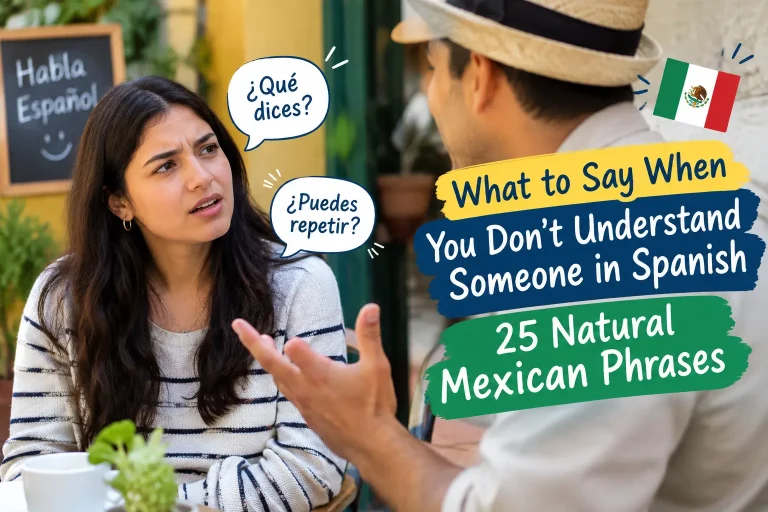
Learning Spanish in a classroom is one thing. Understanding someone when they are speaking quickly, using slang, or connecting several words together is another.
If you are planning to learn Spanish in Mexico, one of the first things you will discover is that you do not have to understand every word to keep a conversation going. Native speakers may speak faster than you expect, use expressions you have never heard before, or pronounce words differently from what you learned in a textbook.
And that is completely normal.
The important thing is knowing what to say when you miss something.
of immediately switching to English or reaching for a translation app, you can use simple Spanish phrases to ask someone to repeat themselves, speak more slowly instead, explain a word, or clarify what they mean.
These expressions are especially useful when you are participating in Spanish immersion classes in Mexico, traveling, ordering food, meeting local people, or simply trying to have a conversation outside the classroom.
Here are 25 natural Mexican Spanish phrases that can help you communicate when you don’t understand.
Why These Phrases Matter When Learning Spanish
When you study Spanish abroad, communication does not always happen at the pace of your textbook.
A teacher might speak clearly and slowly during a lesson. But at a market, restaurant, café, bus station, or social gathering, people may speak much faster.
You might understand:
“Where…?”
but miss everything that comes after it.
Rather than freezing or pretending you understood, learning a few useful expressions gives you a way to keep the conversation moving.
This is one of the advantages of an immersion Spanish program. You learn not only how to form sentences but also how to manage real conversations when communication is imperfect.
25 Natural Mexican Phrases to Use When You Don’t Understand
1. ¿Puedes repetir, por favor?
Can you repeat that, please?
This is one of the most useful phrases for beginners.
You can use it whenever you didn’t hear or understand what someone said.
Example:
—Shall we meet at six?
—Can you repeat that, please?
2. ¿Puede repetir, por favor?
Could you repeat that, please?
This is the more formal version of Can you repeat?
Use can when speaking politely to someone you do not know well or in a more formal situation.
3. No entendí.
I didn’t understand.
Short, natural, and extremely useful.
Notice that I understood is in the past tense. You are essentially saying, “I didn’t understand what you just said.”

Example:
—The appointment is on Thursday at four.
—Sorry, I didn’t understand. Thursday?
4. No entiendo.
I don’t understand.
This is slightly different from I didn’t understand .
- I do n’t understand.
- I didn’t understand = I didn’t understand.
Both are common and useful.
5. ¿Puedes hablar más despacio?
Can you speak more slowly?
This phrase can be a lifesaver when someone is speaking too quickly.
And don’t be embarrassed to use it. When you are learning Spanish in Mexico, asking someone to slow down is a normal part of communication.
6. ¿Puede hablar más despacio?
Could you speak more slowly?
This is the formal version.
If you’re speaking with someone you don’t know or in a professional setting, this is a polite option.
7. ¿Qué dijiste?
What did you say?
This is a natural informal expression when you didn’t catch what someone said.
With friends or people around your age, you will hear this frequently.
8. ¿Qué dijo?
What did you say? / What did you say, sir/ma’am?
This is the formal version of What did you say?
It can also be used when speaking respectfully to someone you don’t know well.
9. ¿Qué significa…?
What does … mean?
This phrase is particularly helpful when you’re building your vocabulary.
For example:
What does “ahorita” mean?
What does “ahorita” mean?
You will encounter plenty of Mexican expressions like this while studying Spanish in Mexico .
10. ¿Qué quiere decir…?
What does … mean?
This is another very natural way to ask about the meaning of a word or expression.
For example:
What does “mande” mean?
It is a useful phrase to add to your everyday Spanish vocabulary.
11. No conozco esa palabra.
I don’t know that word.
This is a simple way to tell someone that you have encountered unfamiliar vocabulary.
You can then follow it with:
What does it mean?
“What does it mean?”
12. No conozco esa expresión.
I don’t know that expression.
This is especially useful when someone uses Mexican slang or an idiomatic expression that you have never heard before.
Language learning involves more than memorizing individual words. Expressions and cultural references are part of everyday communication too.
13. ¿Me lo puedes explicar?
Can you explain it to me?
Use this when repeating the sentence isn’t enough and you need someone to explain what they mean.
For example:
I don’t understand. Can you explain it to me?
“I don’t understand. Can you explain it to me?”
14. ¿Me lo puede explicar?
Could you explain it to me?
This is the formal version.
It’s useful in professional, academic, or unfamiliar situations.
15. ¿Puedes decirlo de otra manera?
Can you say it another way?
Sometimes you know all the individual words but still don’t understand the meaning of the sentence.
This phrase asks the person to rephrase it.
It’s an excellent expression for intermediate Spanish learners.
16. ¿Puede decirlo de otra manera?
Could you say it another way?
Again, this is the more formal version.
Rather than simply saying I don’t understand , you are giving the speaker a practical way to help you understand.
17. Perdón, no escuché.
Sorry, I didn’t hear you.
This phrase is useful when the problem isn’t your Spanish knowledge—you simply didn’t hear the person.
Maybe there was traffic, music, or several people talking at the same time.
18. Perdón, no alcancé a escuchar
Sorry, I didn’t quite catch that.
This is a particularly natural expression in Mexico.
I couldn’t hear can communicate that you weren’t able to hear something clearly.
It is a great phrase to add once you become more comfortable with conversational Spanish.
19. ¿Mande?
What? / Sorry?
Don’t underestimate this tiny word.
In informal conversations, how? can be used when you didn’t hear or understand something.
For example:
—See you at the back entrance.
—What?
The tone matters, so beginners may prefer Can you repeat, please? when they want to sound especially polite.
20. ¿Mande?
Pardon? / Yes?
You may hear Mande? frequently in Mexico.
It is commonly used as a polite way to ask someone to repeat themselves or as a response when someone calls your name.
For Spanish learners, it is an interesting example of how language and culture are connected.
21. ¿Me puedes dar un ejemplo?
Can you give me an example?
This is particularly useful in class.
If your teacher introduces a new grammar structure or expression and you are not sure how to use it, ask:
¿Me puedes dar un ejemplo?
A real example often makes a confusing concept much easier to understand.
22. ¿Puedes escribirlo?
Can you write it down?
Sometimes hearing a new Spanish word isn’t enough.
If you want to remember the spelling, pronunciation, or meaning, ask someone to write it down.
This is especially useful when learning new names, addresses, places, or unfamiliar vocabulary.
23. ¿Cómo se dice ___ en español?
How do you say ___ in Spanish?
This is one of the most valuable phrases for language learners.
For example:
¿Cómo se dice “appointment” en español?
Instead of immediately checking a translation app, you can ask the person you’re speaking with.
That creates another opportunity to communicate in Spanish.
24. ¿Me puedes ayudar?
Can you help me?
When you are struggling to understand a situation, this simple phrase can open the door to assistance.
For example:
Perdón, no entiendo. ¿Me puedes ayudar?
“Sorry, I don’t understand. Can you help me?”
It is polite, clear, and easy to remember.
25. Estoy aprendiendo español.
I’m learning Spanish.
This may be the most useful phrase of all.
When you tell someone estoy aprendiendo español, they often understand that you may need them to speak more slowly or explain unfamiliar words.
You don’t need to apologize for being a learner.
You’re learning—and speaking with people is part of the process.
What Should You Say When Someone Speaks Too Fast?
If you are a beginner participating in intensive Spanish immersion programs, fast speech can initially feel overwhelming.
Instead of simply saying no entiendo, try:
Perdón, ¿puedes hablar más despacio?
Then, if you still don’t understand:
¿Puedes repetir, por favor?
And if the problem is a particular word:
¿Qué significa esa palabra?
This three-step approach can help you stay in the conversation rather than abandoning it.
Mexican Spanish You May Hear During Conversations
When you learn Spanish in Mexico, you will encounter vocabulary and expressions that may not appear in the Spanish courses you have previously taken.
For example, Mexican speakers may use expressions such as:
- Ahorita – depending on context, “right now,” “in a little while,” or “soon”
- Mande – a polite response such as “pardon?” or “yes?”
- Qué padre – how cool / that’s great
- Platicar – to chat or talk
- Camión – commonly used for bus in Mexico
- ¿Qué onda? – what’s up?
The exact meaning of an expression can depend on context, tone, and region.
That is why language immersion in Mexico can be so valuable. You aren’t only memorizing vocabulary—you are learning how people actually use the language.

Don’t Be Afraid to Ask for Clarification
One of the biggest mistakes Spanish learners make is pretending to understand.
You smile, nod, and simply say sí.
And then you realize you have absolutely no idea what the person just told you.
It happens.
But asking for clarification is actually a communication skill.
When you say:
“No entendí. ¿Puedes repetir?”
you are not failing at Spanish. You’re successfully communicating that you need more information.
That distinction is important.
If your goal is to learn Spanish fast, you need to become comfortable managing conversations, including conversations where you don’t understand everything.
How Immersion Helps You Understand Real Spanish
A textbook can teach you vocabulary and grammar, but real conversations expose you to something different: speed, accents, expressions, interruptions, gestures, and context.
This is where a Spanish language program in Mexico can make a difference.
In an immersion environment, you have opportunities to use Spanish in and outside the classroom. You hear the language repeatedly, try new expressions, make mistakes, ask questions, and gradually become better at understanding what people actually say.
At a Spanish immersion school, the goal isn’t simply to know about Spanish.
It is to use Spanish.
For students considering Spanish immersion programs for adults in Mexico, this practical approach can be especially valuable because the language is connected to everyday situations rather than isolated exercises.
Final Thoughts: You Don’t Have to Understand Everything
Learning a language doesn’t mean understanding every sentence perfectly.
There will be days when someone speaks too quickly. You’ll hear an unfamiliar expression. You’ll recognize every word in a sentence but somehow still miss the meaning.
That’s part of learning.
Instead of getting frustrated, use phrases such as “¿Puedes repetir?”, “¿Puedes hablar más despacio?”, “¿Qué significa?”, or “¿Puedes decirlo de otra manera?”
These simple expressions allow you to keep communicating.
And that is one of the most important skills you can develop when you study Spanish abroad.
Whether you’re taking a short course or joining one of the best Spanish immersion programs in Mexico, remember that fluency doesn’t come from never making mistakes. It comes from continuing to communicate despite them.
The more you listen, ask questions, clarify, and speak, the more natural Spanish becomes.
Eventually, you may find yourself in a conversation where someone speaks quickly—and instead of thinking, “I don’t understand,” you simply respond:
“¿Puedes repetir, por favor?”
And keep going.
That’s real progress.
Frequently Asked Questions About Understanding Mexican Spanish
What should I say if I don’t understand someone in Spanish?
You can say “I don’t understand” or “I didn’t understand.” You can also ask “Can you repeat that, please?” or “Can you speak more slowly?”
How do you politely ask someone to repeat themselves in Spanish?
A polite option is “¿Puede repetir, por favor?” For informal situations you can say “¿Puede repetir, por favor?”
How do you say “I don’t understand” in Mexican Spanish?
“I don’t understand” is commonly used in Mexico, just as it is throughout the Spanish-speaking world.
What does “Mande?” mean in Mexico?
Send? It is commonly used in Mexico as a polite way to ask someone to repeat something or as a response when someone calls you.
How can I improve my ability to understand native Spanish speakers?
Regular listening practice helps, but real-world interaction is particularly valuable. Joining Spanish immersion classes in Mexico can give you frequent opportunities to hear and use Spanish in authentic situations.
Is Mexican Spanish difficult to understand?
It can be challenging at first, particularly when people speak quickly or use regional vocabulary. However, regular exposure makes comprehension easier. Spending time in Mexico gives learners the opportunity to become familiar with the rhythm, vocabulary, and expressions of Mexican Spanish.