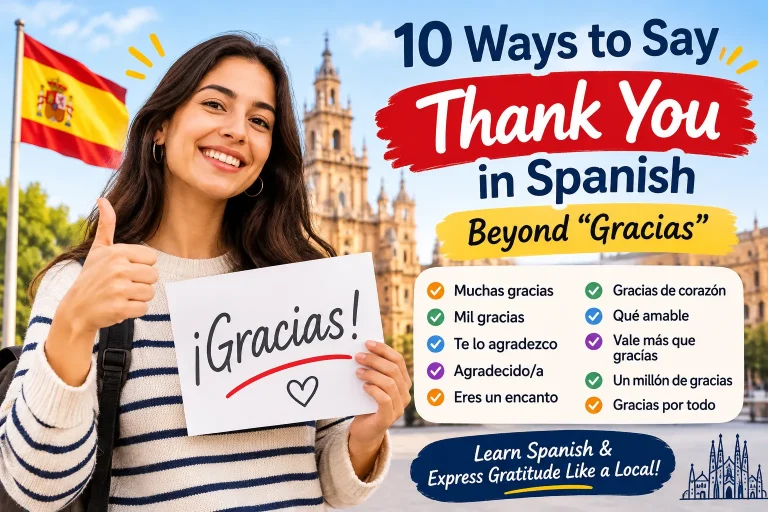
If you’ve recently started learning Spanish, chances are Gracias is one of the first words you memorized. It’s simple, useful, and understood everywhere Spanish is spoken. Whether you’re ordering coffee, asking for directions, or receiving a compliment, thank you usually works perfectly.
But spend a little time speaking with native Spanish speakers, especially in Mexico, and you’ll notice that people express gratitude in many different ways.
Sometimes a quick “thank you” isn’t enough. You might want to show genuine appreciation, recognize someone’s kindness, or thank a person who has gone out of their way to help you.
Knowing a few alternatives to Gracias can make your Spanish sound warmer, more natural, and appropriate for different situations.
Below are 10 useful ways to say thank you in Spanish, along with their meanings, examples, and tips for using them in everyday conversations.
Why Learn Different Ways to Say Thank You in Spanish?
Learning another language isn’t just about translating words. It’s also about understanding how people express emotions, build relationships, and communicate politely.
In Mexico, courtesy plays an important role in everyday interactions. You’ll frequently hear expressions of appreciation in restaurants, markets, workplaces, and conversations between friends.
Using different Spanish thank-you phrases helps you:
- Express different levels of gratitude.
- Sound more natural during conversations.
- Communicate politely in formal and informal situations.
- Understand expressions commonly used by native speakers.
- Build confidence when speaking Spanish in Mexico.
You don’t need to memorize dozens of complicated phrases. Just learning a few commonly used expressions can noticeably improve your everyday communication.
10 Natural Ways to Say Thank You in Spanish
1. Thank You Very Much – Thank You Very Much
Thank you very much is one of the most common alternatives to a simple thank you .
It adds warmth and emphasis without sounding overly formal or dramatic. You can use it with friends, strangers, teachers, coworkers, and service staff.
Example:
Thank you so much for your help.
Thank you very much for your help.
Imagine you’re visiting Puebla and someone helps you find the correct bus stop. Saying thank you very much is a friendly and polite way to acknowledge their assistance.
It’s an excellent expression for beginners because it works naturally in almost any situation.
2. Thank you so much!
When you want to express stronger appreciation, try thank you very much .
It means “thank you so much” or “thank you very, very much.”
The expression communicates enthusiasm and sincere gratitude, particularly when someone has done something meaningful for you.
Example:
Thank you so much for everything!
Thank you so much for everything!
Suppose a host family prepares a special dinner for you during your Spanish immersion program. This phrase would be a wonderful way to express how much you appreciate their hospitality.
You can use it in both casual and professional conversations, although its emotional emphasis makes it especially suitable for heartfelt situations.
3. Thousand Thanks – A Thousand Thanks
Mil Gracias literally translates to “a thousand thanks.”
Of course, you aren’t thanking someone exactly one thousand times. It’s simply a warm and expressive way to show appreciation.
You’ll hear this phrase in friendly conversations and informal messages.
Example:
Thank you so much for the favor!
A thousand thanks for the favor!
Imagine a classmate shares their notes after you miss a Spanish lesson. You could respond with a thousand thanks to show how grateful you are.
It’s short, cheerful, and easy to remember.
Although it can appear in professional messages, it’s particularly natural when speaking with friends or people you know well.
4. I really appreciate it.
If you want to move beyond variations of thank you , I appreciate it is an excellent expression to learn.
It means “I appreciate it” or “I’m grateful to you for it.”
Unlike simply saying thank you, this phrase emphasizes your personal appreciation for someone’s action.
Example:
Thank you very much.
I really appreciate it.
You might use this expression when a friend helps you practice Spanish pronunciation or explains something you couldn’t understand.
Because te is the informal form of “you,” this expression works best with friends, classmates, and people you address using tú .
It’s particularly useful when you want your gratitude to sound sincere without being overly emotional.
5. I appreciate it – I appreciate it (Formal)
Spanish has different ways of addressing people depending on the relationship and situation.
Se lo agradezco is the formal counterpart of te lo agradezco when speaking respectfully to someone addressed as you .
It’s useful when interacting with teachers, older adults, officials, or people you don’t know well.
Example:
Thank you very much, professor.
I really appreciate it, professor.
Imagine a teacher spends extra time explaining a challenging grammar concept. This expression allows you to communicate appreciation respectfully.
Learning when to use tú and tú is an important part of understanding Spanish-speaking cultures.
In Mexico, respectful language is common in many professional and unfamiliar social situations, making I appreciate it especially useful.
6. I’m very grateful.
Sometimes you want to express gratitude as a feeling rather than simply acknowledging someone’s action.
That’s when estoy muy agradecer or estoy muy agradecida becomes useful.
Use grateful if you’re male and grateful if you’re female.
Example:
I am very grateful for this opportunity.
I’m very grateful for this opportunity.
This expression works well in thoughtful conversations, speeches, professional situations, and personal messages.
For example, after completing a language course in Mexico, you might use it when thanking your teachers and classmates for their encouragement.
It’s a meaningful way to communicate gratitude without relying on the same familiar words.
7. That’s So Kind of You
Not every expression of gratitude needs to contain the word thank you .
Qué amable de tu parte means “That’s so kind of you.”
Instead of directly saying thank you, you’re recognizing the kindness behind someone’s action.
Example:
How kind of you to help me!
That’s so kind of you to help me!
You might say this when someone offers to carry your bag, helps you understand directions, or makes an unexpected thoughtful gesture.
For a more formal version, you can say:
It’s so kind of you.
That’s so kind of you. (Formal)
This expression is especially useful for sounding warm and appreciative in everyday conversations.
8. I Owe You One
Want to sound more natural when speaking with friends?
Try, I owe you one .
It means “I owe you one” and is commonly used when someone does you in favor.
Example:
Thanks for helping me with my homework! I owe you one.
Thanks for helping me with my homework! I owe you one.
Imagine your Spanish-speaking friend helps you prepare for an important conversation or accompanies you somewhere unfamiliar.
Saying I owe you a shows appreciation while suggesting you’d be happy to return the favor.
It’s a casual expression, so avoid using it in formal business conversations or when addressing someone you don’t know well.
9. I Don’t Know How to Thank You
Occasionally, someone does something so thoughtful that an ordinary thank you doesn’t seem sufficient.
In these moments, you can say I don’t know how to thank you .
It translates to “I don’t know how to thank you.”
Example:
I don’t know how to thank you for everything you’ve done for me.
I don’t know how to thank you for everything you’ve done for me.
This expression communicates strong personal appreciation.
You might use it when a friend supports you through a difficult experience or someone provides important assistance.
It isn’t necessary for small everyday favors. Save it for moments when you genuinely want to emphasize how meaningful someone’s help has been.
10. Thank you from the bottom of my heart.
Gracias de todo corazón is one of the most heartfelt ways to say thank you in Spanish.
The phrase literally means “thanks with all my heart” and communicates deep sincerity.
Example:
Thank you from the bottom of my heart for welcoming me into your home.
Thank you from the bottom of my heart for welcoming me into your home.
Imagine spending several weeks with a Mexican host family and developing a close relationship with them.
Before leaving, this phrase would communicate heartfelt appreciation for their kindness and hospitality.
It’s also suitable for thank-you letters, farewell messages, and other meaningful personal moments.
How to Practice These Spanish Thank-You Expressions in Real Life
Memorizing phrases is helpful, but using them naturally takes practice.
One effective method is to connect each expression to a situation you might experience.
For example, imagine ordering breakfast at a café in Mexico. When the server brings your meal, say thank you very much .
If someone helps you solve a difficult problem, try, I really appreciate it .
When a friend does you in favor, respond with I owe you one .
You can also practice by listening to Spanish conversations, watching Mexican television programs, and paying attention to how native speakers express gratitude.
If you want more opportunities to use these expressions, Spanish immersion classes in Mexico can be particularly valuable.
At the Spanish Institute of Puebla, students learn through a communicative approach that combines formal language instruction with practical conversation.
The Institute offers eight levels of intensive Spanish immersion instruction, with each standard level lasting three weeks. Students can enroll in one level or continue through additional levels based on their goals.
Through classroom conversations and cultural experiences, learners have opportunities to practice Spanish in authentic situations rather than relying exclusively on textbook exercises.
For anyone planning to learn Spanish in Mexico, using simple expressions like these in daily interactions is an excellent place to begin.
Final Thoughts
Learning different ways to say thank you in Spanish might seem like a small step, but these everyday expressions help you communicate with greater warmth and confidence.
You don’t need advanced grammar to make a positive impression. Sometimes knowing when to say thank you , how kind of you , or I appreciate it is enough to make a conversation feel more natural.
As you become familiar with these phrases, try using them whenever you have the opportunity. Pay attention to how people respond and which expressions fit different situations.
And if you’d like to take your communication skills further, consider learning Spanish in an environment where the language is part of everyday life.
At the Spanish Institute of Puebla, students can combine structured language lessons with cultural experiences and practical conversation, helping them develop the confidence to use Spanish beyond the classroom.
Frequently Asked Questions
What is the most common way to say thank you in Spanish?
Thank you is the most common and widely understood expression. Thank you very much is also frequently used when someone wants to express a little more appreciation.
How do you say thank you politely in Mexican Spanish?
You can say thank you very much , thank you very much , or I appreciate it . The best choice depends on the situation and your relationship with the person you’re addressing.
What is the difference between “gracias” and “te lo agradezco”?
Gracias means “thank you,” while te lo agrazco means “I appreciate it.” The second expression places more emphasis on appreciating a person’s specific action.
How do you express heartfelt gratitude in Spanish?
You can use “thank you from the bottom of my heart ,” ” I am very grateful,” or ” I don’t know how to thank you .” These phrases communicate deeper appreciation than an ordinary “thank you.”
Is a thousand thanks commonly used in Mexico?
Yes. Mil Gracias is a natural expression in Mexican Spanish, particularly in friendly conversations and informal written messages.