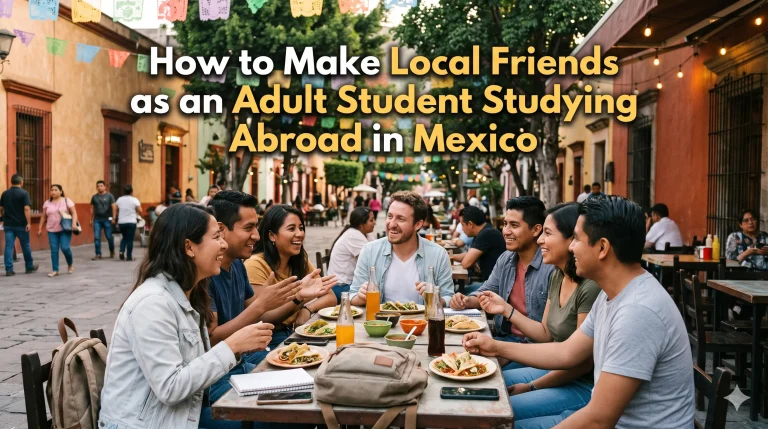
Studying Spanish abroad as an adult is about much more than learning vocabulary and grammar. It is also an opportunity to build relationships, experience everyday Mexican culture, and become more comfortable communicating outside the classroom.
For many adult students, however, making local friends can feel surprisingly difficult at first. You may be arriving in Mexico alone, navigating a new city, and trying to speak Spanish with people you have only just met. If you are older than the typical university student, you may also wonder whether it will be easy to connect with people who have similar interests and experiences.
The good news is that you do not need to be naturally outgoing or speak perfect Spanish to make meaningful friendships in Mexico. In fact, studying at a Spanish immersion school can create many natural opportunities to meet people and practice Spanish in real situations.
Here are practical ways adult students can make local friends while studying Spanish in Mexico.
Why Making Local Friends Matters When You Study Spanish Abroad
Classroom instruction gives you a structured environment to learn Spanish, but conversations with local people teach you how the language actually works in everyday life.
When you make local friends, you have opportunities to:
- Practice conversational Spanish naturally
- Learn expressions and vocabulary used in everyday conversations
- Understand Mexican customs and social traditions
- Become more confident speaking outside class
- Discover restaurants, markets, neighborhoods, and cultural activities
- Experience Mexican life from a local perspective
- Build relationships that can continue after your study abroad experience
This is one reason language immersion in Mexico can be so valuable for adult learners. Instead of limiting Spanish practice to scheduled lessons, you can use the language throughout your day.
A simple conversation over coffee, a walk through a local market, or an invitation to a cultural event can become an unexpected Spanish lesson.
1. Start With Your Spanish School Community
One of the easiest ways to begin making friends is to become involved with the community around your Spanish school.
When you join a Spanish language program in Mexico, you will likely meet other students who are also interested in Spanish and Mexican culture. Some may be traveling alone, while others may be professionals, retirees, or students from different countries.
Although international friendships are valuable, your classmates can also help you become more socially comfortable before you begin making local connections.
Talk to classmates before or after class. Invite someone for coffee. Join extracurricular activities instead of returning to your accommodation immediately after lessons.
At SIPuebla, the focus is not limited to studying Spanish as an academic subject. The program combines language learning with cultural experiences and authentic communication, giving students opportunities to use Spanish in diverse circumstances.
That environment can make meeting people feel much more natural.
2. Join Cultural and Extracurricular Activities
You do not have to walk up to a stranger and say, “Do you want to be friends?”
Shared activities make conversations much easier.
Look for activities involving Mexican culture, such as:
- Cooking classes
- Local food tours
- Art workshops
- Museum visits
- Cultural festivals
- Dance classes
- Walking tours
- Community events
- Music performances
- Local markets
These activities give you an immediate conversation topic.
For example, if you are attending a Mexican cooking class, you can ask another participant about the dish you are preparing. If you visit a market, you can ask someone about a particular ingredient or local specialty.
You are not simply “trying to make friends.” You are participating in something together—and friendships often develop naturally from there.
3. Practice Speaking Spanish Even When You Feel Nervous
One of the biggest obstacles for adult students is the fear of making mistakes.
You may understand what someone is saying but hesitate because you are worried about using the wrong verb tense or pronunciation.
Try not to wait until your Spanish is perfect.
If your goal is to learn to speak Spanish, conversations with local people are essential. Most people understand that language learners make mistakes. Making an effort to communicate in Spanish can also show that you are genuinely interested in the culture.
Start with simple conversations:
“¿Vives cerca de aquí?”
“¿Qué lugares me recomiendas visitar?”
“¿Cuál es tu comida mexicana favorita?”
“¿Qué haces los fines de semana?”
These questions can lead to longer conversations without requiring advanced Spanish.
The more often you practice, the more comfortable you become.
4. Become a Regular Somewhere
Friendships often develop through repeated encounters rather than one memorable conversation.
Choose a café, bookstore, park, fitness class, market, or other local place you enjoy and visit regularly.
When people see you repeatedly, conversations become easier.
The first time, you may simply order a coffee. The next time, someone may recognize you. Eventually, you might have a short conversation about your studies, where you are from, or what you have been doing in Mexico.
This is particularly useful for adult students who prefer meaningful relationships over large social groups.
You do not need to meet dozens of people. A few regular interactions can gradually develop into genuine friendships.
5. Ask Local People for Recommendations
One of the easiest ways to start a conversation is to ask for advice.
Instead of searching online for everything, ask someone locally:
- “Where do you usually eat?”
- “Is there a good market nearby?”
- “What should I see this weekend?”
- “Where can I hear live music?”
- “What Mexican food should I try?”
- “Is there a local event happening this week?”
People often enjoy sharing recommendations about their city.
Even better, follow their advice. If someone recommends a restaurant or cultural event, try it and tell them what you thought.
That creates an opportunity for a second conversation.
6. Look Beyond the International Student Bubble
When you study Spanish abroad, it is tempting to spend most of your time with other international students. After all, communication may be easier because everyone understands what it feels like to be new.
International friendships are an important part of the experience, but try to balance them with local connections.
Use Spanish whenever possible. Shop at local businesses. Attend neighborhood events. Participate in activities where local residents are likely to be present.
This is where an immersion Spanish program can make a difference.
Immersion is not simply about spending time in a Spanish-speaking country. It is about using Spanish as part of your daily life. The more you interact with your surroundings, the more opportunities you have to develop practical communication skills.
7. Be Open About Being a Spanish Learner
You do not need to hide the fact that you are learning.
In fact, saying something like, “Estoy aprendiendo español” can open the door to conversation.
You might even ask a new acquaintance to correct you when you make an obvious mistake.
However, remember that friendships should not become one-sided language exchanges. A local friend is not your personal Spanish teacher.
Show genuine interest in the person, not just in what they can teach you.
Ask about their interests, work, family traditions, hobbies, favorite places, and experiences. Share your own stories as well.
That balance turns language practice into an actual relationship.
8. Use Spanish Outside the Classroom Every Day
If you are taking Spanish immersion classes in Mexico, make a personal goal of using Spanish at least a few times outside school each day.
For example:
Morning: Order breakfast in Spanish.
Afternoon: Have a short conversation with someone at a shop or café.
Evening: Attend an activity or speak with a local acquaintance.
These small interactions add up.
You may initially need to think carefully about every sentence. After several weeks of regular practice, common phrases begin to feel more automatic.
This is one of the practical advantages of choosing to learn Spanish in Mexico rather than studying exclusively through an online course. Your learning environment continues beyond your scheduled lesson.

9. Give Friendships Time to Develop
Adult friendships rarely happen overnight.
You may meet someone interesting but not immediately become close friends. That is completely normal.
Instead of expecting every interaction to become a friendship, focus on being present and approachable.
If you have a good conversation with someone, suggest something simple:
“¿Quieres tomar un café algún día?”
“¿Te gustaría ir al mercado el sábado?”
“¿Quieres practicar español juntos?”
A low-pressure invitation is often easier than proposing a major outing.
And remember: some friendships may last for years, while others may simply make your time in Mexico more enjoyable. Both can be valuable.
10. Choose an Immersion Program That Encourages Real Interaction
For adults deciding how to study Spanish abroad, the learning environment matters.
Online Spanish classes can provide flexibility and structured instruction, but studying in Mexico offers something that a screen cannot fully reproduce: constant exposure to the language and culture around you.
A strong Spanish immersion program combines formal instruction with opportunities to communicate in authentic circumstances.
SIPuebla has offered intensive Spanish immersion in Mexico for more than 35 years, serving students, professionals, and retirees from more than 72 countries. Its program is structured across eight levels, with three weeks for each level, allowing students to attend one level or continue through multiple levels.
The program emphasizes communication and practical use of Spanish alongside comprehension, reading, writing, and linguistic structure.
For an adult learner, that combination can be especially useful because the goal is not simply to memorize Spanish. It is to become comfortable using it in real life.
What If You Are an Introvert?
You do not have to become extremely social to make local friends.
Start small.
Choose one activity. Speak to one person. Ask one question. Return to a place you enjoyed.
If large groups make you uncomfortable, look for smaller activities where conversation happens naturally.
The important thing is consistency rather than quantity.
A few genuine relationships can make your experience of Mexico feel completely different.
Final Thoughts
Making local friends as an adult student in Mexico does not require perfect Spanish, an outgoing personality, or a large social network.
It requires curiosity, patience, and a willingness to participate.
Say yes to activities. Start conversations. Ask locals for recommendations. Visit places more than once. Use Spanish even when you make mistakes. Most importantly, be interested in people as people—not only as opportunities to practice Spanish.
That is where the real value of studying abroad begins.
When you learn Spanish in Mexico, the classroom becomes only one part of your education. Conversations over coffee, cultural activities, everyday errands, and new friendships all become part of the learning experience.
For adults who want to move beyond memorizing vocabulary and actually learn to speak Spanish, an immersive experience can turn language study into something much more personal: a chance to live the language while discovering a new culture and building relationships along the way.
Frequently Asked Questions
1. Is it difficult to make local friends in Mexico as an adult student?
It can take time, especially if you are new to the country or still developing your Spanish skills. However, joining cultural activities, attending a Spanish school, and regularly visiting local places can create natural opportunities to meet people.
2. Do I need to speak fluent Spanish to make Mexican friends?
No. You can begin with basic Spanish. Making an effort to communicate is often more important than speaking perfectly. As your confidence improves, conversations will naturally become longer and more comfortable.
3. What are the best ways to meet local people while studying Spanish in Mexico?
Cultural activities, cooking classes, local events, dance classes, markets, cafés, community activities, and extracurricular programs can all provide opportunities to meet local people.
4. Can an adult student make friends through a Spanish immersion program?
Yes. Immersion programs bring together students with a shared interest in Spanish and Mexican culture. Extracurricular activities and opportunities for communication can also help students interact beyond formal classroom lessons.
5. Is studying Spanish in Mexico better than learning Spanish online?
The right option depends on your goals, schedule, and learning preferences. Online classes offer convenience and flexibility, while studying in Mexico provides direct exposure to Spanish-speaking environments, cultural experiences, and everyday opportunities to practice the language.
6. How can I practice Spanish with local friends without making the relationship feel like a language exchange?
Focus on genuine friendship. Talk about hobbies, food, travel, work, culture, and everyday life rather than constantly asking for corrections. You can naturally practice Spanish while also sharing your own language, culture, and experiences.
7. How long does it take to become comfortable speaking Spanish in an immersion environment?
There is no single timeline because progress depends on your starting level, study intensity, previous language experience, and how much Spanish you use outside class. Consistent practice in real situations can help build confidence alongside formal instruction.