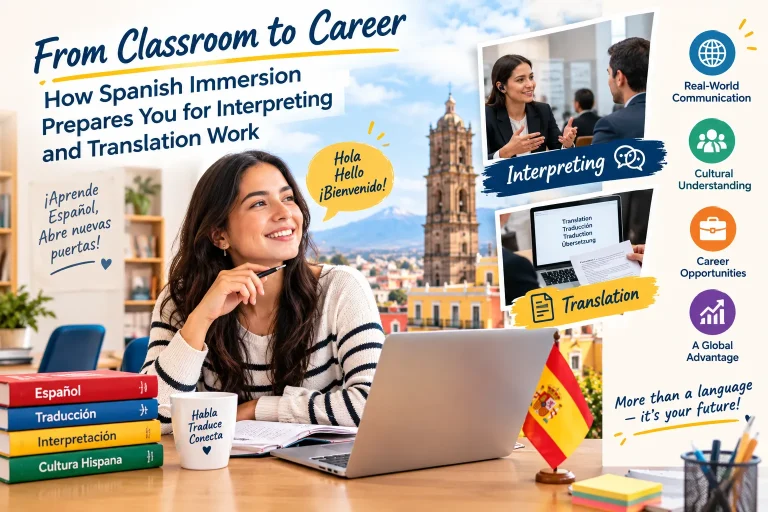
Learning Spanish can open doors to travel, friendships, education, and international opportunities. But for people who want to use Spanish professionally, simply knowing vocabulary and grammar is not enough. Careers in interpreting and translation require a deeper understanding of how the language works in real conversations, different cultures, professional settings, and everyday situations.
This is where Spanish immersion can make a meaningful difference.
When you study Spanish in an immersive environment, you are not only memorizing words for a test or completing exercises on a screen. You are continually listening, responding, asking questions, adapting your language, and learning how native speakers communicate. Over time, these experiences can help develop the practical language skills that interpreting and translating work demand.
For students considering a career where Spanish is part of their professional toolkit, an immersion program in Mexico can provide valuable preparation.
What Is the Difference Between Learning Spanish and Using Spanish Professionally?
A classroom can teach you the structure of Spanish. Professional communication requires you to use that structure quickly and appropriately.
Consider a simple conversation. A Spanish learner might understand the individual words someone says but struggle to understand the speaker’s intention, tone, regional expression, or speed. An interpreter, however, needs to understand the complete message and communicate it accurately to another person.
Translators face a similar challenge in written communication. Translating a document word for word can produce technically correct vocabulary but unnatural or misleading language. A professional translator needs to understand context, audience, terminology, cultural references, and the purpose of the original text.
This is why practical exposure matters.
Students who learn Spanish in Mexico have opportunities to encounter Spanish as it is naturally spoken around them. Conversations at school, interactions in the community, cultural activities, and everyday situations can all contribute to developing stronger listening and communication skills.
How Spanish Immersion Builds Real-World Communication Skills
One of the defining features of immersion is the amount of meaningful exposure students receive.
Instead of treating Spanish as something that exists only inside a textbook, immersion makes it part of the learner’s daily environment.
At a Spanish immersion school, students may need to:
- Ask and answer questions in Spanish.
- Explain an idea without immediately switching to English.
- Listen to different speakers and accents.
- Participate in group conversations.
- Read and discuss Spanish-language material.
- Write clearly for different purposes.
- Understand expressions that may not translate literally.
- Communicate even when they do not know every word.
These experiences develop an important professional skill: learning how to communicate meaning, not simply individual words.
For future interpreters, this ability is particularly important because spoken language often moves quickly. You may have only a few seconds to understand what someone means and communicate the message accurately.
Immersion gives learners repeated opportunities to practice that kind of mental flexibility.
Why Listening Skills Matter for Future Interpreters
Many Spanish learners concentrate heavily on speaking and grammar. Those skills are important, but interpreting begins with listening.
An interpreter needs to understand what is being said, how it is being said, and what the speaker actually means.
Real conversations can include:
- Different speaking speeds
- Informal expressions
- Regional vocabulary
- Cultural references
- Interruptions
- Changes in tone
- Incomplete sentences
- Idiomatic expressions
Listening to Spanish in authentic circumstances helps students become more comfortable with these variations.

For someone planning to study Spanish abroad, this constant exposure can be particularly valuable. Instead of hearing only carefully constructed textbook dialogues, learners encounter Spanish in a broader range of situations.
The goal is not simply to understand every word. It is to develop the ability to follow the meaning of a conversation even when the language is unfamiliar or unpredictable.
Cultural Understanding Is Just as Important as Language
Language and culture cannot be completely separated.
A phrase that sounds natural in one culture may sound strange or inappropriate when translated literally into another. A gesture, expression, joke, or social convention can also carry meaning that does not appear in a dictionary.
Professional interpreters and translators therefore need cultural awareness alongside language proficiency.
Studying Spanish in Mexico can provide learners with firsthand exposure to Mexican culture, communication styles, customs, and everyday expressions. This does not mean that Mexican Spanish represents every variety of Spanish. Rather, it gives students experience with a rich Spanish-speaking cultural environment.
That experience can help learners become more attentive to context—an essential habit for anyone working across languages and cultures.
Immersion Encourages You to Think in Spanish
One of the biggest transitions for advanced Spanish learners is moving away from translating everything mentally.
Beginners often follow this pattern:
English → Spanish → response
With continued practice, the process becomes more direct:
Idea → Spanish → response
This change can make communication faster and more natural.
For interpreters, developing this habit is especially useful. Interpreting often requires listening and producing language almost simultaneously. If every sentence has to pass through a slow internal translation process, maintaining a natural flow becomes difficult.
An intensive immersion program gives students frequent opportunities to think and respond in Spanish. Over time, this repeated practice can help reduce dependence on word-for-word translation.
How Immersion Helps With Professional Vocabulary
A future interpreter or translator may eventually specialize in areas such as:
- Healthcare
- Business
- Tourism
- Education
- Legal services
- International organizations
- Customer service
- Technology
- Government and public services
Each field has its own terminology and communications conventions.
An immersion program does not replace specialized interpreter or translator training. However, it can help establish the strong general Spanish foundation needed before developing professional terminology.
Students who already have confidence communicating in Spanish can spend more time learning the specialized vocabulary and professional standards of their chosen field instead of struggling with basic communication at the same time.
Why Studying Spanish in Mexico Can Be Different From Learning Online
Online Spanish classes can be useful for building vocabulary, practicing grammar, and maintaining language skills. However, immersion provides something that a screen cannot completely reproduce: continuous interaction with the language in a real environment.
When you study Spanish in Mexico, Spanish can become part of your daily routine.
You may hear Spanish before class, use it during lessons, encounter it during activities, and continue practicing outside the classroom. This creates more opportunities to connect language with current experiences.
For learners who want to move toward professional language use, that constant exposure can be particularly helpful.
The question is not necessarily whether online learning or immersion is universally better. They serve different purposes. Online learning can offer convenience and flexibility, while immersion provides intensive real-world practice.
For someone preparing for a career involving frequent Spanish communication, the latter experience can complement formal professional training.
What Should You Look for in a Spanish Immersion Program?
Not every immersion program follows the same approach. If your long-term goal involves interpreting or translation, look for a program that develops more than conversational Spanish.
Important features can include:
1. A Structured Curriculum
A strong program should provide progression rather than simply placing students in conversations without guidance.
SIPuebla, for example, offers eight levels of intensive immersion , with each level designed around three weeks of study. Students can attend one level or continue through multiple levels according to their goals.
2. Strong Speaking and Listening Practice
Interpreting is highly dependent on listening comprehension and verbal communication. Look for programs that give students regular opportunities to interact in Spanish rather than relying primarily on written exercises.

3. Reading and Writing Development
Translation is primarily concerned with written language, so reading and writing should not be overlooked.
A balanced program should help students understand Spanish structure while also giving them opportunities to communicate in writing.
4. Authentic Situations
Language becomes more useful when learners practice it in meaningful contexts.
SIPuebla’s communicative approach emphasizes using Spanish in authentic and diverse circumstances, combining formal language instruction with opportunities to use Spanish actively.
5. Cultural Exposure
A professional language worker needs more than grammatical accuracy. Understanding cultural context can influence how effectively a message is interpreted or translated.
Programs that combine language learning with cultural activities can help learners see how language functions beyond the classroom.
From Spanish Student to Language Professional
An immersion program should not be viewed as a direct substitute for professional interpreter or translator training.
Instead, think of it as part of the foundation.
A potential career pathway might look like this:
Spanish immersion → Advanced language proficiency → Specialized interpreter/translator training → Field-specific terminology → Professional experience
The immersion stage helps develop the language foundation. Later training can focus on interpreting techniques, translation methods, ethics, terminology management, specialization, and professional standards.
This distinction is important because being fluent in Spanish does not automatically make someone a professional interpreter or translator. Professional language work requires specialized skills and accuracy.
However, strong Spanish proficiency gives future professionals a much stronger foundation on which to build those skills.
Who Can Benefit From Spanish Immersion?
Spanish immersion can be useful for several types of learners, including:
Students: Those considering careers in international studies, languages, healthcare, education, tourism, or business can develop practical Spanish skills early.
Working professionals: Employees who regularly communicate with Spanish-speaking clients, colleagues, or communities can gain greater confidence in professional interactions.
Aspiring interpreters: People interested in interpreting can use immersion to strengthen listening, speaking, comprehension, and cultural awareness before pursuing specialized training.
Future translators: Learners interested in written translation can develop stronger reading, writing, vocabulary, and contextual understanding.
Career changes: Adults considering a new career can use intensive language study to build a foundation before moving into professional certification or specialized education.
Why Intensive Immersion Can Accelerate Your Progress
Consistency matters when learning a language.
Studying Spanish for an hour occasionally can certainly help, but intensive immersion creates a different rhythm. Students spend a concentrated period repeatedly engaging with the language.
SIPuebla’s program is built around intensive immersion and has been teaching Spanish in Mexico for more than 35 years. Its students have come from more than 72 countries, creating an international learning environment.
The program follows the Common European Framework of Reference for Languages (CEFR) and ACTFL guidelines, providing a structured framework for language development.
For learners who want to learn Spanish abroad in Mexico, this combination of structured instruction, communication practice, and cultural exposure can make the learning experience much more connected to real-world use.
The Classroom Is Only the Beginning
A career in interpreting or translation requires dedication well beyond learning Spanish grammar.
You need to understand people, recognize context, listen carefully, communicate clearly, and continually expand your vocabulary and cultural knowledge.
That is why an immersive Spanish experience can be so valuable.
When you learn Spanish in Mexico, you are not simply studying another subject. You are practicing how to use the language as part of everyday communication. Every conversation becomes an opportunity to listen more closely, choose better words, understand context, and become comfortable thinking in Spanish.
For someone interested in a future career involving languages, those habits can become an important part of the journey from classroom learning to professional communication.
If your goal is to build a strong Spanish foundation before pursuing interpreting or translation training, an intensive immersion experience can be a practical place to begin.
Final Thoughts
Interpreting and translation are careers built around much more than knowing two languages. They require precision, cultural understanding, strong listening skills, adaptability, and the ability to communicate meaning clearly.
Spanish immersion helps learners develop these underlying abilities through consistent, practical language use.
For anyone considering the best place to study Spanish in Mexico, the most important consideration is not simply where Spanish is taught. Look for an environment where you can actively use the language, receive structured instruction, practice communication, and experience Spanish in authentic cultural contexts.
That is the difference between simply studying Spanish and learning how to live and work with the language.
Frequently Asked Questions
1. Can Spanish immersion prepare me for a career in interpreting?
Yes. Immersion can help develop listening comprehension, speaking ability, vocabulary, cultural awareness, and the ability to communicate meaning in real-time situations. However, professional interpreting also requires specialized training and practice.
2. Is studying Spanish in Mexico useful for aspiring translators?
Yes. Spending time in a Spanish-speaking environment can strengthen reading, vocabulary, cultural understanding, and overall language proficiency. These skills can provide a useful foundation before pursuing specialized translation education.
3. Does Spanish immersion teach professional interpreting techniques?
Not necessarily. General Spanish immersion programs focus on language acquisition and communication. Professional interpreting requires additional training in areas such as interpreting methods, ethics, terminology, and specialized fields.
4. How does immersion help me think in Spanish?
Frequent communication reduces the need to mentally translate every sentence from your first language. Regularly listening and responding in Spanish encourages more direct connections between ideas and Spanish expressions.
5. Is Mexican Spanish useful for an interpreting or translation career?
Mexican Spanish is one important variety of Spanish and can provide valuable exposure to vocabulary, pronunciation, expressions, and cultural context used in Mexico. Professionals who work across Spanish-speaking communities should also become familiar with regional differences.
6. Should I choose an immersion program or online Spanish classes?
The right option depends on your learning goals, schedule, and preferred learning environment. Online classes offer flexibility, while immersion provides concentrated exposure and frequent real-world interaction. Learners pursuing professional Spanish may also combine both approaches.
7. How long should I study Spanish before pursuing interpreting or translation?
There is no single timeframe that applies to everyone. Your starting level, study intensity, target specialization, and professional requirements all matter. Building strong overall Spanish proficiency first can make later specialized training more productive.