Have you ever practiced a Spanish sentence several times, only to discover that it sounds completely different when a native speaker says it? You know the words, understand their meaning, and can even write them correctly. But when you speak, something feels slightly off.
Perhaps your pronunciation sounds too English, your sentences lack a natural rhythm, or you struggle to keep up when someone speaks quickly.
These are common challenges for Spanish learners, and improving them doesn’t necessarily require memorizing more vocabulary.
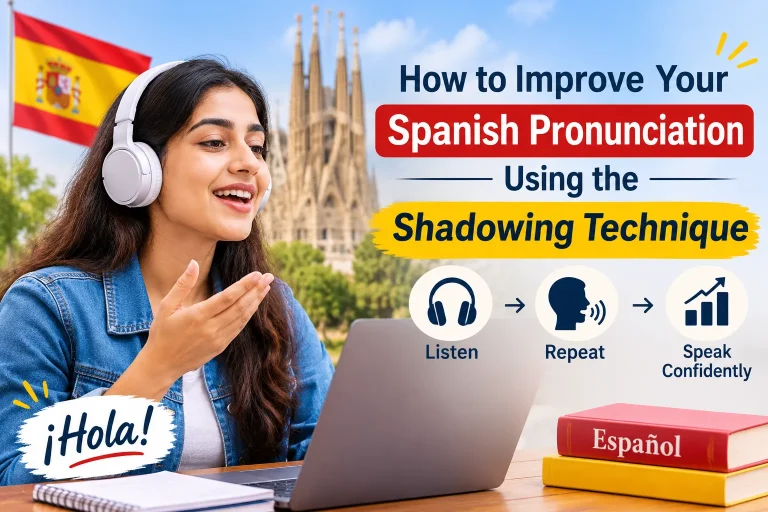
One useful method is called the shadowing technique. It involves listening to a native speaker and repeating their words almost immediately, imitating their pronunciation, rhythm, and intonation.
With consistent practice, shadowing can help you develop clearer Spanish pronunciation and become more comfortable with natural conversations.
What Is the Shadowing Technique in Spanish Learning?
The shadowing technique is a language-learning exercise in which you listen to spoken Spanish and repeat what you hear with a slight delay, following the speaker as closely as possible.
Instead of waiting until the entire sentence finishes, you begin repeating while the audio continues.
Think of how a shadow follows someone’s movements. Your voice follows the speaker’s words in much the same way.
For example, imagine hearing:
“Good morning, how are you?”
Rather than translating the sentence into English, you immediately repeat it while concentrating on how the speaker pronounces each word.
You pay attention to which syllables receive emphasis, how the speaker’s voice rises or falls, and how naturally the words flow together.
This exercise trains your ears and speaking habits simultaneously.
A 2025 systematic review of research on second-language pronunciation found encouraging evidence that shadowing can improve how understandable speech sounds, along with certain aspects of rhythm and fluency. However, improvement varies, and the evidence for correcting individual sounds remains less conclusive.
Why Does Shadowing Help Improve Spanish Pronunciation?
Learning Spanish pronunciation involves more than producing individual letters correctly.
You also need to understand how sounds work together during everyday speech.
Shadowing encourages you to notice several important features of spoken Spanish.
1. It Helps You Recognize Natural Spanish Rhythm
English and Spanish have different rhythm patterns.
English often reduces unstressed vowels, while Spanish generally maintains clearer vowel sounds across syllables.
When you shadow native speakers, you begin noticing these differences.
Instead of giving every word an unnatural pause, you practice delivering sentences more smoothly.
2. It Improves Your Awareness of Intonation
Intonation refers to how your voice rises and falls while speaking.
In Spanish, intonation helps communicate questions, emotions, and emphasis.
For instance:
- Are you coming tomorrow?
- “You’re coming tomorrow.”
Although the words are identical, their meaning and delivery differ.
Shadowing helps you recognize and reproduce these vocal patterns.
3. It Trains You to Respond More Naturally
Many learners mentally translate English sentences before speaking Spanish.
This can create long pauses and interrupt conversations.
By repeatedly listening and speaking almost simultaneously, you practice producing familiar Spanish expressions without analyzing every word.
Over time, commonly used phrases may become easier to recall during real conversations.
How to Practice Spanish Shadowing: Step-by-Step Guide
You don’t need expensive equipment or advanced language skills to begin shadowing.
A phone, headphones, and a short Spanish recording are enough.
The following process works particularly well for beginners and intermediate learners.
Step 1: Choose a Short Spanish Audio Recording
Begin with a recording lasting approximately 15–30 seconds.
Choose material that matches your current proficiency level.
Good options include:
- Beginner-friendly Spanish podcasts
- Short conversations between native speakers
- Spanish-language learning videos
- Audiobooks with simple dialogue
- Recorded lessons featuring Mexican Spanish
If you’re planning to learn Spanish in Mexico, recordings featuring Mexican speakers can help familiarize you with the pronunciation and expressions you’re likely to encounter.
Avoid starting with complicated interviews or fast-moving television conversations.
Your goal is to practice pronunciation, not struggle to understand every sentence.
Step 2: Listen Without Speaking
Play the recording once or twice.
Concentrate on the speaker’s pronunciation, pace, and intonation.
Notice where they pause and which words seem to connect.
For example:
“I would like to learn Spanish.”
Pay attention to the stressed syllables in gustaría , aprender , and español .
You don’t need to imitate anything yet.
Simply become familiar with the sound of the sentence.
Step 3: Repeat the Audio Slowly
Play the recording again and repeat individual phrases after hearing them.
This preparation is sometimes called listen-and-repeat practice.
Focus on producing the sounds clearly before trying simultaneous shadowing.
If necessary, slow the recording to around 75–85% of its original speed, provided the audio remains clear.
Don’t worry about speaking quickly.
Accuracy and comfort are more important during your first attempts.
Step 4: Begin Shadowing the Speaker
Now play the recording and begin speaking just behind the original voice.
Try to imitate:
- Pronunciation of individual sounds
- Stress on particular syllables
- Sentence rhythm
- Rising and falling intonation
- Natural pauses between phrases
You may struggle initially because you’re listening and speaking simultaneously.
That’s normal.
Start with following short phrases rather than attempting an entire paragraph.
As you improve, gradually return to the recording’s normal speed.
Step 5: Record Yourself and Compare
Recording your voice is one of the most useful additions to shadowing practice.
Speak along with the recording, then make a separate recording of yourself saying the same sentence.
Listen to both versions.
Ask yourself whether you’re stressing the correct syllables, pronouncing vowels clearly, and maintaining a similar rhythm.
You may discover that certain sounds consistently cause difficulties.
These observations help you identify what to practice next.
Spanish Pronunciation Challenges to Practice With Shadowing
Some Spanish sounds require particular attention, especially for native English speakers.
Here are three useful areas to focus on.
The Single R and Rolled RR
Spanish distinguishes between the single r sound and the stronger rolled rr sound in certain positions.
Consider:
- But
- Dog
These words have different meanings because their consonant sounds differ.
Listen carefully to native pronunciation and practice the tongue movement separately before using shadowing.
Clear Spanish Vowels
Spanish has five principal vowel sounds: a, e, i, o, and u.
Unlike English, Spanish vowels generally maintain consistent qualities.
Practice phrases such as:
“My friend lives in Mexico.”
Listen for the clear vowel sounds and avoid turning them into English-style diphthongs.
Word Stress
Incorrect stress can make otherwise familiar words difficult to understand.
For example:
- I speak
- He or she spoke
The change in stress also changes the meaning.
Shadowing can help you develop a better ear for these differences.
Common Mistakes to Avoid When Shadowing Spanish
Shadowing is simple, but certain habits can make it less productive.
Choosing Audio That’s Too Difficult
If you understand almost nothing in a recording, following the speaker becomes unnecessarily stressful.
Choose audio containing mostly familiar vocabulary and gradually increase the difficulty.
Focusing Only on Speaking Speed
Speaking quickly isn’t the same as speaking clearly.
Pay attention to pronunciation, stress, and rhythm before trying to match a fast speaker.
Ignoring the Meaning
Repeating unfamiliar words without understanding them can make the exercise mechanical.
Review the meaning of the recording before shadowing so you’re practicing meaningful communication.
Never Using Spanish in Real Conversations
Shadowing is excellent preparation, but it doesn’t replace spontaneous speaking.
You still need opportunities to ask questions, respond to unexpected comments, and communicate your own ideas.
Combining Shadowing With Spanish Immersion in Mexico
Shadowing can help you prepare for conversations, but language immersion gives you opportunities to apply what you’ve practiced.
When participating in Spanish immersion classes in Mexico, you encounter different speakers, accents, and everyday expressions.
You might practice pronunciation during morning lessons, then use those same expressions when ordering food, shopping, or speaking with local residents.
At the Spanish Institute of Puebla, language instruction emphasizes practical communication alongside listening, reading, and writing.
The Institute offers eight proficiency levels, with each standard level lasting three weeks. Its intensive courses include dedicated conversational practice, giving students opportunities to use Spanish actively.
Students from different backgrounds can also participate in cultural activities that introduce them to everyday life in Mexico.
For someone hoping to learn Spanish fast, combining focused pronunciation exercises with regular conversation can be a productive approach.
Whether you’re considering a short language course or a longer Spanish immersion program, real-world interaction helps turn practiced sentences into useful communication skills.
Final Thoughts
Improving your Spanish pronunciation doesn’t require sounding exactly like a native speaker. The real goal is to speak clearly, understand others, and feel comfortable participating in conversations.
The shadowing technique provides a practical way to work toward that goal.
Start with simple recordings, listen carefully, imitate what you hear, and pay attention to small improvements. As you become more confident, challenge yourself with longer conversations and natural speaking speeds.
Most importantly, use the Spanish you’re practicing.
If you’re ready to strengthen your pronunciation through classroom instruction and everyday communication, explore the Spanish immersion courses at the Spanish Institute of Puebla.
Learning Spanish becomes more meaningful when you have opportunities not only to study the language but also to speak it in real life.
Frequently Asked Questions About Spanish Shadowing
Can beginners use the shadowing technique to learn Spanish?
Yes. Beginners can start with short recordings containing familiar greetings and everyday expressions. Practicing one sentence at a time is often easier than shadowing long conversations.
How long does it take to improve Spanish pronunciation with shadowing?
Progress varies depending on your starting level, consistency, and the difficulty of the sounds you’re practicing. Regular practice over several weeks can help you notice changes, but there is no guaranteed timeline.
Should I use Mexican Spanish or Spain Spanish for shadowing?
Choose recordings that match the variety of Spanish you’re most interested in learning. If you’re planning to study Spanish abroad in Mexico, Mexican Spanish recordings are a practical starting point.
Is shadowing better than speaking with native Spanish speakers?
Both serve different purposes. Shadowing helps you practice listening, pronunciation, and rhythm, while real conversations develop your ability to respond spontaneously. Combining both approaches offers broader speaking practice.
Can shadowing help me understand fast Mexican Spanish?
Yes. Practicing with natural Mexican Spanish recordings can help you become more familiar with connected speech, common expressions, and speaking rhythms, although listening comprehension also requires vocabulary and contextual understanding.