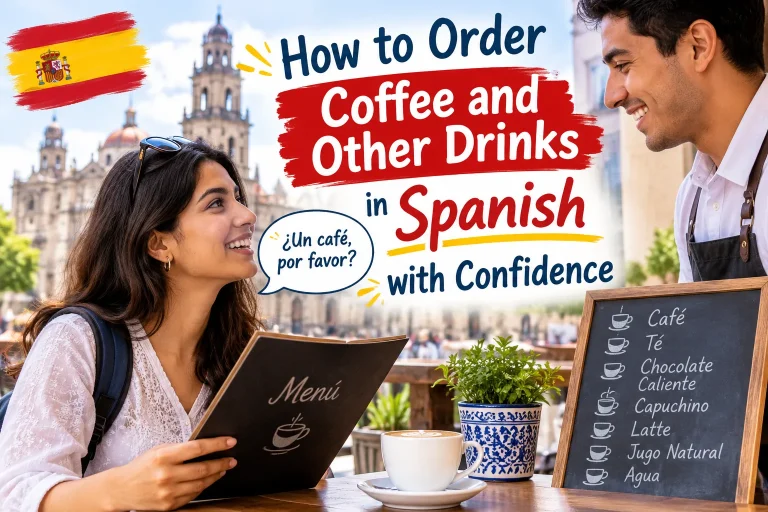
Imagine walking into a cozy café in Mexico. The smell of freshly brewed coffee fills the room, people are chatting around you, and the barista greets you with a friendly “¡Buenos días! ¿Qué le damos?”
You know you want a cappuccino, but suddenly, the Spanish words you practiced disappear from your mind. Should you say quiero, quisiera, or me gustaría? And what if the barista asks a question you don’t understand?
Ordering coffee in Spanish can feel intimidating when you’re still learning the language. Fortunately, you don’t need advanced vocabulary or perfect grammar to handle these everyday conversations.
With a few useful expressions and some practice, you can confidently order coffee, tea, juice, and other beverages while traveling or studying in Mexico.
Let’s explore what to say, how to respond, and how to make ordering drinks an enjoyable part of learning Spanish.
How Do You Order Coffee in Spanish?
The easiest way to order coffee in Spanish is to say “Un café, por favor,” which means “A coffee, please.”
However, if you want to sound a little more polite and conversational, you can use several other expressions.
- Quisiera un café con leche, por favor. — I would like a coffee with milk, please.
- ¿Me puede dar un capuchino? — Could you give me a cappuccino?
- Me gustaría un café americano. — I would like an Americano.
- Para mí, un café descafeinado. — A decaf coffee for me.
- ¿Me trae un café, por favor? — Could you bring me a coffee, please?
All these expressions are understandable and appropriate in everyday situations.
In Mexico, you’ll frequently hear “Me da…” or “¿Me puede dar…?” when people order food and drinks.
For example, “¿Me da un café con leche, por favor?” sounds natural and polite.
You don’t need to memorize every expression. Start with one or two that feel comfortable, then gradually expand your vocabulary.
Popular Types of Coffee You Can Order in Mexico
Before ordering, it’s helpful to recognize common coffee names. Many will look familiar because they’re similar to the English terms.
Café Americano
A café americano is espresso diluted with hot water. It’s a common choice if you prefer a larger, less concentrated black coffee.
You can order it by saying, “Un café americano, por favor.”
Café con Leche
A café con leche combines coffee with milk. The exact preparation varies between cafés, so you can ask how it’s served if you have a preference.
Try saying, “Quisiera un café con leche caliente,” meaning “I would like a coffee with hot milk.”
Capuchino
A capuchino is a cappuccino made with espresso, steamed milk, and milk foam.
You might say, “¿Me prepara un capuchino, por favor?” — Could you prepare a cappuccino for me, please?
Café de Olla
One traditional Mexican drink worth trying is café de olla.
This coffee is commonly prepared with cinnamon and piloncillo, an unrefined cane sugar. Some regional recipes include additional spices.
Its distinctive aroma and sweetness make it an interesting introduction to Mexican coffee traditions.
To try it, ask, “¿Tienen café de olla?” — Do you have café de olla?
If it’s available, you can respond, “Me da uno, por favor.”
How to Order Iced Coffee and Customize Your Drink
Sometimes, knowing the name of the drink isn’t enough. You may want less sugar, a different type of milk, or something cold.
Learning a few descriptive expressions makes ordering easier.
For iced coffee, say:
“Quisiera un café frío, por favor.” — I would like an iced coffee, please.
You can also ask for specific adjustments:
- Sin azúcar — Without sugar.
- Con poca azúcar — With a little sugar.
- Con leche de almendra — With almond milk.
- Con leche de avena — With oat milk.
- Sin leche — Without milk.
- Con hielo — With ice.
- Extra caliente — Extra hot.
- Descafeinado — Decaffeinated.
For example, “Quisiera un café frío con leche de avena y sin azúcar, por favor” communicates a complete order.
Not every café offers the same options, so you can politely ask “¿Tienen leche de avena?” before placing your order.
How to Order Tea, Juice, and Other Drinks in Spanish
Coffee isn’t your only option when visiting a café or restaurant in Mexico.
Knowing how to order other beverages is especially useful when traveling with friends or exploring local food traditions.
Ordering Tea
Tea is called té in Spanish.
You can say, “¿Me puede traer un té de manzanilla?” — Could you bring me chamomile tea?
Other familiar options include té verde (green tea) and té negro (black tea).
Ordering Fresh Juice
Fresh juice is called jugo in Mexico.
Some common varieties include:
- Jugo de naranja — Orange juice.
- Jugo de piña — Pineapple juice.
- Jugo de zanahoria — Carrot juice.
- Jugo de toronja — Grapefruit juice.
For example, “Quisiera un jugo de naranja natural, por favor” means “I would like a fresh orange juice, please.”
Ordering Water
Water is agua in Spanish.
If you prefer still water, ask for agua natural or agua sin gas.
For sparkling water, request agua mineral or agua con gas.
If you want a bottle, you can say, “Una botella de agua, por favor.”
Trying Traditional Mexican Drinks
Mexico also offers refreshing beverages called aguas frescas, commonly prepared with fruit, flowers, seeds, or grains.
Popular choices include agua de jamaica (hibiscus drink), agua de horchata (often rice-based with cinnamon), and agua de tamarindo (tamarind drink).
Ask “¿Qué aguas frescas tienen hoy?” to discover what’s available.
Understanding Common Questions from Café Staff
Ordering is only half the conversation. Understanding the response is equally important.
Mexican café staff may ask several questions while preparing your order.
“¿Para aquí o para llevar?” means “For here or to go?”
You can answer “Para aquí” if you’re staying or “Para llevar” if you want takeaway.
“¿De qué tamaño?” means “What size?”
You might respond with “Chico,” “Mediano,” or “Grande,” depending on the available sizes.
“¿Algo más?” means “Anything else?”
If you’ve finished ordering, simply say “No, gracias. Es todo.”
You may also hear “¿Cómo va a pagar?” meaning “How will you pay?”
Respond with “Con tarjeta” for a card payment or “En efectivo” for cash.
Understanding these short questions can make an entire interaction feel much easier.
A Realistic Spanish Conversation at a Café
Here’s an example of how a typical café conversation might unfold in Mexico.
Barista: ¡Buenos días! ¿Qué le damos?
Good morning! What can I get you?
Customer: Buenos días. Quisiera un capuchino mediano, por favor.
Good morning. I would like a medium cappuccino, please.
Barista: Claro. ¿Para aquí o para llevar?
Of course. For here or to go?
Customer: Para aquí, gracias.
For here, thank you.
Barista: ¿Con leche normal o de avena?
With regular milk or oat milk?
Customer: Con leche de avena, por favor.
With oat milk, please.
Barista: ¿Algo más?
Anything else?
Customer: No, gracias. ¿Cuánto es?
No, thank you. How much is it?
Barista: Son setenta pesos.
It’s seventy pesos.
Customer: Aquí tiene. Muchas gracias.
Here you go. Thank you very much.
Barista: ¡Con gusto!
My pleasure!
Notice how the conversation uses simple vocabulary. Even as a beginner, you can complete an entire order with a handful of familiar expressions.
What Should You Do If You Don’t Understand the Barista?
One of the biggest challenges when learning Spanish is understanding native speakers at their normal conversational speed.
If someone speaks too quickly, don’t panic or immediately switch to English.
Try these expressions instead.
“¿Puede repetirlo, por favor?” — Could you repeat that, please?
“¿Puede hablar más despacio?” — Could you speak more slowly?
“Perdón, no entendí.” — Sorry, I didn’t understand.
“¿Qué significa eso?” — What does that mean?
These phrases are valuable far beyond cafés. You’ll use them in shops, restaurants, transportation, and countless everyday conversations.
Remember, asking someone to repeat a question is a normal part of communicating in another language.
How Ordering Coffee Helps You Learn Spanish Faster
A short café conversation might seem insignificant, but it provides valuable language practice.
You listen to authentic pronunciation, select vocabulary, form sentences, and respond without knowing exactly what the other person will say.
These are the same skills needed for longer conversations.
When you learn Spanish in Mexico, simple activities such as ordering breakfast or buying a drink become opportunities to reinforce classroom lessons.
This is one reason Spanish immersion classes in Mexico appeal to learners who want more opportunities to practice outside formal instruction.
Instead of only memorizing phrases, you’re using them for a genuine purpose.
At the Spanish Institute of Puebla, students participate in an intensive Spanish language program that combines structured instruction with conversation practice and cultural experiences.
The Institute offers eight proficiency levels, each lasting three weeks, and emphasizes communication through authentic situations.
For students who want to study Spanish abroad, this approach creates opportunities to connect language lessons with experiences throughout daily life.
Final Thoughts: Your Next Coffee Could Be Your Next Spanish Lesson
Learning how to order coffee and other drinks in Spanish is about more than memorizing vocabulary. It’s an opportunity to participate in everyday life, understand Mexican culture, and become more comfortable communicating with native speakers.
Start with a simple phrase, listen carefully to the response, and allow yourself to make mistakes.
The next time you enter a café in Mexico, try ordering entirely in Spanish. You might be surprised by how much you already know.
If you’d like to take your learning further, explore the Spanish immersion programs at the Spanish Institute of Puebla. With structured lessons and practical conversation opportunities, you can continue developing the skills needed to communicate confidently in Spanish.
Frequently Asked Questions
What is the most polite way to order coffee in Spanish?
You can say “Quisiera un café, por favor” or “¿Me puede dar un café, por favor?” Both expressions are polite, natural, and widely understood.
How do you ask for coffee to go in Mexico?
Say “Un café para llevar, por favor.” The phrase para llevar means “to go” or “takeaway.”
How do you ask for the bill in Spanish?
Say “La cuenta, por favor” when you’re ready to pay at a table. At a counter, “¿Cuánto es?” is a natural way to ask the total.
What if I don’t know much Spanish?
Start with basic phrases, speak clearly, and don’t worry about making small mistakes. A few useful expressions are often enough to order successfully.
Can practicing everyday conversations improve Spanish fluency?
Yes. Regular conversations help develop listening comprehension, vocabulary recall, pronunciation, and speaking confidence. Even short interactions can reinforce what you’ve learned in class.