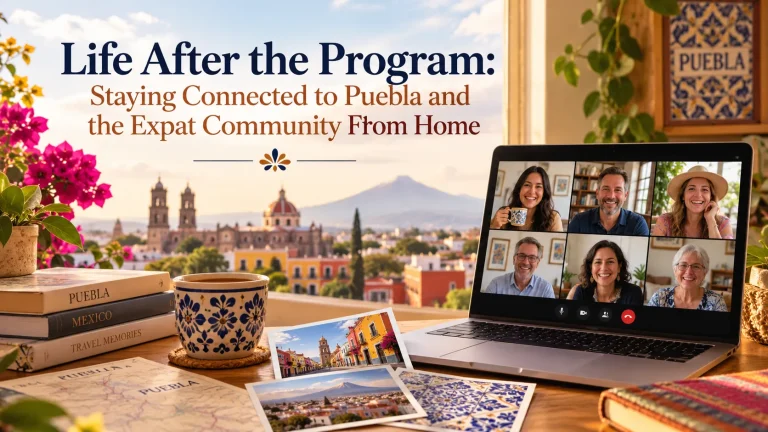
Leaving Puebla after an intensive Spanish program can feel surprisingly emotional. During your time in Mexico, Spanish becomes part of your everyday routine. You hear it at cafés, use it while shopping, practice it with classmates, and discover that conversations become easier with each passing week. Then, suddenly, you are back home—and Spanish is no longer all around you.
That transition does not have to mean the end of your progress.
In fact, returning home can become the beginning of a new stage in your Spanish journey. With a few intentional habits, you can continue practicing what you learned, stay connected with friends in Puebla, and remain part of the international and expat community you discovered during your time in Mexico.
Whether you completed one level or several levels of an immersive Spanish course, staying connected can help turn your experience in Puebla into a lasting part of your life.
What Happens to Your Spanish After You Leave Mexico?
One of the biggest challenges after completing Spanish immersion programs is maintaining regular exposure to the language.
When you were in Puebla, Spanish was naturally present throughout the day. You may have spoken with teachers in class, ordered food in Spanish, participated in cultural activities, or chatted with local people. At home, those opportunities may become less frequent.
This is normal.
Language development is not simply about memorizing vocabulary. It also depends on regular exposure, listening, speaking, reading, and using the language in meaningful situations. The goal after returning home is therefore not to recreate your entire Mexican experience. Instead, create smaller opportunities that keep Spanish active in your daily life.
Even 15–30 minutes of Spanish each day can become a useful long-term habit.

Stay Connected With Friends You Met in Puebla
Your classmates can become one of your most valuable connections after completing a Spanish immersion class.
People who study Spanish together often share a unique experience. You have struggled through difficult grammar, laughed over mistakes, explored Puebla, and practiced conversations together. Those shared experiences make it easier to stay in touch.
Create a group chat before everyone leaves Puebla. WhatsApp, email, or another messaging platform can make it simple to continue communicating.
You could:
- Send each other short messages in Spanish.
- Share photos and memories from Puebla.
- Schedule occasional video calls.
- Recommend Spanish-language books, podcasts, or films.
- Practice speaking together once a week.
- Celebrate milestones such as completing another Spanish level.
You do not need every conversation to be a formal language lesson. Sometimes, simply talking naturally about your week is excellent practice.
Continue Practicing With Your Spanish-Speaking Community
Returning home does not mean your Spanish-speaking community has to disappear.
Look for Spanish conversation groups, cultural organizations, international meetups, community events, or language exchanges in your area. Many cities have communities of Spanish speakers and people interested in learning Spanish.
Online communities can also help.
Virtual conversation groups allow you to speak with people from different countries without leaving home. Some communities organize regular video conversations, while others use messaging platforms to encourage daily practice.
The important thing is to find activities that you genuinely enjoy. If practicing Spanish feels like another obligation, it can be difficult to maintain. If it becomes part of your social life, it is much easier to continue.
Keep Puebla Part of Your Everyday Life
One of the simplest ways to maintain your connection with Mexico is to continue engaging with Puebla from home.
Follow local news, cultural organizations, restaurants, museums, universities, and community pages. Look for events happening in Puebla and learn about celebrations, traditions, food, and local culture.
You can also create a personal “Puebla routine.”
For example, once a week, choose something connected to the city:
- Read a Spanish-language article about Puebla.
- Watch a video about Mexican culture.
- Cook a traditional Mexican dish.
- Listen to Mexican music.
- Review photographs from your time in Puebla.
- Talk with a former classmate.
- Learn a few expressions commonly used in Mexico.
These small habits can keep your memories connected to active language learning rather than allowing your experience to become something that simply happened in the past.
Use Spanish in Your Professional and Personal Life
After completing Spanish immersion courses, look for practical ways to use Spanish outside traditional study.
If your job involves international clients or Spanish-speaking colleagues, try incorporating Spanish into appropriate conversations. If you work in healthcare, education, tourism, hospitality, business, or customer service, Spanish can become particularly useful in professional situations.
You can also use Spanish in everyday activities.
Change the language settings on an app you frequently use. Write your shopping list in Spanish. Keep a journal. Write social media posts in Spanish. Send voice messages to friends instead of always typing.
The more naturally Spanish becomes part of your routine, the less likely you are to lose confidence.
Join the Expat and International Community From Home
Your time in Puebla may have introduced you to more than the Spanish language. You may have met students, travelers, teachers, professionals, retirees, and expats from different parts of the world.
That international network can continue long after your program ends.
Many former students stay connected through social media groups and online communities. These spaces can be useful for sharing travel experiences, discussing Mexican culture, planning future visits, or simply keeping in touch.
You may also discover that people from your Puebla community eventually move to other countries. Maintaining those relationships gives you an international network that extends beyond Mexico.
For many students, this becomes one of the most unexpected benefits of studying abroad: the friendships continue even after the program finishes.
Plan Your Next Visit to Puebla
Having a future connection to Puebla can provide extra motivation to maintain your Spanish.
You do not necessarily need to plan another long-term stay. Even a shorter visit can give you something to look forward to.
When you return, you may notice something interesting: places that once felt unfamiliar can begin to feel recognizable. Conversations that previously required concentration may become more comfortable. You may also discover that your relationship with the city has changed because you now understand more of its language and culture.
For students who enjoyed their first experience, returning to Puebla can become part of a longer language-learning journey.
And if you are considering another Spanish immersion program for adults, a future visit can provide an opportunity to continue from the level where you previously stopped rather than starting over.
Keep Learning Without Making It Feel Like School
After an intensive program, it is understandable if you want a break from textbooks and structured lessons.
You can maintain your Spanish without turning every day into a classroom.
Try learning through activities that match your interests.
If you like cooking, follow Mexican recipes in Spanish. If you enjoy sports, watch Spanish-language coverage. If you love movies, choose Mexican films. If music is your interest, explore Spanish-language artists and read the lyrics while listening.
For travelers, researching your next Mexican destination in Spanish can combine language practice with trip planning.
This approach helps you encounter Spanish in meaningful contexts—the same kind of practical exposure that makes immersion Spanish so valuable.
Why Staying Connected Matters
Language learning is rarely a straight line.
There may be periods when your Spanish improves quickly and other periods when progress feels slower. After returning home, you might even feel that you are forgetting words you used easily in Puebla.
That doesn’t mean your learning experience was wasted.
Language knowledge can become easier to access again when you return to regular exposure. The key is to keep Spanish present in your life.
Your experience at a Spanish language school is not limited to the weeks you spend in the classroom. The habits, relationships, cultural understanding, and confidence you develop can continue influencing how you use Spanish for years.
The objective is not to remain permanently in “student mode.” It is to make Spanish part of who you are and how you connect with other people.
Turn Your Puebla Experience Into a Long-Term Spanish Journey
Completing an immersive Spanish course in Puebla can mark an important milestone, but it does not have to be the final chapter.
Stay in touch with classmates. Continue conversations with Spanish speakers. Follow Mexican culture from home. Join international communities. Read, listen, write, and speak regularly. And whenever possible, return to Puebla and experience the language in its natural environment again.
An immersion experience can give you much more than classroom knowledge. It can introduce you to a city, a culture, friendships, and a community that remain meaningful long after you return home.
For students looking for an authentic way to learn Spanish in Mexico , the Spanish Institute of Puebla offers an intensive immersion approach across eight levels, with each level designed around three weeks of study. Students can choose to complete one level or continue through multiple levels while combining classroom learning with cultural and extracurricular experiences.
Your flight home may mark the end of your program—but it does not have to mark the end of your connection to Puebla.
Frequently Asked Questions
1. How can I maintain my Spanish after completing a Spanish immersion program?
Continue using Spanish regularly through conversation, reading, listening, writing, podcasts, films, language exchanges, and communication with friends you meet during your program.
2. Can I stay connected with my classmates after leaving Puebla?
Yes. Creating a group chat or scheduling regular video calls can help former classmates continue practicing Spanish and maintain friendships after returning home.
3. How can I stay connected to Puebla from another country?
You can follow Puebla-based cultural organizations and local communities, read Mexican news in Spanish, participate in online groups, cook Mexican food, and keep in contact with people you meet during your stay.
4. Is a language exchange useful after completing Spanish immersion courses?
A language exchange can provide regular speaking practice and help you maintain conversational confidence. It can be especially useful when combined with independent reading and listening.
5. Should I return to Mexico after completing my Spanish program?
Returning to Mexico is not required to maintain your Spanish, but another visit can provide valuable opportunities for real-world communication and cultural immersion. Some students choose to continue their studies during a future visit.
6. Can adults continue learning Spanish after completing an immersion program?
Absolutely. A Spanish immersion program for adults can be one stage of a longer learning journey. Adults can continue through conversation practice, advanced classes, cultural activities, and regular use of Spanish in daily life.
7. Why is Puebla a useful place for continuing Spanish and cultural connections?
Puebla offers opportunities to experience Mexican culture and Spanish in everyday settings. For students who have already studied there, maintaining relationships and returning to familiar surroundings can make continued language practice feel more personal and meaningful.