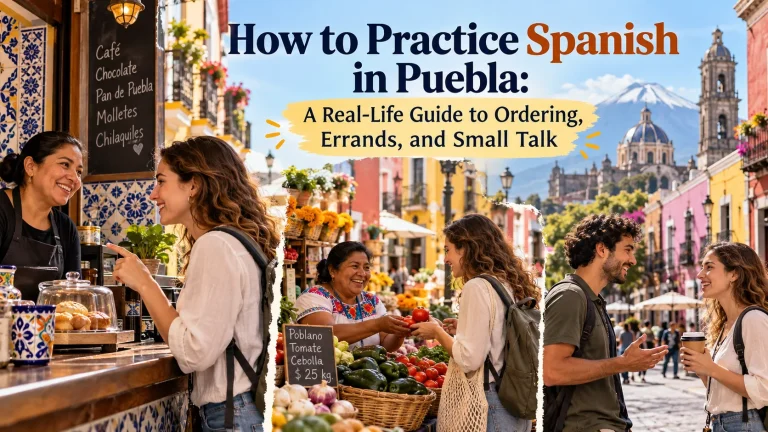
Learning Spanish in a classroom gives you an important foundation, but using Spanish in everyday life is where the language starts to feel natural. In Puebla, everyday situations—from ordering breakfast to asking for directions or chatting with a shopkeeper—can become valuable opportunities to practice.
For Spanish learners, these simple interactions are more than daily tasks. They help you build confidence, improve listening skills, learn natural expressions, and understand how Spanish is actually spoken in Mexico.
That is one of the biggest advantages of joining Spanish immersion programs in Mexico. Instead of limiting your practice to textbooks and exercises, an immersive environment encourages you to use Spanish throughout the day.
Whether you are a beginner, returning to Spanish after many years, or looking for a Spanish immersion program for adults, Puebla offers plenty of realistic situations where you can put your skills to work.
Why Real-Life Spanish Practice Matters
It is possible to understand Spanish grammar and still feel nervous when someone speaks to you at normal speed.
Real-life practice helps close that gap.
When you order food, buy something at a local shop, take transportation, or make small talk, you have to listen, understand the context, and respond. You may not use a perfectly constructed sentence every time—and that is okay.
The goal is communication.
Over time, repeated everyday interactions can help you:
- Respond more naturally instead of translating every word.
- Become familiar with Mexican Spanish expressions.
- Improve your listening comprehension.
- Develop confidence speaking with people outside the classroom.
- Learn vocabulary that is immediately useful.
- Become more comfortable making mistakes and correcting yourself.
This combination of structured instruction and everyday practice is an important part of an immersive Spanish course.
1. Ordering Food and Drinks in Puebla
Food is one of the easiest ways to start practicing Spanish because you will probably need to use it every day.
At a café, restaurant, bakery, or local food stand, begin with simple phrases.
Useful expressions include:
- “Buenos días. ¿Me puede dar un café, por favor?”
- “Quisiera una botella de agua.”
- “¿Qué me recomienda?”
- “¿Cuánto cuesta?”
- “¿Me puede traer la cuenta, por favor?”
- “Para llevar, por favor.”
- “¿Tiene opciones vegetarianas?”
You may also hear questions such as “¿Algo más?”, meaning “Anything else?” A simple “No, gracias” or “Sí, también quisiera…” is enough to keep the conversation going.
Do not worry if the person serving you speaks quickly. Ask them to repeat themselves:
“¿Me puede repetir, por favor?”
This is a useful phrase to learn early because it allows you to stay in the conversation instead of switching immediately to English.
A small challenge
Next time you eat out, try ordering completely in Spanish. Even if your order is simple, resist the temptation to switch languages immediately.
The interaction may only last a few minutes, but that repeated practice adds up.
2. Practicing Spanish While Running Errands
Errands are another excellent way to turn ordinary activities into language practice.
Imagine you need to buy toiletries, groceries, stationery, or something for your accommodation. Instead of simply finding the item yourself, use the opportunity to speak.
For example:
“Disculpe, ¿dónde puedo encontrar el jabón?”
Or:
“¿Tiene este producto en otro tamaño?”
You can also ask:
- “¿Cuánto cuesta?”
- “¿Tiene otro color?”
- “¿Aceptan tarjeta?”
- “¿Me puede ayudar?”
- “¿Dónde está la caja?”
- “¿Me da una bolsa, por favor?”
These questions may seem basic, but they introduce you to vocabulary and expressions you are likely to use repeatedly.
If you make a mistake, do not stop. Communication does not require perfect Spanish.
In fact, correcting yourself can be a valuable part of learning.
3. Making Small Talk With Local People
Small talk can feel more difficult than ordering food because there is no predictable script.
However, casual conversations are extremely useful for developing conversational Spanish.
You might begin with:
“¿Cómo está?”
“¿Qué tal su día?”
“¿Hace mucho calor hoy, verdad?”
Depending on the situation, you might talk about food, weather, places to visit, work, studies, or daily activities.
You do not need to have a long conversation. Even two or three exchanges are useful.
For example:
“¿Es de Puebla?”
“Sí, soy de aquí.”
“Qué interesante. ¿Qué lugar me recomienda visitar?”
A simple question can lead to a much longer conversation.
The important skill is learning how to listen and respond rather than preparing every sentence in advance.
4. Asking for Directions
Getting around Puebla can also become a practical Spanish lesson.
Instead of relying entirely on your phone, try asking someone for directions occasionally.
Useful phrases include:
- “Disculpe, ¿cómo llego al centro?”
- “¿Está lejos de aquí?”
- “¿Puedo caminar hasta allí?”
- “¿Dónde está la parada de autobús?”
- “¿Tengo que tomar un taxi?”
- “¿Me puede indicar en el mapa?”
You will also hear directional words such as derecha (right), izquierda (left), cerca (near), lejos (far), aquí (here), and allí (there).
Listening to these words in a real situation helps make them easier to remember than simply memorizing them from a vocabulary list.
5. Using Spanish at Markets and Local Shops
Markets are particularly useful for learners because they combine practical vocabulary with spontaneous conversation.
You might ask about prices, quantities, ingredients, or recommendations.
Try phrases such as:
“¿Cuánto cuesta el kilo?”
“¿Tiene algo más pequeño?”
“¿Cuál me recomienda?”
“¿Me da medio kilo, por favor?”
You may also hear informal expressions that are not always introduced in beginner textbooks. Listening carefully can help you become familiar with the rhythm and vocabulary of everyday Mexican Spanish.
You do not need to understand every word. Focus first on understanding the overall meaning.
6. Turn Everyday Activities Into a Spanish Immersion Class
One of the most effective ways to learn is to connect classroom learning with real situations.
Suppose your Spanish immersion class covers ordering food. After class, use those expressions at a café.
If you learn vocabulary about shopping, practice it at a local store.
If you study directions, ask someone how to reach a nearby place.
This creates a useful learning cycle:
Learn → Practice → Make mistakes → Get feedback → Try again.
That is the advantage of immersion Spanish. The language is not something you only study for a test. It becomes part of your daily routine.
At the Spanish Institute of Puebla, students can build their skills through an intensive immersion approach while also experiencing Mexican culture and everyday life. The program is structured across eight levels, with three weeks dedicated to each level, allowing students to study from one level through all eight depending on their goals.
7. Don’t Be Afraid of Mistakes
One of the biggest obstacles for adult Spanish learners is the fear of saying something incorrectly.
But mistakes are unavoidable—and useful.
If you say something incorrectly and someone helps you understand the correct expression, you are more likely to remember it because you experienced it in context.
Instead of thinking, “My Spanish isn’t good enough to speak,” try thinking, “I am here to practice.”
That small change in mindset can make everyday interactions much less intimidating.
You can also keep a small notebook or phone note with phrases you hear during the day. Write down expressions that seem useful and ask about them during your next class.
8. Create Your Own Puebla Spanish Practice Routine
You do not need to spend hours studying every evening to benefit from immersion.
Try creating small daily challenges:
Monday: Order breakfast entirely in Spanish.
Tuesday: Ask a shopkeeper for help finding something.
Wednesday: Ask someone for directions.
Thursday: Have a two-minute conversation.
Friday: Visit a market and practice asking about prices.
Weekend: Use Spanish while exploring Puebla.
These small goals make speaking practice manageable.
The more frequently you use Spanish in real situations, the less unusual speaking it will feel.
Why Puebla Is a Practical Place to Learn Spanish
Studying Spanish in Mexico gives learners the opportunity to combine formal lessons with real-world exposure to the language and culture.
Puebla adds another dimension because students can practice Spanish while participating in everyday activities, exploring the city, interacting with local people, and experiencing Mexican culture.
For learners who want more than traditional classroom study, Spanish immersion courses can provide a structured environment where classroom instruction and everyday communication complement each other.
Rather than asking, “When will I be fluent enough to speak?” try asking, “Where can I use Spanish today?”
That question turns ordinary experiences into learning opportunities.
Conclusion
Practicing Spanish in Puebla does not require complicated conversations. Ordering a coffee, asking for a price, finding your way around town, or exchanging a few words with a local person can all become meaningful language practice.
The key is consistency.
A structured Spanish immersion program for adults can give you the grammar, vocabulary, and communication skills you need. Everyday life then gives you the opportunity to use those skills naturally.
When you combine classroom learning with real-world experiences, Spanish becomes more than a subject you study. It becomes a language you actually use.
Frequently Asked Questions
1. Why is real-life practice important when learning Spanish?
Real-life practice helps learners apply grammar and vocabulary in spontaneous situations. It can improve listening, pronunciation, confidence, and the ability to respond naturally.
2. What Spanish should I learn before visiting Puebla?
Start with practical phrases for greetings, ordering food, shopping, asking directions, transportation, and requesting clarification. Basic conversational Spanish can take you a long way.
3. Is Puebla suitable for Spanish immersion?
Puebla provides many opportunities to use Spanish in everyday situations, including restaurants, markets, shops, transportation, cultural activities, and conversations with local people.
4. Are Spanish immersion programs suitable for adults?
Yes. Spanish immersion programs can be adapted to learners at different levels and are particularly useful for adults who want structured instruction combined with practical speaking opportunities.
5. How can I practice Spanish if I am still a beginner?
Start with short, predictable interactions. Order food, ask simple questions, practice greetings, and request directions in Spanish. You do not need advanced vocabulary to begin speaking.
6. What is the difference between an immersive Spanish course and a regular Spanish class?
A regular class primarily focuses on structured instruction, while an immersive Spanish course combines language learning with frequent opportunities to use Spanish in real-life contexts.
7. How can I get more speaking practice while studying Spanish in Mexico?
Look for opportunities to use Spanish outside class every day. Order meals, shop locally, ask questions, participate in cultural activities, and have short conversations with people you meet. Consistent practice is more important than having long conversations occasionally.