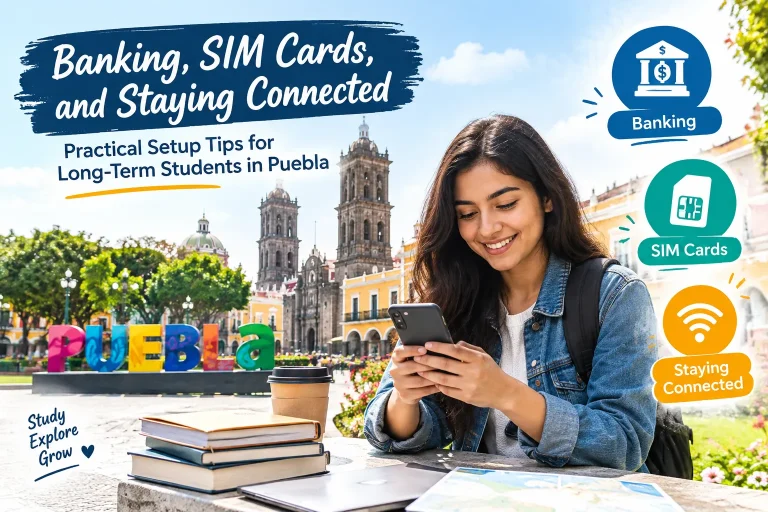
Moving to Puebla for an extended period to study Spanish is exciting. You get the opportunity to practice Spanish every day, explore Mexican culture, meet people from different countries, and turn classroom learning into real-life communication.
But before you can fully enjoy your experience, there are a few practical things to organize.
How will you access your money? Should you open a Mexican bank account? What documents might you need? Should you keep using your home-country phone plan or get a Mexican SIM card? And how can you stay connected while using Spanish in everyday situations?
These questions may seem small, but handling them successfully can make your first few weeks in Mexico much easier.
For students joining a Spanish immersion program in Mexico, these everyday tasks are also part of the learning experience. Ordering a SIM card, asking about an ATM fee, speaking with a bank representative, or explaining your address can become valuable opportunities to use Spanish outside the classroom.
This guide explains what long-term students should know about banking, mobile service, internet access, and staying connected while studying Spanish in Puebla.
Why Practical Setup Matters When You Study Spanish in Mexico
When you first arrive in Mexico, it is natural to focus on your Spanish classes, accommodation, sightseeing, and meeting other students. However, practical matters such as money and communication quickly become part of your daily routine.
For example, you may need to:
- Pay rent or accommodation expenses
- Withdraw Mexican pesos
- Receive money from home
- Purchase a local SIM card
- Contact your school or host family
- Use transportation apps
- Order food or groceries online
- Access online banking
- Communicate with new Mexican friends
These situations provide something that online Spanish classes cannot completely reproduce: spontaneous communication in real circumstances.
A structured Spanish language program in Mexico can help you prepare for these situations while giving you opportunities to use Spanish naturally.
Banking in Puebla: What Long-Term Students Should Know
You do not necessarily need a Mexican bank account immediately after arriving in Puebla. Many students initially use an international debit or credit card to make purchases and withdraw pesos.
However, if you are staying for several months, having a local banking solution may become convenient depending on your accommodation, payment arrangements, and financial needs.
-
Keep your home bank account active
Before leaving your home country, make sure your primary bank account will work internationally.
Check:
- International ATM access
- Foreign transaction fees
- Daily withdrawal limits
- Card expiration date
- Mobile banking access
- International transaction alerts
- Procedures for reporting a lost card
It is also wise to carry a second payment method. Having two cards from different accounts can be useful if one card is blocked, lost, or temporarily unavailable.
-
Carry some Mexican pesos
Cards are widely useful, but cash remains practical for many everyday situations.
Keep a reasonable amount of Mexican pesos available for transportation, smaller businesses, markets, tips, and unexpected expenses.
When using an ATM, check the fee and exchange-rate information before confirming the withdrawal. Mexico’s consumer financial authority, CONDUSEF, notes that ATM commissions can vary depending on the location and type of ATM; machines outside traditional bank branches can sometimes charge higher fees.
-
Consider whether you actually need a Mexican bank account
A local account may be useful for students who are staying for a longer period, regularly receiving money in Mexico, or needing Mexican banking services.
However, requirements differ between financial institutions and account types. Banks may ask for identification, proof of address, immigration documentation, and other information.
Mexico’s current financial regulations also distinguish between different account levels and identification requirements, so students should check the specific requirements of the bank and account they want rather than assuming that every foreign student can open the same type of account.
Practical tip: Do not open a local account simply because you are studying abroad. First consider how long you will stay, how you will receive money, and what payment methods you already have.
What Documents Should You Keep With You?
Long-term students should create a secure digital and physical record of important documents.
Consider keeping copies of:
- Passport
- Immigration documents
- Student or school documentation
- Accommodation information
- Emergency contacts
- Insurance information
- Bank contact details
- Important account information
If your studies require a temporary resident student visa, the Mexican government states that foreign nationals planning to remain in Mexico for more than 180 days for qualifying studies require the relevant student-resident visa process. Once in Mexico, the residence card process must be completed within the applicable period.
Your exact immigration requirements depend on your circumstances, so always verify them with the appropriate Mexican authority or consulate before traveling.
Getting a SIM Card in Mexico
For a long-term student, reliable mobile service is more than a convenience.
Your phone can help you:
- Contact your school
- Communicate with classmates
- Call your accommodation or host family
- Use maps
- Order transportation
- Translate unfamiliar words
- Access banking apps
- Receive verification codes
- Stay in contact with family at home
You can usually choose between keeping your home-country service, using roaming, getting a Mexican physical SIM, or using an eSIM if your phone supports it.
Should You Get a Mexican SIM?
For a longer stay, a local Mexican number can be convenient, particularly if you expect to make local calls or use Mexican services regularly.
Before purchasing one, check whether your phone is unlocked and compatible with the network.
If your phone supports eSIM, you may also have the option of keeping your original SIM active while using a Mexican eSIM for local service.
An important 2026 update for students
Mexico’s mobile-line registration requirements changed in 2026. Telcel currently states that, as of January 9, 2026, mobile users are required to register their lines using an official photo ID and CURP; for foreign users, Telcel says registration can be completed using a valid passport or, where applicable, a temporary CURP for foreigners.
Telcel also states that its tourist eSIM service requires registration and passport-based identity verification.
Because telecommunications rules and provider procedures can change, check the current requirements directly with your chosen provider before purchasing or activating a line.
How to Make Your First SIM Purchase a Spanish-Learning Opportunity?
This is where studying Spanish in Mexico becomes different from simply studying through an online platform.
Imagine walking into a mobile store and needing to explain:
“I need a SIM card for my phone.”
You may then hear questions about your phone, identification, data usage, or preferred plan.
Instead of immediately switching to English or relying entirely on a translation app, you can use the situation as a practical Spanish lesson.
Staying Connected to the Internet
Reliable internet will probably be essential for long-term students.
You may use it for:
- Online banking
- School communication
- Homework and research
- Video calls with family
- Maps and transportation
- Streaming
- Online payments
- Emergency communication
Before arriving, ask your accommodation about its Wi-Fi. If you are staying with a host family, student residence, or apartment, find out whether internet is included and whether there are any usage limitations.
It is also smart to keep mobile data available as a backup.
If your home Wi-Fi stops working before an online class or important video call, mobile data can prevent a small technical problem from becoming a major inconvenience.
Use Technology Without Letting It Replace Communication
Translation apps, maps, banking applications, and messaging platforms can make life in Puebla easier. Use them.
But don’t let them become a substitute for communicating with people.
One of the biggest advantages of language immersion in Mexico is that you encounter Spanish when you are not expecting it.
A bank employee might speak quickly during a conversation. At a store, you may hear an unfamiliar expression. When contacting a phone representative, you could face a question you never practiced in class. Even a neighbor might use local vocabulary that you find difficult to understand.
These moments may initially feel uncomfortable, but they can also accelerate your ability to understand and respond in Spanish.
This is one reason intensive Spanish immersion programs can be particularly valuable for students who want to move beyond textbook Spanish and develop practical communication skills.
Why Long-Term Students May Prefer Spanish Immersion Over Online Classes
Online Spanish classes can be useful for building grammar knowledge, vocabulary, and basic communication skills. They can also be convenient for students with busy schedules.
However, students planning to spend an extended period in Mexico may want an environment where Spanish becomes part of their everyday life.
A Spanish immersion program provides opportunities to use the language through structured classes as well as authentic interactions.
At the Spanish Institute of Puebla, the learning approach focuses on communication and using Spanish in diverse, authentic circumstances. The program is organized across 8 levels, with 3 weeks per level, allowing students to attend one level or continue through multiple levels according to their goals.
For a student staying in Puebla for several weeks or months, this creates an important connection between classroom learning and daily life.
You are not only learning about Spanish. You are using Spanish to solve ordinary problems.
That might mean asking a question at a bank, purchasing a SIM card, ordering lunch, talking with a neighbor, discussing plans with classmates, or explaining something to a service provider.
Those experiences can make vocabulary more memorable because the words are connected to something you actually needed to accomplish.
A Simple Setup Checklist for Long-Term Students in Puebla
Before or shortly after arriving, consider completing this checklist:
Before departure
- Notify your bank about international travel if required.
- Check international ATM and card fees.
- Bring a backup payment method.
- Confirm that your phone is unlocked.
- Check whether your phone supports eSIM.
- Save digital copies of important documents.
- Confirm your accommodation’s Wi-Fi arrangements.
- Save important emergency contacts.
During your first few days
- Obtain Mexican pesos.
- Test your debit and credit cards.
- Set up your Mexican SIM or eSIM if needed.
- Complete any required mobile-line registration.
- Save your Mexican phone number.
- Test mobile data and Wi-Fi.
- Learn basic Spanish banking and telecommunications vocabulary.
During your stay
- Monitor your bank transactions.
- Keep your phone and banking apps updated.
- Keep your important documents secure.
- Maintain a backup payment option.
- Use everyday situations to practice Spanish.
- Ask questions in Spanish whenever practical.
Turn Everyday Tasks Into Spanish Practice
One of the best parts of studying abroad is that learning doesn’t stop when class ends.
Your first banking experience can teach you financial vocabulary.
Your SIM-card purchase can teach you how to ask questions.
Ordering food can teach you informal expressions.
Taking public transportation can teach you directions.
Talking with classmates can improve your listening skills.
These interactions are particularly useful for students who want to learn Spanish fast because they create repeated opportunities to understand, respond, clarify, and try again.
That is the difference between simply studying Spanish and beginning to live the Spanish language.
For adults choosing between online learning and studying abroad, the right option depends on their goals, schedule, learning preferences, and desired level of real-world interaction. But if your objective is to spend significant time in Mexico and communicate confidently in everyday situations, an immersive environment can provide a level of practical exposure that a screen alone cannot fully recreate.
Final Thoughts
Setting up banking, mobile service, and internet access may not be the most exciting part of preparing for a long-term stay in Puebla. Yet these practical details can make your experience smoother and more independent.
More importantly, they can become part of your Spanish-learning journey.
When you ask a bank employee a question in Spanish, explain what kind of phone plan you need, or solve a small everyday problem without immediately switching to English, you are practicing Spanish in a meaningful context.
That is one of the central benefits of choosing to learn Spanish in Mexico.
A strong Spanish language program in Mexico gives you structured instruction, while life outside the classroom gives you opportunities to put that instruction into practice. Together, they can help transform Spanish from something you study into something you actually use.
Frequently Asked Questions
1. Do I need a Mexican bank account to study Spanish in Puebla?
No. Many students can use their existing international debit or credit cards and withdraw Mexican pesos from ATMs. A Mexican bank account may be useful for some long-term students, but requirements and eligibility vary by bank and account type.
2. Should long-term students get a Mexican SIM card?
A local SIM or eSIM can be convenient for students staying in Mexico for several weeks or months. It can make local communication, mobile data, transportation, and everyday services easier. Make sure your phone is unlocked and compatible with the chosen service.
3. Do foreigners need to register a Mexican mobile phone line?
Yes, current 2026 requirements include registration of mobile lines. Telcel states that foreign users can register using a valid passport or, where applicable, a temporary CURP for foreigners. Requirements should be checked with the specific provider before activation.
- Is it better to use an eSIM or physical SIM in Mexico?
Both can work. An eSIM can be convenient if your phone supports it and allows you to keep another SIM profile. A physical SIM may be simpler for some devices. Your choice should depend on phone compatibility, plan availability, and how long you will stay.
5. Can everyday activities help me learn Spanish faster?
Yes. Everyday create interactions opportunities to practice listening, speaking, vocabulary, and problem-solving in authentic situations. Activities such as shopping, banking, ordering food, and asking for directions can complement formal Spanish classes.
6. Is studying Spanish in Mexico better than taking online Spanish classes?
The two formats serve different needs. Online classes can provide flexibility and structured instruction, while immersion gives students frequent opportunities to use Spanish in real-life situations. Students planning to live in Mexico for an extended period may particularly value the practical communication opportunities offered by an immersion environment.
7. How can I prepare for studying Spanish abroad in Mexico?
Start by organizing your financial arrangements, checking your phone compatibility, confirming your accommodation’s internet access, preparing copies of important documents, and learning basic Spanish vocabulary for everyday situations. Once in Mexico, use daily interactions as opportunities to practice what you learn in class.