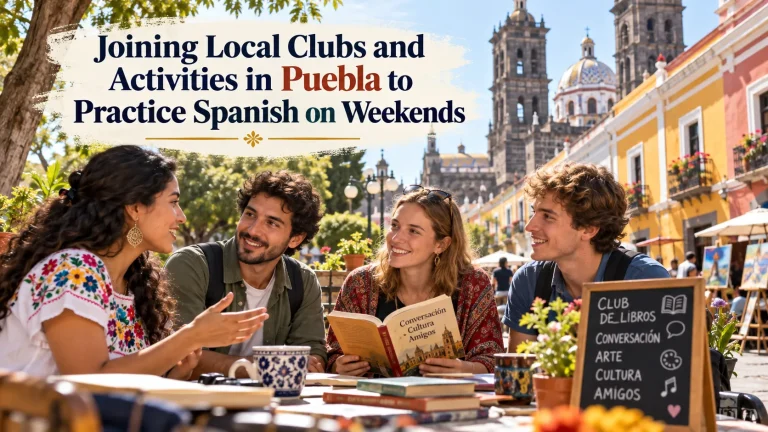
Learning Spanish in a classroom gives you the structure you need. Spending a Saturday morning talking with local hikers, ordering lunch after a cycling trip, or joining a community workshop gives you something equally important: the confidence to use that Spanish in real life.
For students studying Spanish in Puebla, weekends are an opportunity to take the language beyond textbooks and exercises. The city has an active cultural and social life, and joining local clubs, workshops, sports groups, and community activities can turn an ordinary weekend into several hours of natural Spanish practice.
This kind of interaction is especially valuable for students enrolled in a Spanish language program in Mexico because immersion does not need to stop when formal classes end. In fact, some of the most memorable learning moments often happen when you are simply trying to understand a joke, ask someone about their hobby, or keep a conversation going with a new acquaintance.
Here are some practical ways to use your weekends in Puebla to become more comfortable speaking Spanish.
Why Weekend Activities Can Improve Your Spanish
A language is easier to remember when you connect it with experiences.
You may learn the vocabulary for food, directions, hobbies, or introductions during your Spanish lessons. But when you have to use those words while talking to someone in Puebla, they begin to feel less like vocabulary exercises and more like part of your everyday communication.
Joining local activities can help you practice:
- Listening to different speaking styles and accents
- Responding without mentally translating every sentence
- Asking spontaneous questions
- Understanding everyday expressions
- Improving pronunciation through regular conversation
- Becoming more comfortable making mistakes
- Learning vocabulary connected to your interests
This is one reason students considering Spanish schools in Mexico often choose an immersion experience rather than relying entirely on online study.
Classroom instruction develops the foundation. Daily life gives you opportunities to use it.
Join a Hiking or Outdoor Group
Puebla is surrounded by mountains, parks, forests, and remarkable landscapes, making outdoor activities a natural part of weekend life for many residents.
Local hiking groups and outdoor communities regularly organize trips to natural areas around Puebla. Depending on the group and your experience level, activities may range from relaxed nature walks to more demanding mountain hikes.
For a Spanish learner, the advantage is simple: conversations happen naturally.
Instead of sitting across from someone specifically to practice grammar, you might find yourself asking:
“¿Cuánto falta para llegar?”
“¿Vienes seguido a caminar aquí?”
“¿Qué otros lugares recomiendas?”
These short exchanges gradually become longer conversations.
Outdoor activities are also useful because conversations tend to repeat familiar topics: where someone is from, how long they have lived in Puebla, travel experiences, food, weather, and plans for the weekend. Repetition helps reinforce useful vocabulary without making the experience feel like a lesson.
Before joining a group, check the difficulty level, transportation arrangements, equipment requirements, and whether the activity is suitable for beginners.
Try a Dance Class
Dance can be one of the most enjoyable ways to practice Spanish socially.
Puebla has classes and social events involving salsa, bachata, cumbia, and other Latin dance styles. Some venues offer beginner sessions before open dancing begins, which can make them approachable even if you have little experience.
You do not need advanced Spanish to participate.
Simple expressions such as:
“¿Quieres bailar?”
“¿Cómo se hace este paso?”
“¿Puedes repetirlo?”
can quickly become useful parts of your spoken vocabulary.
Dance classes also expose you to instructions given in natural Spanish. You hear verbs involving movement, directions, numbers, body parts, and everyday encouragement.
More importantly, you are interacting with people rather than simply listening to recorded dialogue.
For students taking Spanish language lessons in Mexico, activities like these provide a practical complement to structured classroom learning.
Attend Art and Craft Workshops
If hiking or dancing is not your style, Puebla’s artistic traditions offer another way to interact with Spanish speakers.
The city and surrounding region are known for craftsmanship, ceramics, food traditions, and cultural activities. Workshops may cover painting, pottery, photography, cooking, handicrafts, or other creative skills.
A workshop gives language learners a particularly comfortable environment because everyone is focused on the same task.
You already have something to talk about.
You may ask how to use a material, comment on someone else’s work, follow the instructor’s directions, or ask another participant for help.
This shared activity reduces the pressure many students feel when trying to “start a conversation” in Spanish.
It also introduces vocabulary that you probably would not encounter during a standard lesson.
Look for Local Sports Groups
Sports can create conversation even when your vocabulary is still developing.
Football, running, cycling, yoga, martial arts, and recreational fitness groups are common ways for people to spend their weekends. Joining a regular activity means you may also meet the same people more than once.
That matters for language learning.
The first week, you may only introduce yourself.
The second week, someone may ask what you did during the week.
A few weekends later, you might already be having longer conversations before or after the activity.
This progression is much closer to how relationships develop naturally.
Students attending Spanish schools in Puebla, Mexico have the advantage of practicing Spanish in the same community where they are studying. A recurring sports group can become another regular part of that immersion experience.
Participate in Cooking Classes
Food gives people plenty to talk about.
A Mexican cooking class can introduce you to local ingredients, traditional recipes, regional vocabulary, and cultural customs while giving you repeated opportunities to listen and speak.
You may hear instructions such as:
“Corta la cebolla.”
“Agrega un poco de sal.”
“Déjalo cocinar unos minutos.”
You will also encounter measurements, kitchen vocabulary, flavors, ingredients, and expressions related to food.
Cooking activities can be particularly useful for intermediate learners because instructions require active listening. You need to understand what is happening rather than simply recognize isolated words.
And once everyone sits down to taste what they have prepared, the conversation often becomes informal.
That is exactly the kind of situation where Spanish starts feeling like a language you live rather than a subject you study.
Attend Cultural Events in Puebla
A weekend in Puebla can include museums, exhibitions, music performances, public events, markets, festivals, and neighborhood celebrations.
You do not necessarily need to join a formal club to practice Spanish.
Simply attending local events gives you opportunities to read signs, listen to announcements, ask questions, speak with vendors, and interact with people around you.
Try asking questions instead of silently observing.
For example:
“¿A qué hora empieza?”
“¿Cuánto cuesta la entrada?”
“¿Qué me recomienda?”
“¿Este evento se hace todos los años?”
Small interactions count.
If you are a beginner, five brief conversations during a weekend may already represent more spontaneous speaking than you normally do outside class.
Consider Language Exchange Groups
Language exchanges are a popular option for international students because everyone arrives expecting to meet new people.
Typically, Spanish speakers who want to practice another language meet international participants who want to improve their Spanish.
These gatherings can be useful, but there is one important rule: do not spend the entire event speaking your native language.
Set a personal goal.
For example, you could decide to spend at least 30 minutes speaking only Spanish before switching languages.
Students enrolled in Spanish language programs for adults in Mexico may find exchanges particularly useful because they can practice material learned during the week in a relaxed social environment.
However, language exchanges should ideally supplement immersion rather than replace interaction with Spanish speakers in everyday situations.
Volunteer in the Local Community
Volunteering can provide meaningful language practice while helping you become more connected to Puebla.
Depending on the organization, opportunities may involve community projects, environmental activities, animal welfare, education, charity events, or cultural initiatives.
Volunteering requires communication with a purpose.
You are not speaking Spanish simply because you need practice. You are using Spanish to organize, understand instructions, solve problems, and work alongside other people.
That makes the language meaningful.
Before volunteering, make sure you understand the organization’s expectations, schedule, requirements, and whether your Spanish level is suitable for the role.
Choose Activities You Would Enjoy in Your Own Language
One mistake language learners sometimes make is choosing activities only because they seem good for practicing Spanish.
A better approach is to ask:
What would I genuinely enjoy doing on a Saturday if language learning were not part of the decision?
If photography interests you, consider joining a photography walk. Running enthusiasts can find a local running group. Those who love food might enjoy cooking activities, while book lovers can explore reading clubs or literary events.
When you are genuinely interested in an activity, conversation becomes easier because you already have curiosity, opinions, and questions about the subject.
You are also more likely to return.
Consistency is far more valuable than attending one activity purely because you think it is educational.
Don’t Wait Until Your Spanish Is “Good Enough”
Many learners postpone social interaction because they believe they need to reach an intermediate or advanced level first.
That can slow down progress.
You do not need perfect grammar to introduce yourself, order something, ask for directions, or tell someone you are learning Spanish.
You can even say:
“I’m learning Spanish. Can you speak a little more slowly?”
Most language learning involves moments when you don’t know exactly what to say.
The goal is not to eliminate those moments. It is to become increasingly comfortable handling them.
That ability develops through experience.
Combine Formal Lessons With Real-Life Spanish
A strong immersion experience combines structured learning with frequent real-world communication.
Formal classes help students understand grammar, sentence structure, pronunciation, reading, writing, and vocabulary. Outside the classroom, students learn to retrieve and use that knowledge while communicating spontaneously.
At the Spanish Institute of Puebla, the Intensive Immersion program is designed around this communicative approach. Students study Spanish through structured academic instruction while also experiencing the language and Mexican culture beyond the classroom.
The program includes eight levels, each lasting three weeks, although students can attend from one level through all eight. Instruction follows the European Framework of Reference for Language Learning and ACTFL guidelines.
For more than 35 years, the school has welcomed students, professionals, and retirees from over 72 countries who come to Mexico not simply to learn about Spanish, but to use it.
That distinction matters.
Whether you are comparing Spanish learning schools in Mexico , researching Spanish programs in Mexico, or looking for Spanish lessons in Mexico, consider what opportunities you will have to communicate once your daily lesson ends.
Language development continues at cafes, markets, museums, workshops, parks, and weekend activities.

Make Puebla Part of Your Spanish Classroom
Your classroom does not have to end at the school door.
A conversation during a Saturday hike, a cooking instructor explaining a recipe, a dance partner showing you a new step, or a local vendor recommending something at a market can all become part of your Spanish education.
You will misunderstand things occasionally. You may use the wrong verb or forget a word halfway through a sentence.
Keep talking.
Those imperfect conversations are often where confidence develops.
When you combine formal Spanish lessons in Mexico with genuine interaction in Puebla, Spanish gradually becomes more than something you know.
It becomes something you use.
Frequently Asked Questions
1. What are the best weekend activities in Puebla for practicing Spanish?
Activities that naturally encourage interaction are usually the most useful. Hiking groups, dance classes, cooking workshops, sports clubs, volunteering, cultural events, and language exchanges can all provide opportunities to speak Spanish with local residents.
2. Can beginners join local activities if they do not speak much Spanish?
Yes. Beginners can participate in many activities, particularly those involving sports, art, dance, or other shared tasks. Learning a few practical expressions before attending can make communication easier. Letting people know that you are learning Spanish can also help.
3. Is joining a club better than attending a language exchange?
They serve slightly different purposes. Language exchanges are specifically designed for language practice, while local clubs allow you to use Spanish naturally while participating in an activity. Combining both can be useful.
4. How can I practice Spanish outside my language school in Puebla?
Use Spanish during everyday activities. Visit markets, attend cultural events, join local clubs, take workshops, speak with café or restaurant staff, volunteer, and participate in recreational activities where Spanish is the normal language of communication.
5. Why study Spanish in Puebla instead of taking only online classes?
Online classes can provide convenient instruction, but studying in Puebla allows learners to encounter Spanish throughout the day. Classroom learning can be reinforced through real conversations, cultural experiences, errands, social activities, and interaction with local Spanish speakers.
6. How often should I participate in activities outside class?
There is no fixed requirement, but regular exposure is more useful than occasional intensive practice. Even one or two weekend activities combined with everyday Spanish conversations can add meaningful speaking and listening practice to a structured course.
7. What should I look for when comparing Spanish schools in Mexico?
Consider the teaching methodology, instructor experience, class structure, proficiency levels, academic standards, opportunities for conversation, cultural activities, location, and how easily students can practice Spanish outside the classroom. A well-designed immersion program should give students opportunities both to study the structure of Spanish and to use it in authentic situations.