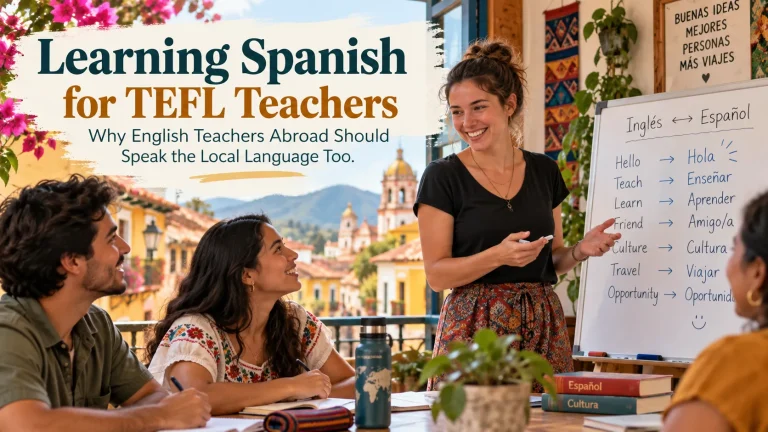
Teaching English abroad is an exciting way to experience another culture, build an international career, and connect with people from different backgrounds. But if you are a TEFL teacher living and working in a Spanish-speaking country, there is another skill that can make your experience much richer
You may be teaching English every day, but knowing the local language can help you communicate outside the classroom, understand your students better, navigate everyday situations, and become more connected to the community around you.
For TEFL teachers in Mexico, this is especially valuable. Spanish is not simply a language you study from a textbook. It is part of everyday life—from ordering food and talking with neighbors to understanding local customs and building friendships.
That raises an important question: Should English teachers abroad learn Spanish through online classes, or is a Spanish immersion program a better option?
For teachers who want practical speaking experience and need to use Spanish in real situations, immersion can offer a very different learning experience from studying exclusively online.
Why Should TEFL Teachers Learn Spanish?
A TEFL qualification prepares you to teach English, but it does not necessarily prepare you for every communication situation you will encounter while living abroad.
Even if your workplace operates primarily in English, Spanish can become essential once you leave the classroom.
Knowing Spanish can help TEFL teachers:
- Communicate more comfortably with local residents
- Build stronger relationships with Spanish-speaking colleagues
- Understand students and their cultural backgrounds
- Handle everyday tasks independently
- Participate in community activities
- Understand local customs and expressions
- Feel more confident outside English-speaking environments
- Experience Mexican culture beyond the tourist perspective
There is also a professional benefit. Learning the local language can give English teachers a better understanding of what their students experience when learning another language.
When you struggle to understand a fast conversation, forget a word, or make a grammatical mistake in Spanish, you experience some of the same challenges your English students face.
That experience can make you more empathetic as a teacher.

Why Spanish Is Particularly Useful for English Teachers in Mexico
Mexico offers many opportunities for English teachers, but living in Mexico is different from simply visiting as a tourist.
You may need Spanish when speaking with a landlord, ordering at a local restaurant, visiting a market, arranging transportation, talking to a doctor, or making friends outside an international community.
You will also hear Spanish in many forms. People may speak quickly, use regional expressions, shorten words, or communicate differently depending on the situation.
This is one reason classroom Spanish alone may not always feel sufficient.
A TEFL teacher might understand a carefully prepared Spanish lesson but struggle when someone speaks naturally at full speed.
Real-world exposure helps bridge that gap.
Neither approach has to be viewed as completely separate from the other. An online course can help establish basic knowledge, while immersion can provide opportunities to put that knowledge into practice.
For a TEFL teacher already living in Mexico, however, an immersion environment can make Spanish part of daily life rather than something that happens only during a scheduled lesson.
Who Should Choose a Spanish Immersion School Instead of Online Spanish Classes?
A Spanish immersion school may be particularly suitable for TEFL teachers who want to speak Spanish confidently in everyday situations rather than simply complete online lessons.
Consider an immersion program if you:
1. Already Live in a Spanish-Speaking Country
If you are already teaching English in Mexico, you have an important advantage: Spanish is all around you.
An immersion program allows you to take advantage of that environment instead of studying Spanish in isolation.
You can learn something in class and then encounter it naturally when shopping, eating out, traveling, or speaking with local people.
2. Want More Speaking Practice
Many language learners understand considerably more Spanish than they can comfortably speak.
This happens when learners spend most of their study time reading, watching videos, completing exercises, or memorizing vocabulary.
Speaking requires a different kind of practice.
Immersion programs emphasize using Spanish in authentic circumstances, giving learners regular opportunities to listen, respond, ask questions, and communicate.
For TEFL teachers, this can be especially valuable because communication is already central to their profession.
3. Learn Better Through Real-Life Interaction
Some people learn languages best when they can immediately connect what they study with real situations.
Instead of only learning the Spanish word for something, you encounter that word while actually using it.
Instead of memorizing a restaurant conversation, you have one.
Instead of studying directions as an exercise, you ask someone how to get somewhere.
These experiences can make language learning feel more meaningful and memorable.
Why Immersion Can Help TEFL Teachers Understand Their Students
There is another advantage that is easy to overlook.
Learning Spanish can make you a better language learner, which can influence how you teach English.
When you learn a new language, you experience moments of uncertainty firsthand.
You may know the grammar but hesitate to speak. You may understand a sentence but struggle to produce one. You may recognize a word but forget it during a conversation.
These experiences provide useful insight into the emotional and practical challenges language learners face.
For an English teacher, that perspective can be valuable when designing classroom activities, correcting mistakes, encouraging reluctant speakers, and creating opportunities for students to communicate.
What Makes an Effective Spanish Immersion Program?
Not every immersion experience is identical. If you are comparing Spanish language immersion programs, look beyond the number of classroom hours.
An effective program should provide opportunities to develop multiple areas of language ability, including:
- Listening comprehension
- Speaking and verbal interaction
- Reading
- Writing
- Grammar and linguistic structure
- Vocabulary development
- Cultural understanding
- Practical communication
A strong immersion program should also give learners opportunities to use Spanish outside formal lessons.
This is particularly important for TEFL teachers because their daily lives may already provide countless opportunities for interaction.
Why Consider Spanish Immersion Programs in Mexico?
Mexico can be a particularly engaging environment for learners who want to combine language study with cultural experience.
Spanish immersion programs in Mexico allow students to study Spanish while being surrounded by the language in everyday life.
For TEFL teachers, this can create a useful routine:
Learn → Practice → Interact → Make mistakes → Improve → Use Spanish again.
That cycle is difficult to reproduce when all your Spanish practice takes place in front of a computer.
At the Spanish Institute, students follow an intensive immersion program designed around progressive language development. The program includes eight levels, with three weeks dedicated to each level , allowing students to attend from one level through all eight depending on their goals.
The school follows the Common European Framework of Reference for Languages (CEFR) and ACTFL guidelines, while its communicative approach emphasizes using Spanish in authentic and diverse circumstances.
With more than 35 years of experience and students from over 72 countries, the program combines formal language instruction with opportunities to experience Spanish as part of everyday life.
How TEFL Teachers Can Make the Most of Spanish Immersion
Simply attending an immersion school does not mean you should stop practicing outside class.
If you are an English teacher in Mexico, try creating a personal Spanish routine.
Use Spanish for everyday tasks. Order your coffee in Spanish, ask questions at local shops, and practice conversations with neighbors.
Resist switching to English immediately. If you know enough Spanish to continue a conversation, give yourself time to find the words.
Keep a vocabulary notebook. Write down expressions you hear in real conversations rather than focusing only on isolated vocabulary.
Talk to people outside your professional circle. Speaking with people of different ages and backgrounds exposes you to different accents, expressions, and communication styles.
Accept mistakes. Fluency does not require perfect Spanish. Making mistakes is a normal part of developing communication skills.
Most importantly, connect classroom learning with real experiences.
If you learn a new phrase during your Spanish lesson, look for an opportunity to use it that same day.
Is Spanish Immersion Worth It for TEFL Teachers?
The answer depends on your goals, schedule, learning preferences, and current level of Spanish.
If your primary goal is occasional vocabulary practice or maintaining an existing skill, online Spanish classes may provide the flexibility you need.
If your goal is to develop practical speaking skills while living in a Spanish-speaking environment, an immersion program offers a more integrated learning experience.
For TEFL teachers, the benefits can extend beyond personal communication. Spanish can help you engage more deeply with your community and culture while giving you firsthand experience of the language-learning process.
Instead of treating Spanish as another subject to study, immersion allows you to make it part of your everyday routine.

Final Thoughts
Teaching English abroad gives TEFL teachers the opportunity to enter a new culture. Learning Spanish can take that experience a step further.
You do not need perfect Spanish to benefit from learning it. Even basic communication can change how you interact with people, navigate daily life, and understand your surroundings.
For teachers living in Mexico, Spanish immersion programs provide an opportunity to connect classroom learning with real communication. Rather than studying Spanish only as a subject, you can begin to use it as part of your everyday life.
And perhaps that is the biggest lesson for any language teacher: languages become meaningful when we use them to connect with people.
At the Spanish Institute, the goal is not simply to learn about Spanish. Through intensive immersion, communicative practice, and cultural experiences, students have the opportunity to live the Spanish language.
Frequently Asked Questions
1. Should TEFL teachers learn the local language?
Yes. TEFL teachers can benefit from learning the local language because it can make everyday communication easier, strengthen connections with local communities, and provide a deeper understanding of the culture in which they live and work.
2. Is Spanish necessary for teaching English in Mexico?
Spanish proficiency is not necessarily required for every TEFL position in Mexico. However, learning Spanish can make everyday life easier and help teachers communicate more effectively outside the English classroom.
3. Are Spanish immersion programs better than online Spanish classes?
They provide different learning experiences. Online classes offer flexibility, while immersion programs provide structured instruction combined with frequent opportunities to use Spanish in real-life situations.
4. How long does it take to learn Spanish through immersion?
The time required depends on your starting level, study intensity, previous language experience, and how much Spanish you use outside class. Consistent immersion and regular speaking practice can support steady progress.
5. Why choose Spanish immersion programs in Mexico?
Studying Spanish in Mexico allows learners to combine formal instruction with everyday exposure to Spanish and Mexican culture. This can give students opportunities to practice language skills beyond the classroom.
6. Can beginner TEFL teachers join a Spanish immersion program?
Yes. Immersion programs can accommodate learners at different stages when instruction is organized progressively. A structured program allows beginners to develop foundational skills before moving toward more advanced communication.
7. Can learning Spanish make me a better English teacher?
It can provide useful firsthand experience of language learning. Experiencing vocabulary gaps, pronunciation challenges, hesitation, and communication difficulties can help teachers better understand some of the challenges their own students face.