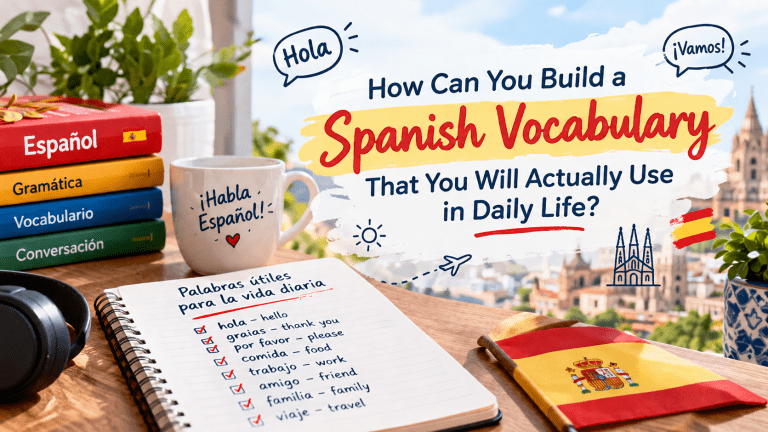
Learning hundreds of Spanish words is easy. Remembering and actually using them in real conversations is much difficult. Build a Spanish Vocabulary That You Will Actually Use in Daily Life.
Many Spanish learners spend hours memorizing vocabulary lists, completing flashcards, or studying words from textbooks. Yet when they meet a native Spanish speaker, they suddenly struggle to find the right words. The problem is often not a lack of vocabulary. It is that they have learned words without learning how to use them in real-life situations.
If your goal is to learn to speak Spanish confidently, your vocabulary needs to be practical, relevant, and connected to everyday experiences. This is one reason Spanish immersion programs in Mexico can be so effective.
When you live and study in a Spanish-speaking environment, you encounter useful words repeatedly in real conversations, shops, restaurants, classrooms, and social situations.
Whether you are preparing for Spanish language classes in Mexico , planning to join one of the best Spanish immersion programs, or simply want to improve your Spanish at home, the key is to build a vocabulary that supports your current life.
So, how can you do it?
What Is the Best Way to Build a Useful Spanish Vocabulary?
The best way to build a practical Spanish vocabulary is to learn words in context, focus on phrases instead of isolated words, use new vocabulary in real conversations, and repeatedly encounter the same words in different situations.
For example, memorizing the Spanish word carne (food) is useful. However, learning phrases such as What food do you like? (What food do you like?) or Let’s find something to eat (Let’s find something to eat) gives you a better understanding of how the word works in everyday communication.
This approach is especially valuable for students participating in Spanish language immersion programs , where vocabulary is connected directly to real experiences.
-
Start With the Vocabulary You Need Every Day
One of the biggest mistakes Spanish learners make is trying to memorize thousands of random words.
Instead, begin with the vocabulary you are most likely to use.
Think about your daily routine.
What do you normally do?
You may:
- Wake up and get ready for work.
- Travel to school or the office.
- Buy groceries.
- Order food.
- Talk to friends.
- Ask for directions.
- Discuss your hobbies.
- Make appointments.
- Talk about your family.
These situations should become the foundation of your Spanish vocabulary.
If you are planning immersion in Spanish in Mexico, start learning words related to everyday life in Mexico before you arrive. This will make it easier to communicate with locals and participate in your surroundings from the beginning.
The goal isn’t to know every Spanish word. The goal is to know the right words for your life.

-
Learn Phrases Instead of Individual Words
Imagine you want to learn the Spanish word compra , which means “to look for.”
You could memorize:
To look for = to search
But you will remember it more effectively if you learn it as part of useful phrases:
- I am looking for a restaurant.
- What are you looking for?
- I’m looking for a pharmacy. – I am looking for a pharmacy.
Now, you are not just learning one word. You are learning how to use it.
This is particularly important if you want to speak Spanish fluently. Fluent speakers do not build every sentence by translating individual words. They naturally remember common combinations and expressions.
During Spanish immersion classes in Mexico, students have the advantage of hearing these expressions repeatedly in natural conversations.
-
Learn Vocabulary Based on Real Situations
Think about the situations you will encounter and create vocabulary groups around them.
For example, if you are traveling to Mexico, you might create categories such as:
At a Restaurant
- Menu – Menu
- Waiter /Waitress
- The bill
- I would like…
- What do you recommend?
Getting Around
- Where is…?
- To the right
- To the left
- Near
- Far – Far
Shopping
- How much does it cost?
- Do you have another size? -Do you have another size?
- I want to buy …
This type of practical vocabulary becomes immediately useful when you participate in language immersion Mexico experiences.
-
Use Your Environment as Your Vocabulary Teacher
One of the biggest advantages of studying at Spanish schools in Puebla Mexico is that the city itself becomes part of your classroom.
- You don’t have to wait until your next lesson to learn something new.
- Look around you.
- Read signs.
- Listen to conversations.
- Pay attention to menus.
- Notice advertisements.
- Observe how people greet each other.
If you are studying Spanish in Mexico, you can turn an ordinary walk through the city into a vocabulary lesson.
For example, visit a local market and notice the names of fruits, vegetables, clothing, and household items. Then try using those words in a conversation later.
This is one of the key benefits of Spanish immersion schools. Instead of learning vocabulary only from a textbook, you see and hear the language being used in real life.
-
Keep a Personal Spanish Vocabulary Journal
A vocabulary notebook can be incredibly useful, but don’t turn it into a dictionary.
Instead, write down words that you actually encounter.
For every new word, record:
- The Spanish word.
- Its English meaning.
- A sentence using the word.
- Where you heard or saw it.
For example:
Word: Aprovechar
Meaning: To take advantage of / make the most of
Sentence: I want to take advantage of my time in Mexico.
Where I heard it: During a conversation with my teacher.
This method creates a personal connection with the word.
Over time, your notebook becomes a record of your current Spanish journey.
-
Don’t Be Afraid to Repeat the Same Words
You don’t need to learn 50 new words every day.
In fact, trying to memorize too many words at once can make learning difficult.
Instead, focus on repetition.
Use a new word:
- In a conversation.
- In a written sentence.
- While thinking.
- While reading.
- While listening.
The more frequently you encounter a word, the more familiar it becomes.
This is one reason Spanish immersion programs in Mexico can accelerate vocabulary development. Students are surrounded by Spanish and naturally encounter the same words repeatedly throughout the day.
-
Practice New Vocabulary Immediately
The best time to use a new word is as soon as you learn it.
Suppose you learn the word mercado (market).
Don’t simply write it down.
Try using it:
I’m going to the market.
Then ask someone:
Do you like this market?
The moment you use a new word in a meaningful interaction, it becomes more memorable.
Students attending Spanish language classes in Mexico can take advantage of this by using classroom vocabulary outside school.
If your teacher introduces words related to food, visit a restaurant.
If you learn vocabulary about transportation, practice asking for directions.
Connect the lesson to your real life.
-
Learn From Conversations, Not Just Textbooks
Textbooks are useful, but real conversations expose you to language that you may not find in traditional lessons.
When you speak with native Spanish speakers, listen carefully to:
- How they greet people.
- How they ask questions.
- Which expressions they repeat.
- How they respond naturally.
- Which words they use instead of textbook phrases.
Don’t worry if you don’t understand everything.
Listen for words you recognize and expressions you hear repeatedly.
This is one of the strongest benefits of Spanish immersion programs in Mexico. Students can hear Spanish as it is naturally spoken and gradually become more comfortable with everyday communication.
-
Use Technology as a Support Tool
Technology can help you organize and review vocabulary, but it should support real language practice rather than replace it.
You can use:
- Flashcard apps.
- Digital dictionaries.
- Spanish podcasts.
- Language-learning apps.
- Online videos.
- Voice recording tools.
For example, record yourself saying five new phrases and listen to the recording later.
You can also use digital flashcards to review words you encountered during your day.
However, if your ultimate goal is to learn to speak Spanish in Mexico or communicate confidently with native speakers, make sure technology is combined with current speaking practice.
-
Learn Words That Match Your Goals
Your vocabulary should reflect why you are learning Spanish.
A traveler may need vocabulary related to:
- Hotels
- Transportation
- Restaurants
- Directions
- Sightseeing
Healthcare professional may need:
- Medical terminology
- Symptoms
- Body parts
- Appointments
A business professional may need:
- Meetings
- Negotiations
- Presentations
- Workplace communication
This is why choosing the right Spanish language course matters.
A well-designed program can help you focus on vocabulary that is relevant to your personal, academic, or professional goals.
-
Practice Thinking in Spanish
One of the biggest steps toward fluency is reducing your dependence on translation.
Start with simple thoughts.
Instead of thinking:
“I need to buy groceries.”
Then translating it into Spanish, try thinking directly:
I need to buy food.
As you become more comfortable, your thoughts can become more complex.
You may eventually find yourself thinking in Spanish without consciously translating.
This is one of the long-term benefits many learners seek when joining Spanish language immersion programs. Constant exposure gives the brain more opportunities to process Spanish naturally.

-
Use Every Conversation as a Learning Opportunity
You don’t need to have perfect Spanish before you start speaking.
In fact, speaking is how you improve.
If you don’t know a word, try explaining what you mean using words you already know.
For example, if you forget the word for “umbrella,” you can describe it:
“It’s something you use when it rains.”
This ability to communicate around missing vocabulary is an important part of becoming fluent.
The more you practice, the better you become at keeping conversations going.
-
Review Vocabulary Through Real-Life Challenges
Turn vocabulary practice into small challenges.
For example:
Day 1: Order your food entirely in Spanish.
2nd Day: Ask a local for directions.
Day 3: Have a five-minute conversation.
4th Day: Buy something at a local market.
Day 5: Describe your daily routine in Spanish.
These small challenges encourage you to use vocabulary actively.
If you are participating in Spanish immersion classes in Mexico, you can easily create these challenges as part of your daily routine.
-
Don’t Try to Sound Perfect
Many learners avoid using new vocabulary because they are worried about making mistakes.
But mistakes are a natural part of language learning.
Your goal should be communication first and perfection later.
If someone understands what you mean, you’ve already achieved something important.
With regular practice, corrections, and feedback, your vocabulary and grammar will improve naturally.
The most important thing is to keep speaking.
How Spanish Immersion Helps You Build Practical Vocabulary
For learners who want to build vocabulary that they can actually use, immersion offers a greater advantage.
When you study at one of the best Spanish immersion programs, you don’t simply memorize words. You experience them.
- You hear them.
- You speak them.
- You read them.
- You use them.
- You hear them again.
This repeated exposure creates stronger connections between vocabulary and real-life experiences.
For students looking to learn to speak Spanish, studying in Mexico can also provide opportunities to practice Spanish outside the classroom. Everyday activities become opportunities to reinforce what you have learned.
Whether you’re ordering breakfast, talking with classmates, visiting a market, or exploring a new neighborhood, you are constantly exposed to useful language.
Final Thoughts: Build the Vocabulary You Will Actually Use
Building a useful Spanish vocabulary isn’t about memorizing the largest possible number of words. It’s about learning words that are relevant to your life and using them repeatedly in meaningful situations.
Start with everyday vocabulary. Learn phrases instead of isolated words. Pay attention to how native speakers communicate. Practice new words immediately and don’t be afraid to make mistakes.
Most importantly, put yourself in situations where Spanish is part of your daily life.
For many learners, Spanish immersion programs in Mexico provide exactly this kind of environment. By combining structured lessons with real-world communication, cultural experiences, and consistent practice, students can develop a vocabulary that goes beyond textbooks and becomes part of their everyday communication.
If your goal is to Speak Spanish Fluently , remember that every conversation is a chance to learn. Every new phrase is an opportunity to communicate. And every mistake brings you one step closer to confidence.
The best vocabulary is not the vocabulary you can memorize.
It is the vocabulary you can actually use.