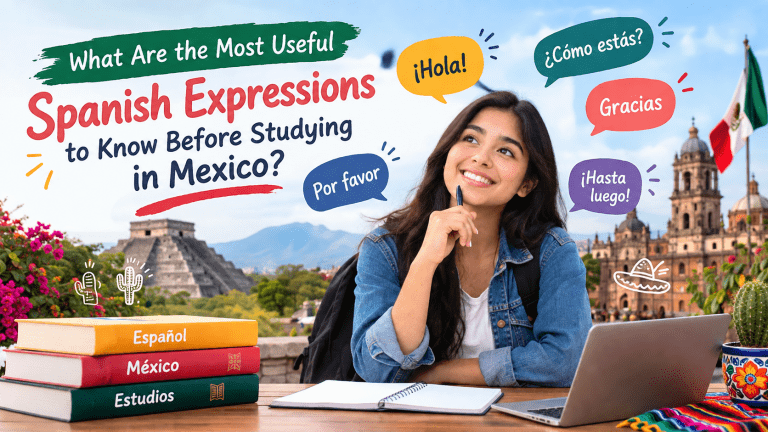
Planning to study Spanish in Mexico is an exciting opportunity to learn a new language while experiencing a new culture. Whether you are preparing to join Spanish language classes in Mexico , enrolling in one of the best Spanish immersion programs , or simply planning to learn to speak Spanish in Mexico , knowing a few useful expressions before you arrive can make your experience much easier.
The good news is that you do not need to be fluent before you start. Even learning a few basic Spanish expressions can help you communicate with locals, navigate daily situations, and feel more confident from your first day.
If you are considering immersion in Spanish in Mexico , these expressions can give you a strong foundation for your language journey. Once you arrive, you will have countless opportunities to practice them in real conversations and gradually build the skills needed to speak Spanish fluently .
What Spanish Expressions Should You Learn Before Studying in Mexico?
Before joining a Spanish language course in Mexico, focus on practical expressions that you can use every day. Greetings, polite phrases, questions, directions, food-related expressions, and emergency phrases are among the most useful.
Here are some essential expressions to learn before your trip.
1. Hello
Hola means “hello” and is one of the first words every Spanish learner should know.
You can use it when meeting:
- Teachers
- Classmates
- Host families
- Shopkeepers
- Restaurant staff
- New friends
Starting a conversation with a simple “Hola” is an easy way to practice Spanish immediately.
2. Good morning
Use Good morning when greeting someone in the morning.
For example:
Good morning, how
are you?
This expression is especially useful when meeting your teachers at a Spanish immersion school or greeting your host family in the morning.
3. Good afternoon
Buenas tardes means “good afternoon.”
You can use it when entering a shop, meeting someone, or starting a conversation during the afternoon.
Learning greetings like these helps you become more comfortable using Spanish throughout the day.
4. Good evening / Good night
Buenas noche can be used as a greeting in the evening or when saying good night.
These three expressions— Buenos días, buenas tardes, and buenas noches —are simple but essential for anyone beginning Spanish in Mexico.
5. How are you?
¿Cómo estás? is an informal way to ask someone how they are.
You can respond with:
I am well .
Very well , thank you.
More or less. – So-so.
When speaking to someone you want to address more formally, you may hear How are you?
Learning these basic exchanges will help you participate in simple conversations from your first day of Spanish immersion classes in Mexico .
6. Please
One of the most important expressions to know is por favor , meaning “please.”
Use it when asking for something politely.
For example:
A coffee, please
Can you help me, please ?
Polite expressions are essential when communicating in everyday situations.
7. Thank You
Gracias means “thank you.”
You will hear and use this word constantly while studying in Mexico.
A slightly stronger expression is:
Thank you so much.
Thank you very much.
Try using thanks whenever someone helps you, gives you directions, or provides a service.
8. You’re welcome
When someone says thank you , you can respond with de nada, meaning “you’re welcome.”
This simple exchange is a great way to practice conversational Spanish.
9. Sorry / Excuse Me
You can use forgiveness to apologize or get someone’s attention.
Excuse me is a more formal way to say “excuse me” or “sorry.”
For example:
Excuse me, where is the bathroom?
These expressions can be particularly helpful when navigating an unfamiliar city.
10. Do you speak English?
If you are a beginner, there may be moments when you need assistance.
You can ask:
Do you speak English?
However, if your goal is to improve through language immersion Mexico programs, try speaking Spanish first. You can ask for help in English if communication becomes difficult.
11. I don’t understand.
One of the most useful phrases for language learners is:
I don’t understand .
There is no need to feel embarrassed about saying this. During Spanish language immersion programs , you will hear unfamiliar words and expressions.
You can also say:
I don’t understand very well.
This lets the other person know that you need additional help.
12. Can you repeat that, please?
When someone speaks too quickly, say:
Could you repeat that, please?
This means “Can you repeat, please?”
You can also say:
More slowly, please .
These phrases are extremely useful during your first days in Mexico.
13. What Does … Mean?
When you hear a new word, ask:
What does it mean…?
For example:
What
does this word mean?
This is an excellent phrase to use during your Spanish language classes in Mexico.
Instead of immediately using a translation app, try asking your teacher or a native speaker. You may remember the explanation more easily because you learned the word in context.
14. How do you say…?
If you know what you want to say in English but do not know the Spanish word, ask:
How do you say “book” in Spanish?
This means:
“How do you say ‘book’ in Spanish?”
This expression will become one of your most valuable tools during Spanish immersion programs in Mexico.
15. Where is…?
If you need directions, use:
Where is…?
For example:
Where
is the bathroom?
Where
is the station?
Where
is the school?
Learning this question will make navigating your surroundings much easier.
16. How Much Does It Cost?
When shopping or ordering something, ask:
How much does it cost?
This means “How much does it cost?”
You can also ask:
How
much does this cost?
Practicing this phrase at local markets and shops can be a fun way to improve your Spanish.
17. I would like… – I Would Like…
Quisiera is a polite way to say “I would like.”
For example:
I would like a coffee , please.
I would like some water, please.
This phrase is useful when ordering food or drinks.
18. The bill, please
After eating at a restaurant, you can say:
The bill, please.
This means “The bill, please.”
Knowing practical expressions like this can help you feel more independent during your time in Mexico.
19. Can you help me?
If you need assistance, say:
Can you help me?
This means “Can you help me?”
You can add please to make it more polite:
Can you help me, please?
This is a useful phrase to remember before starting your Spanish immersion classes in Mexico.
20. See you later
When leaving you can say:
See you later.
It means “See you later.”
Other useful expressions include:
See you tomorrow .
See you.
These phrases will help you end conversations naturally.
Why Should You Learn These Expressions Before Arriving in Mexico?
Learning basic expressions before arriving can make your transition much easier.
You may be nervous about speaking Spanish for the first time. Knowing a few phrases gives you the confidence to start conversations rather than avoiding them.

This is particularly important if you plan to attend Spanish schools in Puebla Mexico or another immersion program.
The goal is not to memorize hundreds of words before your arrival. Instead, learn enough practical Spanish to begin communicating.
Once you arrive, your environment will provide countless opportunities to expand your vocabulary.
How Can You Improve Your Spanish After Arriving in Mexico?
The best way to improve is to use Spanish every day.
If you join one of the Spanish immersion programs in Mexico, try to make Spanish part of your daily routine.
You can:
- Speak Spanish with classmates.
- Practice with your teachers.
- Talk to your host family.
- Order food in Spanish.
- Ask locals simple questions.
- Read signs and menus.
- Keep a Spanish vocabulary notebook.
- Listen carefully to native speakers.
The more you use Spanish outside the classroom, the more natural it will become.
Don’t Be Afraid to Make Mistakes
One of the biggest barriers to learning a language is the fear of making mistakes.
You may pronounce a word incorrectly. You may use the wrong verb tense. You may forget a word in the middle of a sentence.
That’s okay.
Mistakes are part of learning.
When you participate in Spanish language immersion programs, you have the advantage of being surrounded by opportunities to practice. Each conversation teaches you something new.
The goal is not to speak perfectly from day one. The goal is to communicate, learn, and improve.
How Immersion Helps You Move Beyond Basic Expressions
Learning expressions before arriving in Mexico gives you a starting point. Immersion takes you much further.
When you participate in immersion in Spanish in Mexico, you begin to understand how words and phrases work in real conversations.
You will gradually learn:
- Everyday vocabulary
- Local expressions
- Natural sentence structures
- Pronunciation
- Listening skills
- Conversational confidence
Over time, basic expressions become complete conversations.
A phrase like How do you say…? may initially help you learn one new word. Eventually, you may find yourself asking questions, telling stories, and participating in longer conversations entirely in Spanish.
That is the real advantage of immersion.
Final Thoughts: Start With a Few Words and Keep Building
You don’t need to know hundreds of Spanish words before traveling to Mexico. A handful of practical expressions can give you the confidence to start communicating from your first day.
If you’re planning to learn to speak Spanish in Mexico, joining a Spanish language course or Spanish immersion school can help you turn basic vocabulary into practical communication skills.
Whether you are preparing for Spanish immersion classes in Mexico , researching the best Spanish immersion programs, or planning to study at one of the Spanish immersion Schools in Puebla, remember that every conversation is an opportunity to learn.
Start with Hello .
Add Please and Thank You .
Learn to ask “How do you say…?”
And don’t be afraid to say I don’t understand when you need help.
With consistent practice, patience, and an immersive learning environment, these simple expressions can become the foundation for your journey to Speak Spanish Fluently.
The more you use Spanish, the more comfortable you will become—and the more you will discover that learning a language is not just about memorizing words. It is about connecting with people, understanding a culture, and becoming confident enough to communicate in the real world.