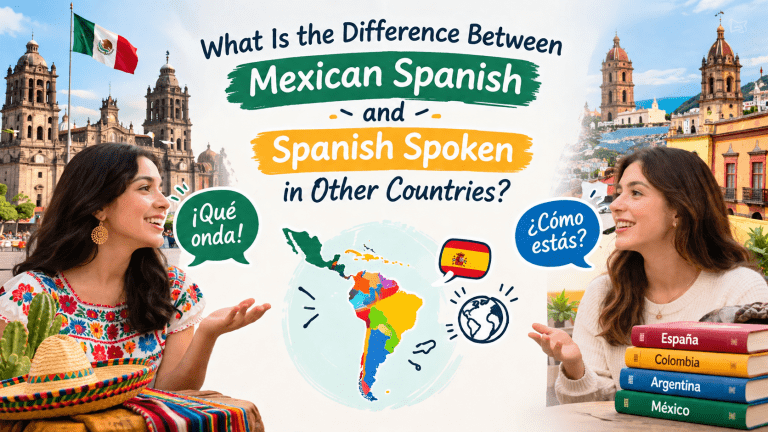
If you are planning to learn to speak Spanish in Mexico , you may be surprised to discover that Spanish does not sound the same everywhere. Although Spanish speakers across the world share the same basic language, vocabulary, pronunciation, expressions, and even grammar can vary from one country to another.
This is one reason why choosing the right learning environment matters. Students who join Spanish immersion programs in Mexico have the opportunity to learn Spanish while experiencing the language as it is naturally spoken in Mexico.
So, what is the difference between Mexican Spanish and Spanish spoken in other countries?
Mexican Spanish is one of the world’s many varieties of Spanish. It has its own pronunciation patterns, vocabulary, slang, expressions, and regional differences. While it is generally easy for Spanish learners to understand, some words and phrases may have different meanings or usage depending on the country.
Let’s explore the key differences and discover why studying Spanish in Mexico can be an excellent choice for students who want practical, real-world language skills.
Is Mexican Spanish Different From Spanish in Other Countries?
Yes, but the differences are usually not large enough to prevent communication.
Spanish is spoken by hundreds of millions of people across many countries, including Mexico, Spain, Colombia, Argentina, Peru, Chile, and many others. Each region has developed its own way of speaking while maintaining the same core language.
The differences are similar to the variations found between American, British, and Australian English. The language remains English, but pronunciation, vocabulary, spelling, and expressions can change.
The same applies to Spanish.
When you attend Spanish language classes in Mexico , you are learning a variety of Spanish that is widely understood throughout Latin America and beyond.
-
Mexican Spanish Has Its Own Pronunciation
One of the first differences you may notice when learning Spanish in Mexico is pronunciation.
Mexican Spanish is generally known for having relatively clear pronunciation. However, pronunciation varies significantly across Mexico itself because the country has many regions and communities.
For example, the Spanish spoken in Mexico City may sound different from Spanish spoken in coastal areas or northern Mexico.

This is important for students attending Spanish immersion classes in Mexico because they are exposed to real conversations rather than only textbook Spanish.
With regular listening and speaking practice, students become more comfortable understanding different accents and speaking naturally.
-
Vocabulary Can Change From Country to Country
One of the biggest differences between Mexican Spanish and Spanish spoken elsewhere is vocabulary.
The same object may have different names depending on the country.
For example, a car may be called:
- Car in Mexico and several Latin American countries
- Car in Spain
- Car in some South American countries
Similarly, a computer may be called a computer in Mexico, while a computer is commonly used in Spain.
These differences can be confusing for beginners, but they are also one of the most interesting parts of language learning.
When you participate in Spanish language immersion programs , you learn the vocabulary that people actually use in your surroundings. This makes it easier to communicate naturally with local speakers.
-
Mexican Spanish Uses “You” and “Tú” Differently Depending on Context
Spanish has different ways of addressing people, and the choice can depend on age, relationship, social situation, and region.
In Mexico, speakers commonly use tú in informal situations and tú in more formal or respectful contexts.
However, the use of these forms can vary across different Spanish-speaking countries.
In some regions, speakers may use vos , a form known as voseo. This is common in countries such as Argentina and Uruguay and is also found in parts of Central America and elsewhere.
For someone taking a Spanish language course , learning these differences can make communication easier when traveling across Spanish-speaking countries.
-
Mexican Spanish Has Unique Expressions and Slang
Every language has informal expressions that are difficult to understand from textbooks.
Mexican Spanish is famous for its colorful expressions and everyday phrases.
For example, you may hear expressions such as:
- What’s up? – A casual way of asking “What’s up?”
- How cool! – Used to say something is great or cool.
- Ahorita – A word that can mean “right now” or, depending on context, “in a little while.”
- Órale – An expressive word that can communicate surprise, encouragement, agreement, or other meanings depending on the situation.
These expressions are best learned through context.
This is one reason Spanish immersion schools can offer an advantage over studying only through apps or textbooks. Students hear how words and phrases are actually used in everyday conversations.
-
Mexican Spanish Is Different From Spanish in Spain
One of the most common questions from Spanish learners is whether Mexican Spanish is the same as the Spanish spoken in Spain.
The answer is no, although speakers from both places can generally communicate without major problems.
One noticeable difference is the pronunciation of z and c before e or i .
In much of Spain, these sounds are pronounced with a “th” sound, while in most of Latin America, including Mexico, they are pronounced more like an “s” sound.
For example, the word thank you may sound different depending on whether you are listening to a speaker from Mexico or Spain.
Spain also commonly uses tú for informal plural “you,” while Latin American countries generally use tú .
Students who choose Spanish immersion programs in Mexico therefore learn the Latin American variety rather than the European variety.
-
Mexican Spanish Is Not the Same as All Latin American Spanish
It is important to remember that there is no single version of “Latin American Spanish.”
The Spanish spoken in Mexico differs from the Spanish spoken in Colombia, Peru, Chile, Argentina, and other countries.
For example:
- Argentina and Uruguay commonly use vos .
- Caribbean Spanish may have distinctive pronunciation patterns.
- Chilean Spanish is known for unique vocabulary and expressions.
- Colombian Spanish varies considerably by region.
Mexican Spanish is simply one of many varieties.
This diversity is actually beneficial for language learners. Once you understand one variety of Spanish well, you can gradually become familiar with others.
A good Spanish language immersion program gives you a strong foundation for communicating with Spanish speakers around the world.
-
Why Learn Spanish in Mexico?
If your goal is to speak Spanish fluently , learning in Mexico can provide an advantage because you are surrounded by opportunities to use the language.
Instead of studying Spanish for an hour and then returning to an English-speaking environment, you can practice throughout your day.
You might:
- Order breakfast in Spanish.
- Ask for directions.
- Talk to local shopkeepers.
- Practice with classmates.
- Communicate with your host family.
- Explore local communities.
- Listen to Spanish in everyday situations.
This type of language immersion experience in Mexico allows students to connect classroom learning with real-world communication.

-
Does Mexican Spanish Prepare You to Speak Spanish in Other Countries?
Yes.
Learning Mexican Spanish does not mean you will only be able to communicate in Mexico.
The fundamentals of the language remain the same. Once you understand essential grammar, vocabulary, sentence structure, and communication skills, you can adapt to different regional varieties.
For example, a student who learns Spanish in Mexico can travel to Colombia, Peru, Spain, or Argentina and continue communicating in Spanish.
You may encounter unfamiliar expressions or accents, but your foundation will help you understand them through context.
This is one reason best Spanish immersion programs focus on developing overall communication skills rather than simply teaching isolated vocabulary.
-
Why Immersion Helps You Understand Regional Differences
One challenge for Spanish learners is understanding native speakers when they speak naturally.
Textbooks often teach carefully structured sentences. Real conversations are different.
People speak quickly, shorten words, use expressions, and communicate through context.
By joining Spanish immersion programs in Mexico , students can gradually develop their listening skills by hearing Spanish in real situations.
This experience can help learners become more comfortable with:
- Different speaking speeds
- Informal expressions
- Everyday vocabulary
- Regional accents
- Natural conversation patterns
The result is greater confidence when communicating outside the classroom.
-
What Should You Learn First: Mexican Spanish or General Spanish?
If you are a beginner, you don’t need to worry too much about choosing between “Mexican Spanish” and “general Spanish.”
Start by learning the fundamentals:
- Basic grammar
- Common vocabulary
- Pronunciation
- Sentence structure
- Everyday conversations
As your skills improve, you can learn regional variations naturally.
If you choose Spanish schools in Puebla, Mexico , for example, you will learn Spanish in an authentic Mexican environment while building a strong foundation that can be used internationally.
The most important thing is to develop confidence and communication skills.
Final Thoughts: Which Spanish Should You Learn?
The differences between Mexican Spanish and Spanish spoken in other countries are important, but they should not discourage you from learning.
Spanish is a global language with wide regional varieties. The vocabulary, expressions, pronunciation, and accents may change from one country to another, but the fundamental language connects Spanish speakers worldwide.
For students who want to learn to speak Spanish in Mexico , an immersive learning experience provides the opportunity to develop practical skills while experiencing the language in its natural environment.
Whether your goal is to travel, work internationally, connect with Spanish-speaking communities, or simply speak Spanish fluently , learning through immersion can help you move beyond memorizing words and start using Spanish confidently.
Choosing Spanish immersion schools in Mexico allows you to learn the language while living the experience. With structured Spanish language classes in Mexico , real-world conversations, and opportunities to practice every day, you can develop a stronger understanding of both the language and the culture behind it.
If you are looking for a meaningful way to improve your Spanish, consider making your learning journey an immersive one. The best way to understand a language is not only to study it – but to experience it.
Frequently Asked Questions About Mexican Spanish
Is Mexican Spanish easy to understand?
For many learners, Mexican Spanish is relatively accessible because pronunciation is generally clear. However, Mexico has many regional accents, so learners may encounter differences depending on where they travel.
Is Mexican Spanish the same as Spanish from Spain?
No. Both are varieties of Spanish, but they differ in pronunciation, vocabulary, and some grammatical features. Mexican Spanish generally follows Latin American usage, while Spanish from Spain has its own distinctive characteristics.
Can I learn Mexican Spanish and travel to other Spanish-speaking countries?
Yes. The fundamentals you learn through Spanish language immersion programs can be used across Spanish-speaking countries. You may encounter regional vocabulary and accents, but your core communication skills remain valuable.
Why should I learn Spanish in Mexico?
Learning Spanish in Mexico allows you to combine structured education with real-life practice. Students can use Spanish in everyday situations, experience local culture, and interact with native speakers.
Is Mexican Spanish useful for business and travel?
Yes. Mexican Spanish is widely spoken and understood throughout Mexico and is also useful when communicating with Spanish speakers in many other parts of the world. Learning through Spanish immersion classes in Mexico can help students develop practical communication skills for travel, work, and everyday life.