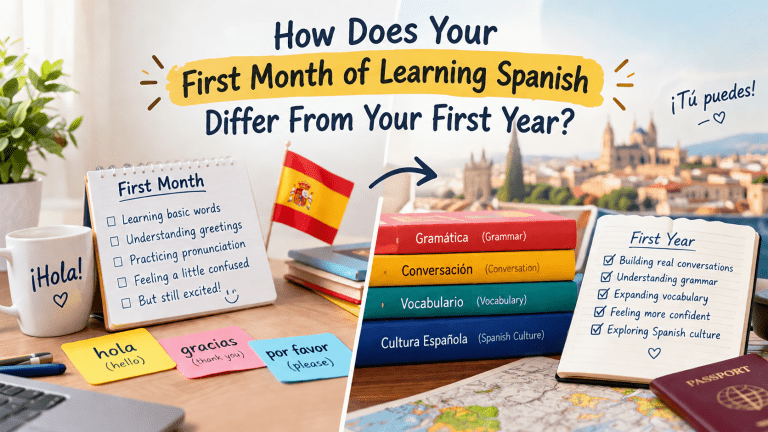
Learning a new language is an exciting journey, but the experience can change dramatically as your skills develop. Your first few weeks may be filled with new words, basic phrases, and the challenge of understanding native speakers.
After a year of consistent practice, however, you may find yourself having longer conversations, understanding more complex Spanish, and communicating with greater confidence.
This is especially true when you choose immersion in Spanish in Mexico . Instead of learning Spanish only through textbooks or occasional lessons, you experience the language as part of your daily life. From ordering food and talking to locals to attending classes and exploring your surroundings, Spanish becomes something you actively use every day.
So, how does your first month of learning Spanish compare with your first year? What can you realistically expect from a Spanish language course or one of the best Spanish immersion programs ?
Let’s explore the journey from your first month to your first year and understand how your skills can develop through consistent practice and Spanish language immersion programs.
What Happens During Your First Month of Learning Spanish?
The first month is often the most exciting and challenging stage of your language-learning journey. Everything feels new, and you are constantly discovering words and expressions you may have never heard before.
If you join Spanish language classes in Mexico, your first month will likely focus on building a strong foundation. Depending on your previous experience, you may learn basic greetings, introductions, numbers, common verbs, and everyday vocabulary.
During this stage, you may learn how to:
- Introduce yourself in Spanish
- Ask and answer basic questions
- Order food and drinks
- Ask for directions
- Talk about your family
- Describe your daily routine
- Understand simple instructions
- Use basic phrases in everyday situations
At first, you may need to translate words in your head before responding. This is completely normal.
The goal of your first month is not necessarily to speak Spanish fluently . Instead, it is about building the foundation you need for future progress.
The First Month: Learning to Communicate
One of the biggest advantages of Spanish immersion classes in Mexico is that you can immediately practice what you learn.
Imagine learning the phrase “How much does it cost?” in the classroom and then using it at a local market. You may learn how to order a coffee and then use that expression at a coffee the same afternoon.
This connection between classroom learning and real-world communication makes language immersion Mexico experiences particularly valuable.
During your first month, you may still make many mistakes. You might forget vocabulary, use incorrect verb forms, or struggle to understand fast conversations.
However, you are also beginning to develop something extremely important: confidence.
Every time you successfully communicate a message in Spanish, you prove to yourself that you can use the language in real life.
What Changes After the First Few Months?
As you continue learning, your vocabulary starts to grow. You begin recognizing words that once sounded unfamiliar, and conversations become easier to follow.
Instead of relying only on memorized phrases, you start creating your own sentences.
This is an important transition in Spanish language immersion programs.
You may begin to:
- Understand common questions without translating
- Respond more quickly
- Use a wider range of vocabulary
- Understand everyday conversations
- Talk about past and future events
- Express your opinions
- Ask follow-up questions
At this point, Spanish starts becoming less of a subject you study and more of a skill you use.

Your First Year: Moving Beyond the Basics
After a year of consistent learning, the difference can be significant.
Your progress will depend on factors such as your starting level, study habits, time spent practicing, and exposure to Spanish. However, students who consistently participate in Spanish immersion programs in Mexico can make substantial progress.
By this stage, you may be able to participate in longer conversations and communicate more naturally in everyday situations.
You may also find yourself thinking in Spanish more often.
Instead of translating every sentence from English, you begin understanding certain words and phrases automatically.
This is one of the best benefits of Spanish in Mexico experiences. Constant exposure gives you more opportunities to hear and use Spanish throughout your day.
First Month vs. First Year: What Is the Difference?
The biggest difference between your first month and first year is not simply the number of words you know.
It is how naturally you can use those words.
During your first month, you may think:
“How do I say this in Spanish?”
After a year of consistent practice, you may simply say it.
This transition from conscious translation to more natural communication is one of the most important milestones in language learning.
Let’s look at some key differences.
1. Vocabulary
First Month: You learn essential words and phrases related to daily life.
First Year: Your vocabulary becomes broader and more specific. You can discuss different topics, explain ideas, and understand more expressions.
2. Speaking
First Month: You may speak slowly and rely on prepared sentences.
First Year: You can participate in longer conversations and respond with greater confidence.
3. Listening
First Month: Native speakers may seem to speak extremely fast.
First Year: You become better at recognizing words, understanding context, and following conversations.
4. Grammar
First Month: You focus on basic sentence structures and common verbs.
First Year: You become more comfortable using different tenses and expressing complex ideas.
5. Confidence
First Month: You may feel nervous about making mistakes.
First Year: You understand that mistakes are part of communication and are more willing to keep speaking.
Why Immersion Can Change the Learning Experience
Traditional language learning often separates study time from everyday life. You might attend a class for an hour and then return to your routine.
With immersion in Spanish in Mexico, the language becomes part of your environment.
You may hear Spanish when:
- Buying groceries
- Ordering meals
- Taking transportation
- Meeting new people
- Visiting local businesses
- Exploring the city
This constant exposure can reinforce what you learn in class.
For students attending Spanish schools in Puebla, Mexico, the city itself can become part of the learning experience. Every interaction provides another opportunity to practice listening and speaking.

Why Puebla Can Be an Excellent Place to Learn Spanish
Choosing the right environment can make a better difference in your language journey.
Puebla offers students the opportunity to study Spanish while experiencing everyday Mexican life. The city’s history, architecture, food, and local communities provide a rich environment for students who want to use Spanish beyond the classroom.
For international students looking for Spanish immersion Schools , studying in Puebla can offer a balance between structured education and authentic language exposure.
Rather than treating Spanish as something you only study during class, you can make it part of your daily routine.
What Can You Expect After One Year?
It is important to remember that everyone learns at a different pace. There is no universal timeline that guarantees fluency after a specific number of months.
However, after a year of consistent learning, many students can expect to have developed stronger abilities in:
- Everyday conversations
- Listening comprehension
- Reading
- Writing
- Vocabulary
- Grammar
- Pronunciation
- Communication confidence
Your exact level will depend on how frequently you practice and how actively you use the language.
Students who regularly participate in Spanish language immersion programs and actively communicate with native speakers may progress differently from those who only attend occasional classes.
How to Make the Most of Your First Year
Whether you are taking a Spanish language course for a few weeks or planning a longer study experience, your habits can influence your progress.
Speak Every Day
Don’t wait until you feel perfect. Use Spanish as often as possible.
Listen Beyond the Classroom
Listen to Spanish podcasts, music, videos, and conversations.
Keep a Vocabulary Journal
Write down useful words and expressions that you encounter in daily life.
Learn From Your Mistakes
Instead of feeling embarrassed by mistakes, use them to identify what you need to practice.
Practice With Different People
Speaking with different people exposes you to different accents, vocabulary, and speaking styles.
Set Monthly Goals
Instead of focusing only on becoming fluent, set smaller goals. For example, you might aim to hold a five-minute conversation or understand a Spanish news segment.
Is One Year Enough to Speak Spanish Fluently?
This is one of the most common questions asked by people who want to learn to speak Spanish in Mexico.
The answer depends on several factors.
Your previous language experience, learning intensity, daily practice, and opportunities for real-world communication can all influence your progress.
Some students may reach a high level of conversational ability within a year, while others may need more time.
The important thing is to focus on consistent progress rather than a specific deadline.
If your goal is to speak Spanish fluently, remember that fluency is a journey rather than a finish line. Even advanced speakers continue learning new expressions and improving their vocabulary.
The Journey From One Month to One Year
Your first month is about building the foundation.
Your first year is about transforming that foundation into practical communication.
At the beginning, you may know only a few phrases. After months of practice, you may start having conversations. Eventually, you can begin expressing opinions, telling stories, asking questions, and connecting with people more naturally.
This is why choosing the right learning environment matters.
A structured program combined with real-world exposure can help you make Spanish part of your everyday experience.
Final Thoughts
The difference between your first month and your first year of learning Spanish can be remarkable. During your first month, you are discovering the basics and learning how to communicate simple ideas. By your first year, consistent practice can help you become more confident, understand more Spanish, and participate in increasingly complex conversations.
For students who want to learn to speak Spanish , Spanish immersion programs in Mexico provide an opportunity to combine structured instruction with daily language exposure.
Whether you are searching for Spanish immersion programs , Spanish immersion classes in Mexico , or a comprehensive Spanish language immersion program, the key to progress is active participation.
The more you listen, speak, practice, and interact with Spanish, the more natural the language becomes.
Your first month may be about learning how to say your first sentences. Your first year can be about discovering how to use those sentences to build genuine connections.
That is the real power of learning Spanish through immersion: you are not simply studying a language. You are learning how to live it.