Imagine arriving at a colorful Mexican market, finding a beautiful handmade souvenir, and asking the vendor how much it costs. They respond quickly in Spanish, and suddenly you’re unsure whether they said 150 or 500 pesos. You smile politely, hoping you understood correctly.
Situations like this are common when traveling in a country where you’re still learning the language. Most interactions are friendly and straightforward, but misunderstandings about prices, transportation, directions, or payments can occasionally become stressful.
You don’t need fluent Spanish to handle these situations confidently. A few practical expressions can help you clarify information, ask questions, and recognize when something doesn’t seem right.
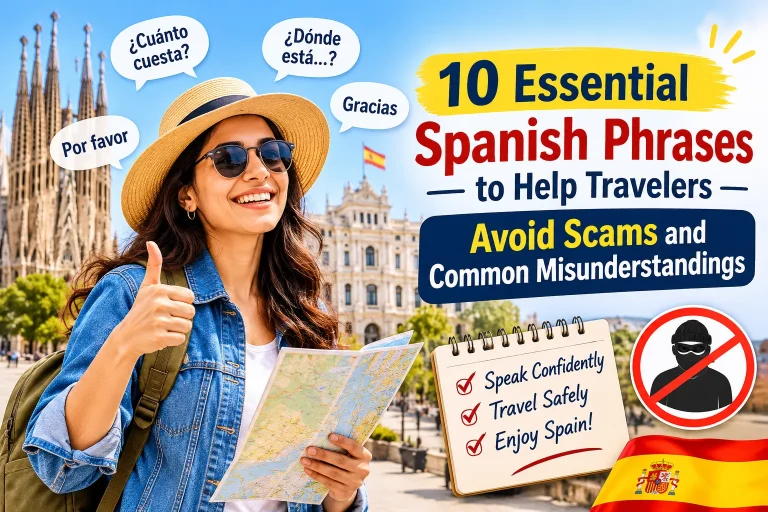
If you’re planning to learn Spanish in Mexico, these ten essential Spanish phrases are an excellent starting point. They’ll help you communicate more comfortably while enjoying everything the country has to offer.
Why Learning Basic Spanish Matters When Traveling in Mexico
Mexico welcomes travelers from around the world, and English is commonly spoken in many popular tourist destinations. However, you’ll encounter plenty of situations where communicating in Spanish makes everyday activities easier.
Consider visiting a neighborhood restaurant in Puebla or taking a taxi outside the main tourist areas. Knowing how to ask about prices, confirm destinations, and request clarification can prevent unnecessary confusion.
Basic Spanish also allows you to communicate more independently instead of relying entirely on translation apps.
While learning useful expressions cannot prevent every scam, it can help you ask better questions, recognize misunderstandings, and make more informed decisions.
Here are ten phrases worth practicing before your next trip.
1. ¿Cuánto cuesta? – How Much Does It Cost?
One of the most useful Spanish phrases for travelers is “¿Cuánto cuesta?”
You’ll hear and use this expression regularly while shopping, dining, or purchasing tickets.
Suppose you’re exploring a traditional market and find something you want to buy. Rather than guessing the price, ask:
“Disculpe, ¿cuánto cuesta esto?”
Translation: “Excuse me, how much does this cost?”
For several items, you can use “¿Cuánto cuestan?”
If the seller answers too quickly, ask them to repeat the amount or write it down.
It’s also helpful to familiarize yourself with Spanish numbers, especially amounts commonly used in Mexican pesos.
Knowing the price before agreeing to purchase something helps prevent misunderstandings about the final amount.
2. ¿El precio está en pesos? – Is the Price in Pesos?
Mexico’s currency is the Mexican peso, but prices in some international tourist destinations may also be advertised in US dollars.
That makes it important to confirm which currency someone is quoting.
You can ask:
“¿El precio está en pesos mexicanos?”
Translation: “Is the price in Mexican pesos?”
This question is particularly useful when booking excursions, paying for accommodations, or shopping in areas that attract international tourists.
For example, a tour advertised at “$100” could mean something very different depending on the currency.
Always confirm the amount and currency before making a payment.
If you’re using a credit card, check the currency displayed on the payment terminal before approving the transaction.
3. ¿Me puede dar un recibo? – Can You Give Me a Receipt?
Keeping receipts is a simple habit that can help you track expenses and resolve payment problems.
Whether you’re paying for transportation, a restaurant meal, or a guided tour, asking for proof of payment is perfectly reasonable.
Say:
“¿Me puede dar un recibo, por favor?”
Translation: “Can you give me a receipt, please?”
In Mexico, you may also hear “ticket” used for an ordinary purchase receipt. A “factura” generally refers to a formal tax invoice.
Having a receipt can help if you’re accidentally charged twice or need to verify the amount you paid.
For larger purchases, confirm the business name, payment amount, and service details.
If a vendor cannot provide a receipt, that doesn’t automatically indicate dishonesty, but it’s sensible to be cautious when paying substantial amounts.
4. ¿Está incluido en el precio? – Is It Included in the Price?
Unexpected additional charges can make an otherwise enjoyable experience frustrating.
Perhaps you’ve booked a tour but aren’t sure whether entrance tickets are included. Or you’ve ordered a meal without knowing whether an additional service charge applies.
Instead of making assumptions, ask:
“¿Está incluido en el precio?”
Translation: “Is it included in the price?”
You can also be more specific:
“¿El transporte está incluido?”
Translation: “Is transportation included?”
This phrase helps clarify what you’re paying for before committing.
When booking tours or activities, ask for the complete price and included services in writing whenever possible.
Clear communication helps avoid disagreements later.
5. No, gracias. No estoy interesado/a. – No, Thank You. I’m Not Interested.
Travelers sometimes encounter persistent street vendors, unsolicited offers, or people promoting services.
You don’t have to accept every invitation or explain why you’re declining.
A polite but firm response is:
“No, gracias. No estoy interesado.”
Translation: “No, thank you. I’m not interested.”
Women may use “interesada,” although everyone can simply say “No, gracias.”
If someone continues insisting, repeat your refusal calmly and move toward a busier, safer location.
Avoid sharing personal information, travel plans, or accommodation details with strangers who approach you unexpectedly.
Being respectful is important, but so is maintaining personal boundaries.
6. ¿Puede hablar más despacio, por favor? – Can You Speak More Slowly, Please?
One of the biggest challenges for beginners is understanding Spanish spoken at a natural pace.
You may know the vocabulary but struggle when someone speaks quickly or uses unfamiliar expressions.
Instead of pretending to understand, say:
“¿Puede hablar más despacio, por favor?”
Translation: “Can you speak more slowly, please?”
Most people appreciate knowing that you’re still learning and may adjust their speaking speed.
This phrase becomes especially useful when someone is explaining directions, discussing prices, or giving important instructions.
Listening to everyday conversations is also an effective way to improve comprehension.
Students participating in Spanish immersion classes in Mexico have opportunities to develop this skill through regular interactions with native speakers.
7. No entendí. ¿Me lo puede repetir? – I Didn’t Understand. Can You Repeat That?
Sometimes speaking more slowly isn’t enough. You may simply miss a word or misunderstand an entire sentence.
There’s no reason to feel embarrassed about asking for clarification.
Use:
“No entendí. ¿Me lo puede repetir?”
Translation: “I didn’t understand. Can you repeat that?”
This expression is especially valuable when someone explains transportation arrangements, payment conditions, or meeting locations.
For example, if a driver explains where they’ll drop you off and you’re uncertain, ask them to repeat the destination.
You can also say “¿Me lo puede escribir?” meaning “Can you write it down for me?”
Confirming important details is much better than making assumptions that could create problems later.
8. ¿Este taxi es autorizado? – Is This an Authorized Taxi?
Transportation is one area where travelers should be particularly careful.
Before entering a taxi, it’s useful to verify that you’re using an authorized transportation service.
You can ask:
“¿Este taxi es autorizado?”
Translation: “Is this an authorized taxi?”
However, remember that asking a driver doesn’t independently verify their authorization.
A safer approach is to use an official taxi stand, arrange transportation through your hotel, or use a reputable ride-hailing service where available.
You should also confirm the fare beforehand when appropriate.
Ask:
“¿Cuánto cuesta el viaje hasta el hotel?”
Translation: “How much does the ride to the hotel cost?”
Check the vehicle and driver details before entering. Understanding basic transportation vocabulary helps, but choosing a trustworthy service remains the most important precaution.
9. ¿Dónde está la oficina de turismo? – Where Is the Tourist Information Office?
When visiting an unfamiliar destination, reliable information can make a significant difference.
You might need help confirming transportation options, locating an attraction, or understanding whether a particular tour operator is legitimate.
Ask:
“¿Dónde está la oficina de turismo?”
Translation: “Where is the tourist information office?”
Official tourist information offices can often provide maps, local recommendations, and guidance about attractions.
This is particularly helpful when you’re uncertain about information provided by an unfamiliar salesperson.
You can also ask staff at your accommodation for recommendations.
Whenever possible, verify important travel arrangements through official websites or established businesses rather than relying solely on unsolicited offers.
10. Necesito ayuda. ¿Puede llamar a la policía? – I Need Help. Can You Call the Police?
Hopefully, you’ll never need this expression, but knowing how to request assistance is valuable.
In an emergency, say:
“Necesito ayuda. ¿Puede llamar a la policía?”
Translation: “I need help. Can you call the police?”
For medical assistance, you can say:
“Necesito un médico.”
Translation: “I need a doctor.”
Mexico’s emergency telephone number is 911.
If you feel threatened, prioritize getting to a safe location rather than confronting anyone or arguing about money.
Before traveling, save your accommodation’s contact information, emergency numbers, and your embassy or consulate’s details.
Learning these phrases is one small but practical part of preparing for unfamiliar situations.
How to Practice These Spanish Phrases Before Traveling
Memorizing ten expressions is a useful beginning, but practicing them in realistic situations makes them easier to remember.
Try creating short conversations around common travel experiences.
For example, practice asking about a restaurant bill, confirming a taxi fare, or requesting directions.
You can also listen to Mexican Spanish conversations to become familiar with pronunciation, rhythm, and everyday expressions.
Role-playing with an instructor or language partner is particularly helpful because you must respond without knowing exactly what the other person will say.
If you want to develop these skills further, language immersion in Mexico provides opportunities to practice Spanish in authentic settings.
At the Spanish Institute of Puebla, students learn through structured instruction and conversation-focused activities. Its Spanish language program in Mexico includes eight proficiency levels, with each standard level lasting three weeks.
The Institute emphasizes practical communication, helping learners apply classroom knowledge to everyday situations.
For travelers interested in studying Spanish abroad, this approach can build confidence in handling real conversations.
Final Thoughts
Traveling through Mexico is an opportunity to discover beautiful destinations, experience local traditions, and connect with people.
Knowing a few essential Spanish phrases can make those experiences more comfortable and help you respond confidently when something is unclear.
Start by practicing expressions for prices, payments, transportation, and emergencies. More importantly, don’t hesitate to ask questions when you don’t understand something.
If you want to move beyond memorized phrases and communicate naturally, consider learning Spanish through real-world interaction.
Explore the Spanish immersion programs at the Spanish Institute of Puebla and discover how studying Spanish in Mexico can help you communicate with greater confidence.
Frequently Asked Questions
What Spanish phrases should every traveler know?
Useful expressions include “¿Cuánto cuesta?” (How much does it cost?), “¿Puede hablar más despacio?” (Can you speak more slowly?), and “Necesito ayuda” (I need help). These help with shopping, communication, and unexpected situations.
Can speaking Spanish help travelers avoid scams in Mexico?
Knowing basic Spanish can help travelers confirm prices, question unexpected charges, and understand important details. However, language skills should be combined with common safety precautions and the use of reputable businesses.
Is Mexican Spanish difficult for beginners to understand?
Mexican Spanish can feel fast to beginners, particularly when speakers use regional vocabulary or informal expressions. Regular listening practice and real conversations can gradually improve comprehension.
Can I learn enough Spanish for traveling in a few weeks?
You can learn many useful travel phrases within a few weeks through focused practice. More advanced conversations generally require additional study, but beginners can develop practical communication skills relatively quickly.