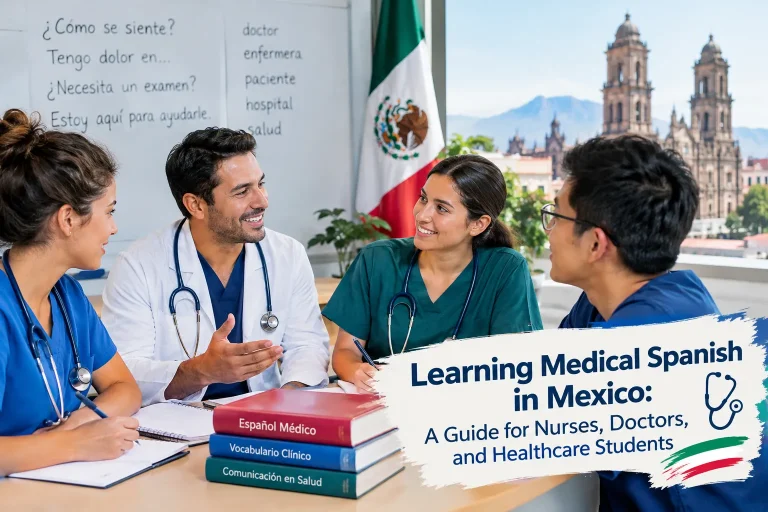
For nurses, doctors, medical students, and other healthcare professionals, learning Spanish is about much more than adding another language to a résumé. In a healthcare setting, being able to communicate clearly with Spanish-speaking patients can make everyday interactions easier, more comfortable, and more meaningful.
You may already know some Spanish from an app, online course, or university class. But healthcare conversations can be very different from practicing vocabulary on a screen. Patients describe symptoms in their own words. Families ask unexpected questions. Conversations happen quickly, and cultural context often matters just as much as vocabulary.
That is where Spanish immersion in Mexico can make a real difference.
Instead of learning Spanish only during scheduled online lessons, an immersion program places you in an environment where Spanish becomes part of your everyday life. You hear it, speak it, read it, and use it in authentic situations.
So, who should consider a Spanish immersion school instead of relying entirely on online Spanish classes?
For healthcare professionals and students who want to build practical communication skills and become more comfortable using Spanish in real-life situations, studying in Mexico can be an especially valuable experience.
Why Is Medical Spanish Important for Healthcare Professionals?
Healthcare depends on communication.
A doctor needs to understand what a patient is experiencing. A nurse may need to explain how to take medication or prepare for a procedure. A medical student may need to ask questions during a clinical interaction.
Even when a patient speaks some English, they may feel more comfortable explaining personal or sensitive health concerns in their first language.
Learning Spanish can help healthcare professionals communicate with greater confidence and reduce misunderstandings.
However, learning medical Spanish should not mean memorizing a long list of medical terms and stopping there.
Healthcare professionals also need a strong foundation in everyday Spanish. You need to be able to greet a patient, build rapport, ask follow-up questions, listen carefully, clarify information, and respond naturally.
That is one reason intensive Spanish immersion programs can be useful.
Who Should Choose a Spanish Immersion School Instead of Online Spanish Classes?
Online Spanish classes can be convenient. They allow you to study from home, choose flexible schedules, and review lessons whenever you have time.
But convenience is not always the same as fluency.
A Spanish immersion school may be a better choice if you learn best through interaction and want to use Spanish throughout the day.
Here are some of the learners who may benefit most.
-
Nurses Who Regularly Communicate with Spanish-Speaking Patients
Nurses often spend more time directly interacting with patients than many other healthcare professionals.
They may need to ask about pain, explain instructions, discuss symptoms, provide reassurance, or communicate with family members.
For nurses, knowing how to communicate naturally can be just as important as knowing individual medical terms.
A language immersion in Mexico experience gives nurses opportunities to practice everyday conversation alongside structured language instruction.
Over time, simple interactions can become more natural:
“How are you feeling today?”
“Where does it hurt?”
“Can you describe the pain?”
“Do you have any allergies?”
“Have you taken this medication before?”
The goal is not simply to translate these sentences. It is to become comfortable using Spanish spontaneously.
-
Doctors Who Want More Confidence Communicating with Patients
Doctors may already have a basic understanding of Spanish but still struggle when conversations become complicated.
A patient may speak quickly, use regional expressions, or describe symptoms in a way that does not match textbook vocabulary.
This is where immersion can help.
When you learn Spanish in Mexico, you are exposed to Spanish outside the controlled environment of a lesson. You hear different accents, expressions, speaking styles, and levels of formality.
That exposure can make it easier to follow real conversations.
For doctors, this can be particularly useful when developing listening skills and conversational confidence.
Of course, language learning does not replace professional interpretation when a qualified interpreter is required. But stronger Spanish skills can help healthcare professionals communicate more effectively within appropriate professional and legal boundaries.
-
Healthcare Students Preparing for Their Careers
Medical and nursing students have an advantage: they can begin developing their Spanish skills before entering full-time professional practice.
If you are studying medicine, nursing, public health, dentistry, or another healthcare field, a Spanish language program in Mexico can provide an opportunity to build communication skills while you still have time to practice.
You do not need to wait until you are an advanced Spanish speaker.
In fact, beginners can benefit from immersion because they learn to use the language from the beginning rather than becoming overly dependent on translation.
A structured program can also help students develop grammar, reading, writing, listening, and speaking skills progressively.
-
Healthcare Professionals Who Understand Spanish but Struggle to Speak It
This is a common situation.
You may be able to understand basic Spanish when someone speaks slowly. You may recognize words while reading. You might even understand medical vocabulary.
But when someone asks you a question in Spanish, the words disappear.
This is often a confidence problem rather than simply a vocabulary problem.
Online classes can provide practice, but immersion creates many more opportunities to actually use the language.
When you learn Spanish abroad in Mexico , speaking does not end when your class finishes. You can continue practicing at a café, restaurant, market, cultural activity, or while interacting with people in your community.
The more often you use Spanish, the less intimidating speaking can become.
Why Choose Immersion Instead of Learning Only Online?
Online learning has its place. It can be an excellent starting point, particularly for vocabulary, grammar, pronunciation, and basic preparation.
But immersion offers something that a screen cannot completely reproduce: constant exposure to the language in context.
Imagine learning how to ask for information in an online lesson and then using the same skill later that day.
You learn a new phrase in class.
You hear a similar phrase from a native speaker.
You try using it yourself.
You make a mistake.
Someone responds.
You adjust.
That process creates a connection between classroom knowledge and real communication.
This is the foundation of an immersion Spanish program.

What Makes Mexico a Good Place to Study Spanish?
Mexico offers a particularly useful environment for people who want to combine formal Spanish education with cultural immersion.
When you learn Spanish in Mexico, Spanish is not restricted to a classroom.
You encounter the language in restaurants, shops, transportation, neighborhoods, cultural activities, and everyday conversations.
This creates repeated opportunities to practice.
For healthcare professionals, that exposure is valuable because communication does not always follow a textbook script.
People speak naturally, use expressions, change their wording, and communicate through context.
Immersion helps you become more comfortable with that reality.
What Should Healthcare Professionals Look for in a Spanish School?
Not every language program will provide the same experience.
If your goal is to use Spanish professionally, look for a Spanish language school in Mexico that offers a structured curriculum rather than relying only on informal conversation.
Consider programs that provide:
- Multiple proficiency levels
- Experienced instructors
- Small-group interaction
- Strong speaking and listening practice
- Grammar and writing instruction
- Cultural activities
- Opportunities to use Spanish outside the classroom
- A clear progression from beginner to advanced levels
A strong program should develop more than conversational phrases. You need a balanced foundation that allows you to understand how the language works and use it naturally.
Do You Need Advanced Spanish Before Joining an Immersion Program?
No.
One of the biggest misconceptions about immersion is that you must already speak Spanish before you begin.
You do not.
Many Spanish immersion programs for adults in Mexico welcome learners at different levels, including complete beginners.
What matters most is your willingness to participate.
You will make mistakes. You may forget vocabulary. Sometimes you will understand only part of a conversation.
That is normal.
Immersion works because you gradually move from recognizing words to understanding sentences, from forming sentences slowly to speaking more naturally, and from translating everything mentally to thinking more directly in Spanish.
How Can Medical Professionals Prepare Before Arriving in Mexico?
You do not need to become fluent before your program begins, but some preparation can make your experience easier.
Start with everyday Spanish rather than focusing exclusively on medical terminology.
Review vocabulary related to:
- Body parts
- Common symptoms
- Family
- Food and nutrition
- Time and dates
- Directions
- Personal information
- Daily routines
- Basic questions
It is also helpful to practice listening to Mexican Spanish before arriving.
Most importantly, prepare yourself to speak.
Don’t wait until you feel perfect.
Your goal is to gradually become comfortable communicating.
Can Immersion Help You Learn Spanish Faster?
Immersion can accelerate learning because it increases the amount of meaningful exposure and practice you receive.
However, there is no guaranteed timeline for becoming fluent.
Your progress depends on factors such as your starting level, study habits, time spent using Spanish, previous language-learning experience, and willingness to communicate.
The advantage is that immersion gives you more opportunities to put new language skills into practice.
For someone searching for ways to learn Spanish fast , that consistent exposure can be more effective than studying occasionally and then returning to an entirely English-speaking environment.

Why Puebla Can Be a Meaningful Setting for Spanish Learning
For students looking for the best place to study Spanish in Mexico, the learning environment matters.
Puebla offers a combination of Spanish-language education, Mexican culture, historical surroundings, and opportunities for everyday interaction.
Studying in a city rather than learning entirely from home gives students a chance to connect language with real experiences.
A conversation about food becomes a vocabulary lesson.
A visit to a local market becomes listening practice.
A cultural activity becomes an opportunity to understand expressions and traditions.
This is what makes Spanish schools in Mexico different from simply taking another online course.
Final Thoughts: Learn Spanish Where You Can Actually Use It
For nurses, doctors, healthcare students, and other professionals, Spanish can become a practical part of your career—not simply another qualification.
Online Spanish classes can help you build a foundation, but immersion gives you something different: the opportunity to live with the language.
When you study through a Spanish language program in Mexico, you can take what you learn in class and immediately apply it in everyday situations. You hear authentic Spanish, interact with people, experience Mexican culture, and gradually become more comfortable expressing yourself.
The most effective best Spanish immersion programs are not simply about sitting in a classroom for several hours. They create an environment where Spanish becomes part of your day.
For healthcare professionals, that experience can be especially valuable. The ability to communicate naturally starts with learning the language—and grows through using it.
If your goal is to learn Spanish in Mexico, improve your conversational confidence, and develop a foundation that you can eventually apply in professional settings, an intensive immersion experience can be a meaningful step toward becoming a more capable Spanish speaker.
Frequently Asked Questions
Is medical Spanish difficult to learn?
Medical Spanish can seem challenging because it combines general language skills with healthcare terminology. However, building a strong foundation in everyday Spanish first can make professional vocabulary easier to understand and use.
Should doctors take online Spanish classes or attend an immersion program?
Both can be useful. Online classes are convenient for structured study, while immersion provides more opportunities for real-world speaking and listening. Doctors who want to develop practical communication skills may benefit particularly from combining both approaches.
Can beginners join Spanish immersion programs?
Yes. Many programs offer different proficiency levels, so you do not need to be fluent before arriving in Mexico.
Is Mexico a good place to learn Spanish for healthcare professionals?
Yes. Mexico provides opportunities to combine structured language education with everyday exposure to Spanish and Mexican culture. This can help healthcare professionals develop broader communication skills.
How long does it take to learn Spanish through immersion?
There is no simple answer. Progress depends on your starting level, the intensity of your program, how much Spanish you use each day, and your learning goals. Consistent practice generally gives you more opportunities to improve.