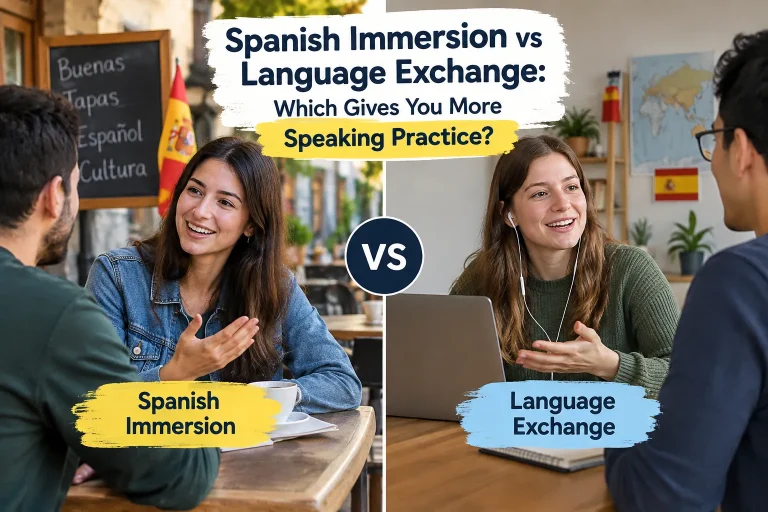
If your main goal is to speak Spanish more confidently, choosing the right way to learn matters. You can study grammar online, attend a language exchange, take private lessons, or spend several weeks in a Spanish-speaking country. Each approach has its advantages, but they do not give you the same kind or amount of speaking practice.
Two options that often get compared are Spanish immersion vs language exchange.
A language exchange can be a fun and affordable way to practice conversation with another person. Spanish immersion, on the other hand, places Spanish into much more of your daily routine, combining structured instruction with opportunities to communicate in real-life situations.
So, which gives you more speaking practice?
For learners who want consistent, structured, and intensive speaking practice, a Spanish immersion program generally offers more opportunities to use Spanish throughout the day. A language exchange can be an excellent supplement, but it usually depends on how often you meet, how long you practice, and how much Spanish both participants actually use.
Let’s look at the difference and what each option can offer.
What Is a Spanish Immersion Program?
A Spanish immersion program combines language instruction with an environment where you regularly hear, use, and interact in Spanish.
Instead of learning Spanish only during a scheduled lesson, you have opportunities to use the language in different situations throughout your day.
For example, during an immersion Spanish program in Mexico, you might:
- Practice conversation with your instructor
- Speak Spanish with classmates
- Order food at a restaurant
- Ask questions while shopping
- Participate in cultural activities
- Talk to local residents
- Listen to Spanish in everyday situations
- Use vocabulary learned in class outside the classroom
The important difference is consistency.
You are not simply studying Spanish as a subject. You are using it as a tool for communication.
At a school such as the Spanish Institute of Puebla, students participate in structured instruction while also having opportunities to connect their classroom learning with authentic situations. The goal is not only to know how Spanish works but to become comfortable actually using it.
What is a language exchange?
A language exchange is usually a conversation between two people who speak different native languages and want to help each other learn.
For example, you might spend 30 minutes speaking Spanish with a Mexican Spanish speaker and then switch to English so your partner can practice.
Language exchanges can happen:
- In person
- Through language-learning apps
- Online video calls
- At community meetups
- Through informal social groups
- With a language partner or friend
They can be particularly useful for learners who already have some basic Spanish and want to practice casual conversation.
However, the amount of Spanish you actually speak can vary considerably.
One week you might have a productive one-hour conversation. Next week, your partner may be unavailable. You might also spend more time speaking your native language than Spanish.
That is one of the biggest differences between language exchange and immersion.
Spanish Immersion vs Language Exchange: The Key Difference
The simplest way to think about the difference is this:
A language exchange gives you a conversation opportunity. Spanish immersion creates an environment for continuous language use.
A language exchange normally revolves around a specific meeting or conversation.
Immersion can influence your entire day.
Imagine that you are learning how to order food in Spanish.
During a language exchange, you might practice saying:
“I’d like some soup, please.”
You may repeat the several sentences times and discuss how to pronounce it.
In an immersion environment, you can then use that language when you actually visit a restaurant.
The classroom teaches you the language. The real-world situation gives you a reason to use it.
That connection can make speaking practice more memorable.
Which Gives You More Speaking Practice?
For most learners, Spanish immersion provides more total speaking opportunities, particularly when the program has a strong communicative focus.
There are several reasons.
1. Speaking Is Part of Your Structured Learning
A good immersion program does not leave speaking practice entirely to chance.
Your classes provide planned opportunities to communicate, ask questions, respond to your instructor, participate in activities, and interact with other students.
This is especially valuable for beginners who may not know how to start or maintain a conversation independently.
Instead of wondering, “What should I practice today?”, you have instructors guiding your development.
2. You Can Practice Spanish Beyond the Classroom
One of the strongest advantages of Spanish immersion classes in Mexico is the opportunity to immediately apply what you learn.
Suppose you learn vocabulary related to transportation in the morning.
Later, you can use that vocabulary while asking for directions or discussing how to get somewhere.
You learn a phrase in class, use it in a real situation, make a mistake, receive feedback, and try again.
That cycle is powerful.
It turns passive knowledge into active communication.
3. You Hear Different Spanish Speakers
A language exchange generally gives you one primary conversation partner.
That can be useful, but immersion can expose you to a wider range of voices and speaking styles.
You may hear instructors, classmates, service workers, neighbors, guides, and other local speakers.
This helps you become more comfortable when Spanish sounds different from the carefully paced Spanish you may hear in a textbook or beginner lesson.
4. Immersion Encourages You to Think in Spanish
One of the challenges of speaking another language is mentally translating everything before you say it.
You may think:
“I want to say this… What’s the Spanish word? Is the verb correct? What tense should I use?”
By the time you have constructed the sentence, the conversation has moved on.
Regular immersion can gradually reduce this hesitation.
As you repeatedly encounter common words, expressions, and sentence structures, they become easier to retrieve naturally.
This is one reason many people choose to learn Spanish abroad in Mexico rather than relying exclusively on study at home.

5. You Practice Communication, Not Just Conversation
Speaking Spanish is more than producing grammatically correct sentences.
Real communication involves:
- Asking for clarification
- Explaining something differently
- Understanding context
- Responding spontaneously
- Expressing opinions
- Describing experiences
- Handling misunderstandings
- Using gestures and tone
- Keeping a conversation going
Immersion gives you more chances to develop these skills because communication happens in different circumstances.
Does That Mean Language Exchange Is Not Useful?
Not at all.
A language exchange can be an excellent way to complement a Spanish course or immersion experience.
It can give you relaxed, informal conversation practice without the pressure of a classroom.
For intermediate and advanced learners especially, language exchanges can help develop conversational flexibility and expose you to everyday expressions.
They can also help you build friendships and learn about another person’s culture.
The limitation is consistency.
If you meet your language partner once a week for an hour, you have one hour of intentional speaking practice. That can be valuable, but it is very different from spending several hours a day learning and using Spanish.
The best results can come from combining approaches.
Why Mexico Is a Strong Choice for Spanish Immersion
Mexico offers an interesting environment for people who want to learn Spanish in Mexico while experiencing the culture in which the language is spoken.
Instead of separating language study from daily life, students can connect the two.
For someone considering Spanish schools in Mexico, the experience can include formal lessons, conversations, cultural activities, local experiences, and everyday interactions.
Puebla can be particularly appealing to students who want a rich cultural environment while studying Spanish.
The important thing, however, is not simply being physically present in Mexico.
You need a program that encourages you to actually use Spanish.
That means looking for an established Spanish language program in Mexico that combines structured learning with meaningful communication opportunities.
Who Should Choose Spanish Immersion Over Language Exchange?
Spanish immersion may be the best choice if you:
Want intensive speaking practice
If your priority is to become more comfortable speaking Spanish quickly, an intensive program gives you a concentrated period of practice.
Struggle to stay motivated while studying alone
Learning a language independently requires discipline. Immersion creates a routine that keeps Spanish at the center of your day.
Are nervous about making mistakes
A supportive classroom environment can give you a safe place to practice before applying your Spanish in everyday situations.
Want structured progression
A language exchange usually does not follow a formal resume. A professional immersion program can organize instruction around your level and learning goals.
Want to combine language and culture
If you want to study Spanish abroad , immersion allows you to experience the language alongside Mexican culture rather than studying it in isolation.
Who Should Choose a Language Exchange?
Language exchange may be ideal if you:
- Already have a foundation in Spanish
- Want casual conversation practice
- Have limited time for formal study
- Enjoy meeting new people
- Want to maintain Spanish after completing a course
- Prefer flexible learning
- Want an inexpensive way to practice regularly
For many learners, language exchange works best as an additional speaking tool rather than a complete replacement for structured language education.
How to Get the Most Speaking Practice from Spanish Immersion
Simply attending an immersion program does not automatically make you fluent. Your participation matters.
Try these strategies:
Speak even when you are unsure. Waiting until your Spanish is perfect will slow you down.
Use new vocabulary outside class. If you learn five new words, try to use them during the day.
Ask people to repeat themselves. Saying “Can you repeat please?” is a useful communication skill.
Keep conversations going. Instead of answering with one word, add a question or another detail.
Avoid switching to English immediately. If you do not know a word, try describing it in Spanish.
Pay attention to everyday expressions. Notice how native speakers naturally phrase things.
Treat mistakes as practice. Every conversation is an opportunity to improve.
This approach helps transform an immersion experience into genuine speaking development.
What Is the Best Option for Speaking Spanish?
If you are comparing Spanish immersion vs. language exchange, there is no need to think of them as competing methods.
They serve different purposes.
A language exchange is excellent for flexible, informal conversation practice. It can help you maintain your skills and meet Spanish speakers.
A well-designed Spanish immersion program offers something broader: structured instruction, frequent speaking opportunities, real-world communication, cultural exposure, and an environment where Spanish becomes part of everyday life.
For whose learners primary goal is to increase speaking practice and build confidence, immersion has a clear advantage because it gives you more opportunities to use Spanish in different contexts.
That is particularly valuable if you want to learn Spanish fast , improve your conversational ability, and become comfortable communicating beyond the classroom.

Final Thoughts: More Speaking Comes From More Opportunities to Speak
If your biggest goal is to improve your Spanish speaking skills, think beyond the question of which method is “better.”
Ask yourself: How often will I actually use Spanish?
A language exchange can give you valuable conversation practice, but it is usually limited to scheduled interactions. A Spanish immersion experience can surround you with opportunities to listen, respond, ask questions, make mistakes, and communicate throughout the day.
That is what makes immersion particularly powerful.
When you learn Spanish in Mexico, you are not simply memorizing vocabulary or completing grammar exercises. With the right program, you can connect what you learn in class with what you experience outside it.
For students, professionals, retirees, and anyone who wants to develop practical communication skills, a structured Spanish immersion program in Mexico can turn Spanish from something you study into something you actually use.
And ultimately, that is how speaking becomes more natural: you practice speaking by having more real reasons to speak.
Frequently Asked Questions About Spanish Immersion and Language Exchange
Is Spanish immersion better than language exchange?
Spanish immersion can provide more consistent and varied speaking practice because learners use Spanish in structured lessons as well as everyday situations. Language exchange is useful for additional informal conversation practice.
How much speaking practice do you get in a Spanish immersion program?
The amount depends on the specific program, schedule, and how actively you participate. In an intensive immersion environment, speaking practice can take place during classes, activities, and everyday interactions rather than being limited to one conversation session.
Can a language exchange make me fluent in Spanish?
A language exchange can significantly improve conversational confidence, but fluency usually requires more than informal conversation alone. Combining conversation with structured instruction, listening, reading, writing, and consistent practice can provide a more complete learning experience.
Is Mexico a good place to study Spanish?
Yes. Mexico provides learners with opportunities to combine formal Spanish instruction with exposure to Spanish in everyday life. Students can practice communication while experiencing Mexican culture and interacting with Spanish speakers.
Should beginners choose Spanish immersion?
Yes. Beginners can benefit from immersion when the program provides instruction appropriate to their level and creates a supportive environment for communication. You do not need to be fluent before starting an immersion program.
Can I do a language exchange after Spanish immersion?
Absolutely. In fact, it can be an excellent combination. After completing an intensive Spanish immersion program, a regular language exchange can help you maintain your speaking skills and continue communicating in Spanish.