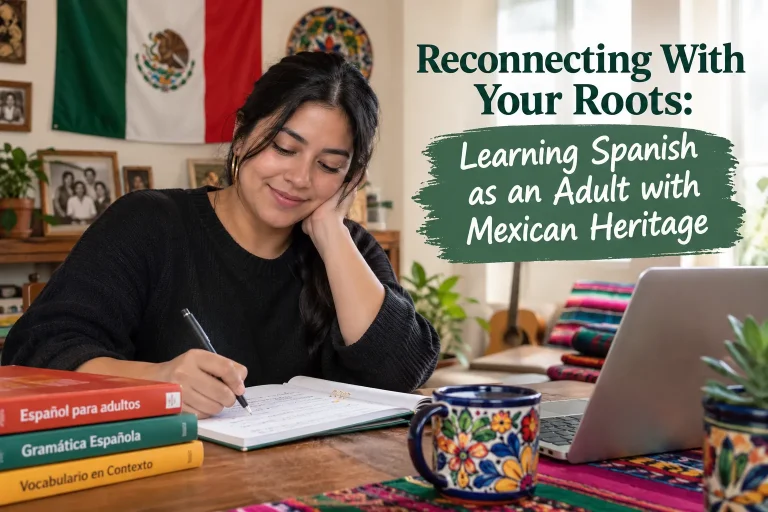
For some people, learning Spanish is about picking up a new skill. For Learning Spanish as an adult with Mexican heritage, it can feel like something much more personal.
Maybe you grew up hearing Spanish at home but never became comfortable speaking it. Perhaps your parents or grandparents spoke Spanish, but you answered in English. Or maybe you have always wanted to understand family conversations, connect more deeply with relatives, or simply feel closer to a part of your cultural identity.
Whatever your story, it is never too late to learn Spanish.
In fact, learning Spanish as an adult with Mexican heritage can be a rewarding way to reconnect with your family, culture, and personal history. And while apps and online courses can provide a useful starting point, spending time in Mexico and using Spanish in everyday situations can take that connection much further.
So, what is the best way for adults with Mexican heritage to reconnect with their roots through Spanish?
A combination of structured learning, cultural immersion, real-world practice, and patience can make the experience both meaningful and effective.
Why Learn Spanish as an Adult with Mexican Heritage?
When Spanish is connected to your family history, learning the language can have a different meaning than studying a completely unfamiliar language.
You may already recognize certain words, expressions, foods, songs, or family traditions. You may even understand more Spanish than you realize.
This is sometimes called heritage language learning. Heritage learners often have some previous exposure to a language through family or community, even if they did not grow up speaking it fluently.
For example, you might understand when your grandmother is speaking Spanish but struggle to respond. You may know common expressions but feel uncomfortable having a full conversation.
That is not a failure.
It simply means your listening and speaking abilities developed differently.
A structured Spanish language program in Mexico can help turn that passive familiarity into active communication.
Learning Spanish Can Help You Connect with Family
One of the most meaningful reasons to learn Spanish is communication with family.
Imagine being able to have a conversation with a Spanish-speaking grandparent without constantly asking someone else to translate. Or being able to speak more naturally with relatives when visiting Mexico.
Even simple conversations can feel meaningful.
You might talk about family traditions, childhood memories, recipes, local communities, or stories that have been passed down through generations.
Language creates opportunities for conversations that translation cannot always capture.
Humor, expressions, tone, and cultural references can carry meanings that are difficult to translate word for word.
For adults reconnecting with their Mexican heritage, learning Spanish can therefore become more than an academic goal. It can become a way to participate more fully in family life.
You Don’t Have to Start from Zero
One common concern among heritage learners is:
“I understand some Spanish, but I don’t speak it. Am I a beginner?”
Not necessarily.
Your previous exposure to Spanish may give you advantages in pronunciation, vocabulary, listening comprehension, or familiarity with sentence patterns.
At the same time, you may have gaps in grammar, writing, or formal vocabulary.
This is why a structured placement process can be helpful.
A good Spanish immersion program should recognize that students arrive with different backgrounds and abilities. Some may be complete beginners, while others may already understand conversations but need confidence speaking.
At a professional language school, instruction can be adapted to your level rather than assuming everyone starts from the same place.

Why Mexico Can Be an Especially Meaningful Place to Learn Spanish
For someone with Mexican heritage, studying Spanish in Mexico can add another dimension to the learning experience.
Instead of learning about Mexican Spanish from a distance, you experience the language in its natural cultural environment.
You hear Spanish at restaurants, markets, shops, museums, neighborhoods, and social gatherings. You encounter everyday expressions and different ways of communicating.
This is one of the main advantages of language immersion in Mexico .
The language is no longer limited to a textbook or computer screen.
It becomes part of your daily routine.
If you are looking to learn Spanish in Mexico, you can combine classroom instruction with opportunities to use what you learn immediately.
That connection between formal education and everyday communication can make new vocabulary much easier to remember.
Immersion Helps Turn Understanding Into Speaking
Many heritage learners experience a frustrating gap between understanding Spanish and actually speaking it.
You might follow a family conversation but hesitate when it is your turn to respond.
You know what you want to say, but the words don’t come quickly enough.
This is where Spanish immersion classes in Mexico can make a difference.
An immersion environment encourages you to use Spanish repeatedly throughout the day.
You may learn a new grammatical structure in class and then hear it during a conversation later. You may learn vocabulary related to food and immediately use it at a restaurant. You can practice asking for directions and then use the phrase while exploring the city.
This repetition helps language become more automatic.
The goal is not simply to know Spanish rules.
The goal is to use Spanish.
Reconnecting With Mexican Culture Through Language
Language and culture are deeply connected.
As you improve your Spanish, you may begin to understand cultural references, humor, sayings, and traditions that previously felt distant.
Studying in Mexico also gives you the opportunity to explore culture beyond what you may have learned through your family.
Depending on your experience, this could include:
- Traditional food and regional cuisine
- Mexican history and heritage
- Local celebrations and traditions
- Music and popular culture
- Mexican art and architecture
- Everyday customs and social interactions
- Regional differences in vocabulary and expressions
This is one reason choosing Spanish schools in Mexico can be particularly valuable for heritage learners.
You are not simply studying a language associated with your family history. You are experiencing the wider cultural environment in which that language is spoken.
Don’t Be Afraid of Making Mistakes
For adults who grew up around Spanish, there can sometimes be an unexpected emotional challenge: feeling that you should already know the language .
You may think:
“My parents speak Spanish. Why can’t I?”
Or:
“I grew up hearing it. I should be able to speak it.”
Try to let go of that pressure.
Language ability is not a measure of how connected you are to your heritage.
You may have had fewer opportunities to speak Spanish growing up. You may have attended school in another language. Your family may have encouraged you to speak English. There are countless reasons why heritage speakers develop different levels of Spanish.
Learning as an adult gives you the opportunity to build those skills on your own terms.
Mistakes are part of that process.
A supportive immersion Spanish program should give you space to experiment, ask questions, make mistakes, and try again.
Why Adult Learners Can Benefit from Intensive Immersion
Adults often bring something valuable to language learning: clear motivation.
You may know exactly why you want to learn Spanish.
Perhaps you want to communicate with family. Maybe you want to travel to Mexico more confidently. Perhaps you want to understand your grandparents better or pass the language on to your children.
That motivation can make intensive learning especially meaningful.
Intensive Spanish immersion programs provide concentrated exposure to Spanish rather than limiting learning to a few minutes a day.
At the Spanish Institute, students participate in an intensive immersion experience designed around communication and practical language use. The program follows the European Framework of Reference for Languages and ACTFL guidelines and includes eight levels, with each level lasting three weeks.
Students can choose to attend one level or continue through multiple levels depending on their goals and schedule.
This structured approach allows learners to develop progressively while continuing to use Spanish in authentic situations.
Choosing the Right Spanish School in Mexico
Not every learner needs the same type of program.
When looking for the best Spanish language schools in Mexico , consider more than location or course length.
Ask questions such as:
- Does the school offer different proficiency levels?
- Are classes focused on communication?
- Are instructors experienced in teaching adults?
- Is there an opportunity to practice Spanish outside the classroom?
- Does the program include cultural activities?
- Can you study for a few weeks or continue for longer?
- Does the school provide a structured curriculum?
For heritage learners, the right environment should be encouraging rather than judgmental.
You should feel comfortable asking questions and making mistakes.
The goal is to help you become a more confident Spanish speaker—not to make you feel embarrassed about what you don’t yet know.

Puebla: A Place to Experience Spanish Beyond the Classroom
Choosing the right destination is also part of the experience.
For learners who want to study Spanish abroad, Puebla offers an opportunity to experience Mexican culture while developing practical Spanish skills.
Rather than spending your entire day inside a classroom, you can encounter Spanish throughout your surroundings.
A conversation at a café, a visit to a local market, or an interaction with someone in the community can become an unexpected language lesson.
These moments may seem small, but they add up.
They teach you how Spanish is actually used in everyday life—and help you become more comfortable communicating spontaneously.
How to Make the Most of Your Spanish Immersion Experience
If you are planning to learn Spanish abroad in Mexico, arrive with realistic expectations.
You do not need to become fluent overnight.
Instead, focus on progress.
Start conversations even when you are nervous. Keep a notebook of words you hear during the day. Ask people to repeat themselves when necessary. Pay attention to expressions that your teachers introduce in class and listen to them outside the classroom.
Most importantly, use Spanish as much as possible.
If you already understand Spanish because of your family background, challenge yourself to respond in Spanish instead of switching automatically to English.
That small change can have a surprisingly large impact.
Is It Too Late to Learn Spanish as an Adult?
No.
Adults can absolutely develop strong Spanish communication skills.
You may have responsibilities that make learning more challenging than it was when you were younger, but adults also bring life experience, motivation, and a better understanding of why they are learning.
For heritage learners, the emotional connection can be an additional source of motivation.
You are not simply memorizing vocabulary.
You are building a bridge between where you are now and a part of your family’s story.
Final Thoughts: Learning Spanish as an Adult with Mexican Heritage
Learning Spanish as an adult with Mexican heritage is not about trying to make up for lost time.
It is about creating new opportunities.
You can learn to have conversations with relatives, understand family stories more deeply, explore Mexican culture with greater confidence, and communicate with people in Spanish without depending on someone else to translate.
And you do not have to wait until your Spanish is perfect to begin.
Whether you choose a short Spanish language program in Mexico or commit to a longer immersion experience, every conversation brings you one step closer to using Spanish naturally.
For adults who want to reconnect with their Mexican roots, studying Spanish in Mexico can make the journey especially meaningful. You are not simply learning about the language—you are living it, hearing it, practicing it, and discovering how it connects with culture and everyday life.
Sometimes, reconnecting with where you come from begins with learning how to say it in your own words.
Ready to learn Spanish in Mexico? Explore an immersive Spanish learning experience where language, culture, and real-world communication come together.
Frequently Asked Questions
Can I learn Spanish if I only understand it but don’t speak it?
Yes. Many heritage learners understand Spanish better than they speak it. A structured language program can help you strengthen grammar, vocabulary, pronunciation, and conversational confidence.
Is Mexico a good place to learn Spanish as an adult?
Yes. Mexico offers opportunities to combine structured Spanish instruction with everyday exposure to Spanish and Mexican culture. This makes it an appealing destination for adults who want an immersive experience.
What is the best place to study Spanish in Mexico?
The best place depends on your goals, learning preferences, desired environment, and program. When choosing among Spanish schools in Mexico, look for experienced teachers, structured levels, communication-focused instruction, and opportunities to practice Spanish outside class.
Do heritage Spanish speakers need Spanish classes?
Not necessarily, but structured classes can be extremely useful. Heritage learners often have strengths in listening and vocabulary but may need support with grammar, writing, pronunciation, or speaking confidence.
Can I learn Spanish fast through immersion?
Immersion can accelerate your exposure and give you significantly more opportunities to practice, but becoming proficient still takes consistent effort. The more actively you participate in Spanish conversations, the more you can gain from the experience.