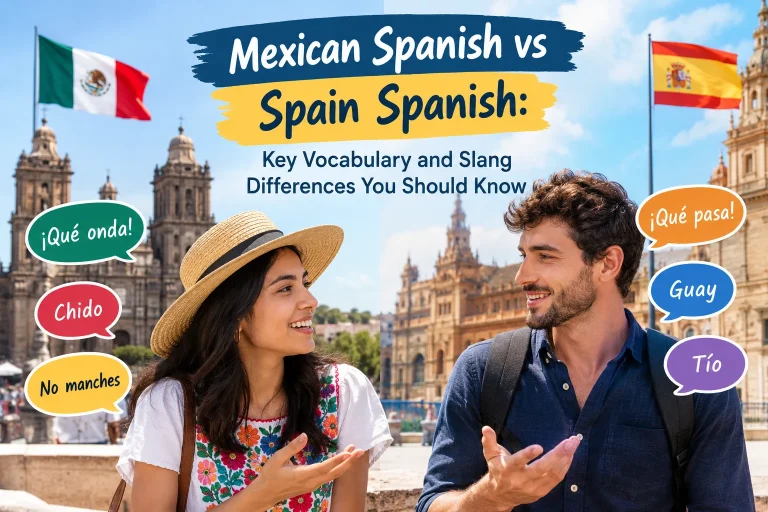
Spanish may be spoken in more than 20 countries, but that does not mean it sounds exactly the same everywhere.
If you have learned Spanish in Spain, studied with an online course, or watched Spanish-language content from different countries, you may already have noticed that people sometimes use completely different words for the same thing. A word that sounds perfectly normal in Madrid might sound unusual in Mexico. Likewise, an everyday expression in Mexico may leave a Spanish speaker from Spain wondering what you mean.
These differences are one of the most interesting parts of learning Spanish.
If you are planning to learn Spanish in Mexico, understanding the difference between Mexican Spanish and Spain Spanish can make everyday conversations much easier. It can also help you recognize regional vocabulary, slang, pronunciation, and cultural expressions without assuming that one version is “correct” and the other is not.
So, what are the biggest differences between Mexican Spanish and Spain Spanish?
The main differences appear in everyday vocabulary, slang, informal expressions, pronunciation, and some grammatical preferences. Let’s look at the words and expressions you are most likely to encounter.
Mexican Spanish vs Spain Spanish: What’s the Difference?
Mexican Spanish and Spain Spanish are both varieties of the Spanish language. Speakers from both regions can understand one another, but regional differences have developed over centuries.
Think of it like English. Someone from the United States, the United Kingdom, and Australia can communicate easily, but they may use different words for everyday objects and activities.
Spanish works in much the same way.
For students participating in Spanish immersion classes in Mexico, these differences become particularly noticeable because you are not only studying vocabulary—you are hearing it in real conversations.
Here are some of the most useful differences to know.
-
Car: “Coche” vs. “Carro”
One of the easiest differences to notice is the word for car.
In Spain, car is commonly used.
In Mexico, carro is widely used, although auto is also common.
For example:
- Spain: Where is my car?
- Mexico: Where is my car?
Both mean, “Where is my car?”
If you are taking language courses in Mexico, learning regional alternatives like this will help you understand conversations more naturally.
-
Computer: “Computer” vs. “Computer”
Technology vocabulary is another area where Mexican and Spain Spanish differ.
In Spain, you will commonly hear:
computer
In Mexico, you will generally hear:
computer
For example:
- Spain: I need to use the computer.
- Mexico: I need to use the computer.
Both mean, “I need to use the computer.”
This is a good reminder that learning Spanish is not simply about memorizing one word for every object. As your Spanish develops, you will encounter different regional vocabulary.
-
Cell Phone: “Mobile” vs. “Cellular”
If you are traveling between Spain and Mexico, this is another word worth remembering.
In Spain:
mobile
In Mexico:
cellular
So, if someone in Mexico asks:
Can I have your cell phone number?
They are asking for your cell phone number.
In Spain, you are more likely to hear:
Can I have your mobile number?
The meaning is the same.
-
Bus: “Bus” vs. “Truck”
This difference can be especially important when you are traveling in Mexico.
In Spain, bus is commonly used for bus.
In Mexico, you may hear truck in everyday conversation, particularly when referring to local buses.
This can initially be confusing because truck may also refer to a truck depending on the context.
For students who learn Spanish abroad in Mexico, transportation vocabulary is something you will quickly encounter outside the classroom.
-
Juice: “Zumo” vs. “Jugo”
Ordering something to drink can introduce another vocabulary difference.
In Spain:
juice
In Mexico:
juice
For example:
- Spain: I want an orange juice.
- Mexico: I want an orange juice.
Both mean orange juice.
This is a simple difference, but knowing it before you arrive can make ordering food and drinks much more comfortable.
-
Potato: “Patata” vs. “Papa”
Food vocabulary is particularly interesting because Mexico has an enormous variety of regional ingredients and culinary traditions.
In Spain, potato is generally:
potato
In Mexico:
dad
So, while visiting Mexico, you might hear:
I want some potatoes.
If you have primarily studied Spain Spanish, you may initially expect patatas .
Neither word is wrong. They simply belong to different regional varieties.
-
“Vosotros” vs. “Ustedes”
One of the most noticeable grammatical differences involves the plural form of “you.”
In Spain, speakers commonly use:
you (plural)
for informal plural “you.”
In Mexico, tús is generally used for plural “you,” including situations where Spain Spanish might use tús.
For example, in Spain:
Do you guys go to the movies?
In Mexico:
Do you go to the movies?
If you have learned Spanish through materials from Spain, this difference may take some adjustment when you begin a Spanish language program in Mexico.
The good news is that you will hear you frequently in everyday Mexican Spanish, so immersion gives you plenty of opportunities to become familiar with it.
-
“Tú” vs. “Usted”: Context Matters
Both Mexico and Spain use tú and tú , but the situations in which speakers choose them can vary.
In Mexico, you can be used more frequently in polite or respectful interactions, including situations involving age, professional relationships, or social distance.
For example, you may hear:
How are you?
In informal situations:
How are you?
Understanding when to use tú and tú is about more than grammar. It is also about culture and social context.
This is one reason language immersion in Mexico can be so valuable. You get to observe how native speakers actually communicate with one another.
-
Mexican Slang: “How cool!”
One of the expressions students often encounter in Mexico is:
How cool!
Depending on context, it can mean something like:
“That’s great!”
“How cool!”
For example:
What a great house you have!
That’s a really cool house!
This expression is strongly associated with Mexican Spanish and is useful to recognize when you hear casual conversations.
You probably will not find it used in exactly the same way in Spain.
-
“Chido” – Another Mexican Expression for “Cool”
Another common Mexican slang word is:
cool
It can describe something cool, nice, or enjoyable.
For example:
It’s really cool.
“That’s really cool.”
You may hear this type of informal vocabulary while talking with friends, younger speakers, or people in casual situations.
If you learn Spanish in Mexico, slang like this can make your Spanish sound more connected to the local environment—but remember that slang is usually context-dependent. You do not need to use every expression you hear immediately.
Listen first. Learn how native speakers use it. Then decide when it feels natural for you.
-
“Güey” – A Very Common Mexican Slang Word
One of the most recognizable Mexican slang terms is:
güey (also commonly written wey ).
Depending on the context and relationship between speakers, it can be used similarly to “dude,” “mate,” or “man.”
For example:
What’s up, dude?
This is highly informal language and is not appropriate for every situation.
Students in Spanish immersion programs for adults in Mexico may hear it regularly in casual conversations, movies, social media, or among friends.
The important lesson is not simply to memorize the word. Learn the social context in which it is used.
-
“Okay” vs. “Alright”
Another interesting contrast involves informal expressions of agreement or reaction.
In Spain, you may frequently hear:
Okay
It can mean “okay,” “alright,” or “sounds good.”
In Mexico, you are more likely to hear expressions such as:
Okay
Depending on context, órale can express agreement, surprise, encouragement, or even “wow.”
For example:
Alright! Let’s go.
“Alright! Let’s go.”
The exact meaning depends heavily on tone and context.
This is why simply translating slang word-for-word does not always work.
-
“Coger” Has a Different Meaning
This is one vocabulary difference Spanish learners should know before traveling.
In Spain, coger is a normal everyday verb meaning “to take,” “to catch,” or “to grab.”
For example:
I’m going to take the train.
“I’m going to take the train.”
In much of Latin America, including Mexico, coger can have a vulgar sexual meaning.
In Mexico, speakers commonly use:
take
or another context-appropriate expression instead.
So, if you are learning Spanish through Spain-based materials and planning to study Spanish abroad in Mexico, this is an especially useful cultural distinction to understand.
-
“Plantain” and “Banana”
Fruit vocabulary can also vary across Spanish-speaking regions.
In Mexico, plantain is commonly used for banana.
In Spain, you may also hear banana , so this is an example where vocabulary overlaps rather than differs completely.
However, regional food vocabulary can still vary depending on the specific variety of fruit or local usage.
This is one reason food is such a useful way to expand your vocabulary during an immersion Spanish program.
Why Does Mexican Spanish Sound Different?
Vocabulary is only part of the story.
Pronunciation also varies across Spanish-speaking regions.
One difference you may notice is that Spain Spanish often distinguishes between the sounds represented by z and c before e or i and the s sound. This is commonly associated with the pronunciation heard in much of Spain.
In most of Mexico, these sounds are pronounced more like an s .
For example, the pronunciation of words such as thank you can sound different depending on whether you are hearing Mexican Spanish or Spain Spanish.
There are also regional differences within Mexico itself. Spanish spoken in Mexico City, Puebla, Yucatán, northern Mexico, and other regions can have distinct accents and expressions.
So, there is no single “Mexican accent.”
Should You Learn Mexican Spanish vs Spain Spanish?
The best variety to learn depends on your goals.
If you plan to live, work, travel, or study in Mexico, learning Mexican Spanish through a Spanish language program in Mexico can give you practical exposure to the vocabulary and expressions you are most likely to encounter.
If you plan to live in Spain, Spain Spanish may be more relevant.
But you don’t need to worry about choosing the “correct” Spanish.
A strong Spanish learner should eventually be able to understand different varieties of the language.
Learning regional differences actually makes you a more flexible communicator.
How Immersion Helps You Learn Regional Spanish
Studying vocabulary from a textbook is useful, but hearing Spanish in real situations is a different experience.
When you participate in intensive Spanish immersion programs, you encounter Spanish in context.
You hear how people greet one another.
You notice which words they use at restaurants.
You learn how conversations change between formal and informal situations.
You begin recognizing slang from tone and context rather than translating every word.
That is one of the biggest advantages of choosing to learn Spanish in Mexico.
At a school such as the Spanish Institute, structured classes provide the foundation, while communication and cultural experiences give you opportunities to put that knowledge into practice.
The goal is not simply to know what a Spanish word means. It is to understand when, where, and how people actually use it.

Final Thoughts
The differences between Mexican Spanish and Spain Spanish are not obstacles—they are part of what makes Spanish such a rich and diverse language.
A student who learns carro in one course and later hears carro in Mexico has not learned one “wrong” word. They have learned that Spanish adapts to the people and places that speak it.
The same applies to ordenador and computadora , móvil and celular , or zumo and jugo .
If your goal is to learn Spanish in Mexico, getting familiar with Mexican vocabulary and slang will help you feel more comfortable when communicating outside the classroom. More importantly, spending time in an immersive environment allows you to understand how language works in real life—not just how it appears in a textbook.
Whether you are a beginner, an experienced Spanish learner, or someone looking for the best Spanish immersion programs, remember that fluency is about more than memorizing vocabulary.
It is about listening, participating, making mistakes, understanding context, and gradually becoming comfortable enough to use Spanish as part of your everyday life.
That is the real advantage of learning Spanish through immersion: you do not just study the language—you experience it.
Frequently Asked Questions About Mexican Spanish vs Spain Spanish
Is Mexican Spanish different from Spain Spanish?
Yes. Both are varieties of Spanish and are mutually understandable, but they differ in vocabulary, pronunciation, slang, and some grammar. Words such as computador , cellular , and juice are common in Mexico, while Spain commonly uses contacto , mobile , and zumo .
Which Spanish is better to learn, Mexican or Spain Spanish?
Neither is inherently better. The best choice depends on where you plan to use Spanish. If you intend to travel, live, work, or study in Mexico, Mexican Spanish is particularly useful.
Is Mexican Spanish easy to understand for Spanish learners?
Yes. Mexican Spanish can be very accessible to learners, especially when you have regular opportunities to listen and communicate with native speakers. Like any variety of Spanish, regional slang and fast informal speech may take some time to understand.
Can I learn Mexican Spanish through an immersion program?
Absolutely. A Spanish immersion program allows you to combine structured lessons with real-world exposure. You can practice vocabulary, pronunciation, conversation, and cultural communication throughout your daily experience.
Do Mexicans understand Spain Spanish?
Yes. Mexican and Spain Spanish speakers generally understand each other without major difficulty. Some vocabulary and slang may be unfamiliar, but context usually makes communication possible.
Why should I learn Spanish in Mexico?
If Mexico is your intended destination, learning Spanish in Mexico gives you the opportunity to practice the language in authentic everyday situations. You can combine classroom instruction with conversations, cultural experiences, travel, and daily interactions.