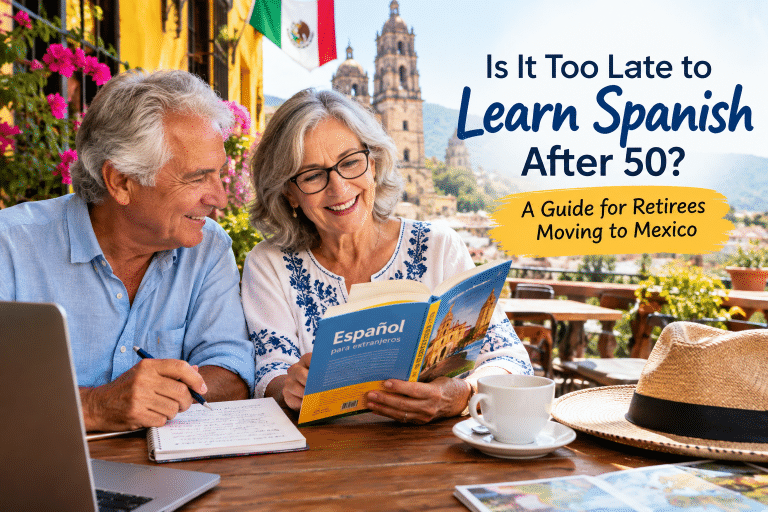
Retirement can open the door to a completely different kind of adventure. For some people, that means traveling more. For others, it means spending part of the year—or even making a permanent move—to Mexico.
But there is often one question that comes up before making the move:
“Am I too old to learn Spanish?”
If you are over 50, the answer is simple: No, it is not too late to learn Spanish.
In fact, retirement can be an excellent time to learn a new language. You may have more time, clearer personal goals, and a strong reason to use Spanish every day. If you are planning to live in Mexico, learning the language can also help you do much more than order food or ask for directions. It can help you build friendships, handle everyday situations, understand Mexican culture, and feel more at home in your new community.
For retirees moving to Mexico, Spanish immersion programs for adults in Mexico can be particularly valuable because they combine structured lessons with real-world communication.
So, what is the best way to learn Spanish after 50? And should you choose online lessons or a Spanish immersion program in Mexico?
Let’s explore what older learners should know.
Is 50 Too Old to Learn Spanish?
Absolutely not.
One of the biggest misconceptions about language learning is that only children or young adults can become proficient in another language. While younger learners may have certain advantages, adults bring their own strengths to the process.
After 50, you may have:
- More life experience to connect new ideas with
- A larger vocabulary in your native language
- Stronger motivation and discipline
- Clear reasons for learning Spanish
- More opportunities to practice in real-life situations
- A genuine interest in understanding Mexican culture
These advantages matter.
A retiree moving to Mexico, for example, is not learning Spanish simply because it is a school requirement. There is a practical purpose behind the learning. You may need Spanish to speak with neighbors, communicate with local service providers, visit a doctor, shop at a market, make friends, or participate in community activities.
That real-world motivation can make learning more meaningful.
Why Learning Spanish Before or After Moving to Mexico Matters?
You can certainly move to Mexico without speaking Spanish. Many expatriates do.
However, depending entirely on English can make everyday life more limited.
Learning Spanish gives you the ability to interact more independently and understand the environment around you.
Imagine being able to:
- Have a conversation with your Mexican neighbors
- Order at a local restaurant without relying on a translation app
- Chat with a shopkeeper at a neighborhood market
- Ask for help when you need it
- Understand local announcements
- Make friends outside an English-speaking community
- Discuss your interests and experiences with local people
These small interactions can eventually become the foundation of a much richer life in Mexico.
That is one reason many retirees choose to learn Spanish in Mexico rather than studying exclusively from home.
Why Spanish Immersion Can Be Especially Effective for Retirees?
Online Spanish classes are convenient. You can study from your living room, choose flexible schedules, and review lessons whenever you want.
But there is a major difference between studying Spanish and using Spanish as part of your everyday life.
A language immersion experience puts you in situations where Spanish becomes useful immediately.
At a Spanish immersion school, you can study grammar and vocabulary in the classroom and then use those skills during conversations, cultural activities, meals, shopping, or interactions around the city.
This is the central idea behind language immersion in Mexico: you don’t simply learn about Spanish—you have opportunities to live it.
At the Spanish Institute of Puebla, the intensive immersion program combines structured language instruction with communication and cultural experiences. The program is organized into eight levels, with each level lasting three weeks, allowing students to choose how much of the program fits their goals and schedule.
What Makes Learning Spanish After 50 Different?
Learning later in life does not necessarily mean learning poorly. It may simply mean that you need to approach the process differently.
You might need more repetition when learning new vocabulary. You may find it difficult to remember certain verb forms at first. You might also feel self-conscious about making mistakes.
That is normal.
The goal is not to memorize thousands of words immediately. The goal is to gradually become comfortable using Spanish.
For retirees, practical communication is often more valuable than trying to sound perfect.
For example, knowing how to say:
“Could you repeat that more slowly?”
can be more useful in daily life than memorizing an advanced grammar rule you rarely use.
An effective Spanish language program in Mexico should therefore give you opportunities to practice listening, speaking, reading, and writing—not just complete exercises in a textbook.
Immersion Helps You Get Comfortable With Real Spanish
One challenge many online learners experience is the difference between classroom Spanish and everyday conversation.
A recorded lesson may be slow and carefully pronounced. A real conversation can be much faster.
People may use informal expressions, shorten words, change topics quickly, or speak with regional accents.
This is where immersion becomes valuable.
When you spend time in Mexico, your ears gradually become accustomed to hearing Spanish around you. You begin recognizing familiar words in different contexts. You also become more comfortable asking people to repeat themselves.
The process may feel difficult at first.
Then, sometimes quite suddenly, a conversation that once sounded like a blur starts making sense.
That moment is one of the most rewarding parts of learning a language.
Why Puebla Can Be a Great Place to Learn Spanish?
If you are looking for the best place to study Spanish in Mexico , consider more than just the number of schools available.
The environment matters.
Puebla offers retirees an opportunity to combine language learning with cultural exploration. The Spanish Institute of Puebla is located in the historic center, and its immersion approach is designed around communication and authentic circumstances.
Students can learn Spanish while experiencing Mexican history, food, traditions, neighborhoods, and everyday life.
That combination is particularly useful if your ultimate goal is not simply to pass a language test but to live comfortably in Mexico.
What Should Retirees Look for in a Spanish Immersion School?
Not every language program will suit every learner.
Before choosing among Spanish schools in Mexico, consider the following factors.
-
Different proficiency levels
You should not feel that you have to start from zero if you already know some Spanish.
A good program should have a structured way to identify your level and place you appropriately.
The Spanish Institute of Puebla offers eight levels ranging from beginner to advanced, with students able to take one or several consecutive levels.
-
Conversation practice
If your goal is to communicate after moving to Mexico, conversation should be a better part of your education.
Grammar matters, but knowing grammar is different from being able to use it naturally in a conversation.
-
Cultural experiences
Language and culture are connected.
Understanding how people greet each other, interact socially, eat, celebrate, and communicate can make your transition to life in Mexico much easier.
-
A supportive environment
Older learners should feel comfortable making mistakes.
You don’t want to spend your lessons worrying about whether your pronunciation is perfect. You want teachers who encourage you to keep speaking.
-
An intensive but manageable structure
Retirement may give you more flexibility, but that doesn’t mean you need to rush.
Look for a program that gives you enough exposure to make meaningful progress while allowing you to enjoy the experience.
Online Spanish Classes vs. Spanish Immersion in Mexico
So, should you give up online learning completely?
Not necessarily.
Online lessons can be excellent for maintaining Spanish before or after an immersion experience. They are also useful for people who cannot travel.
However, immersion offers something that an online class cannot completely reproduce: an environment where Spanish is happening around you.
| Online Spanish Classes | Spanish Immersion in Mexico |
| Convenient from home | Learn while living in Mexico |
| Flexible schedule | Intensive daily exposure |
| Mostly controlled lessons | Real-world conversations |
| Limited cultural context | Direct cultural experience |
| Easy to pause and review | Continuous communication practice |
| Good for independent learners | Useful for learners seeking practical communication |
For someone preparing to relocate to Mexico, immersion can be especially valuable because it connects language learning directly with the life they are preparing to live.
Can You Learn Spanish Fast After 50?
You can make meaningful progress after 50, but it is better to think about consistent progress rather than instant fluency .
How quickly you learn depends on several factors:
- Your starting level
- How much time you dedicate to Spanish
- How frequently do you practice?
- Your willingness to speak
- Your exposure to native speakers
- The intensity of your course
- Your personal learning style
An intensive program can give you concentrated exposure in a relatively short period. At the Spanish Institute of Puebla, each standard level lasts three weeks, with intensive instruction designed around the four communication areas of listening, speaking, reading, and writing, with particular emphasis on conversation.

The important thing is not to compare your progress with someone else’s.
Your Spanish journey is your own.
How Retirees Can Make the Most of Immersion?
If you decide to study Spanish abroad, don’t limit your practice to the classroom.
Try these simple habits:
Speak every day. Even short conversations count.
Keep a vocabulary notebook. Write down useful words you hear during the day.
Ask questions. If you don’t understand a phrase, ask someone to explain it.
Don’t hide behind translation apps. Use them, when necessary, but try to communicate yourself first.
Talk to local people. A five-minute conversation at a market can be excellent practice.
Accept mistakes. Mistakes are evidence that you are using the language.
Connect Spanish with your interests. If you enjoy cooking, learn food vocabulary. If you love history, read about Mexican history in Spanish as your skills improve.
The more personally relevant Spanish becomes, the easier it is to stay motivated.
Moving to Mexico Is a Reason to Learn, Not a Reason to Wait
Many retirees tell themselves they will learn Spanish once they move to Mexico.
There is nothing wrong with that approach, but starting earlier can make the transition easier.
Even basic Spanish can help you feel more confident when you arrive.
And once you are in Mexico, an immersion Spanish program can help turn that foundation into practical communication skills.
The goal isn’t to become a perfect Spanish speaker overnight.
The goal is to gradually move from:
“I don’t understand.”
to:
“I understand some of that.”
Then:
“I can respond.”
And eventually:
“I can have this conversation in Spanish.”
That progression is possible at 50, 60, 70, and beyond.
Final Thoughts: It Is Never Too Late to Learn Spanish
Turning 50 is not a deadline for learning a language. It can actually be the beginning of one of the most rewarding learning experiences of your life.
If you are retiring or planning to move to Mexico, Spanish can help you do more than navigate daily life. It can help you connect with people, understand your surroundings, participate in the community, and experience Mexican culture more deeply.
While online courses can provide a useful foundation, Spanish immersion classes in Mexico give you something difficult to recreate at home: the opportunity to learn and use Spanish within the culture itself.
So if you have been thinking, “Maybe I am too old to learn Spanish,” replace that thought with a better question:
“What could my life in Mexico look like if I could speak Spanish?”
That is a much more exciting place to begin.
For retirees ready to take that step, the right Spanish immersion program in Mexico can turn language learning from a distant goal into part of everyday life.
Frequently Asked Questions About Learning Spanish After 50
Is 50 too old to learn Spanish?
No. Adults over 50 can successfully learn Spanish. Motivation, consistent practice, and regular exposure to the language are more important than simply being young.
Is Mexico a good place to learn Spanish?
Yes. Mexico provides opportunities to combine structured education with everyday Spanish communication and cultural experiences. This makes it a popular destination for people who want to learn Spanish abroad in Mexico .
Are Spanish immersion programs suitable for retirees?
Yes. Many programs welcome adult learners and retirees. The Spanish Institute of Puebla has taught students, professionals, and retirees from more than 72 countries over more than 35 years.
Can I join a Spanish immersion program as a complete beginner?
Yes. Immersion programs can be suitable for beginners as well as more experienced learners. A placement process can help determine the appropriate level.
Is immersion better than online Spanish classes?
Neither approach is automatically better for everyone. Online classes offer convenience, while immersion provides intensive exposure and real-life opportunities to communicate. For retirees preparing to live in Mexico, immersion can be especially practical.
How long should I study Spanish in Mexico?
That depends on your goals. Some learners may benefit from a few weeks as a foundation or refresher, while others may choose several consecutive levels for more substantial progress. The Spanish Institute of Puebla offers eight three-week levels, allowing students to choose one or continue through multiple levels.