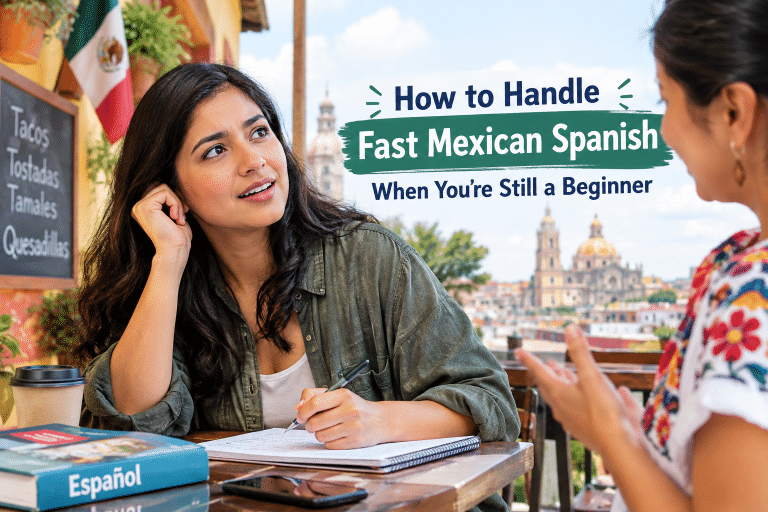
One of the most surprising moments for beginners learning Spanish in Mexico happens when they finally leave the classroom.
You may have spent days learning common phrases, practicing vocabulary, and answering your teacher’s questions. Then you walk into a restaurant, market, taxi, or conversation with a local—and suddenly, Spanish sounds much faster than it did in class.
You recognize some words. You understand the general topic. But the sentences seem to run together, and before you can process one phrase, the speaker has already moved on to the next.
If this sounds familiar, don’t worry. Struggling to understand fast Mexican Spanish is completely normal for beginners . It doesn’t mean you are bad at Spanish or that you are not progressing.
In fact, learning to understand naturally spoken Spanish is one of the most important steps toward becoming a confident speaker.
How can beginners handle fast Mexican Spanish?
The best approach is to slow down the interaction when necessary, focus on key words instead of every word, practice listening regularly, and gradually expose yourself to natural conversations. Here are practical strategies that can help.
-
Don’t Expect to Understand Every Word
One of the biggest mistakes beginners make is trying to understand every single word.
Imagine someone says:
“Well, if you want we can go later because right now I have some things to do…”
If you’re still learning Spanish, trying to translate every word in real time can quickly become overwhelming.
Instead, listen for the words that carry the main meaning.
You might recognize:
- you want
- ir — to go
- later
- right now
- things
Even if you miss some words, you can often understand the general idea.
This is an important skill when you learn Spanish in Mexico. Native speakers don’t usually speak like language-learning textbooks. Your goal is not perfect understanding from the beginning. Your goal is to gradually understand more of the conversation.
-
Ask People to Slow Down
You don’t have to pretend that you understood something when you didn’t.
If someone is speaking too quickly, politely ask them to slow down.
Useful phrases include:
- Can you speak more slowly, please?
- Can you repeat that?
- I didn’t understand. —I didn’t understand.
- What does … mean?
- Can you say it another way ?
These phrases are worth memorizing before starting an immersion Spanish program.
Most people will understand that you’re learning. And asking someone to repeat something is not a failure. It is an active communication strategy.

-
Get Used to the Rhythm of Mexican Spanish
Sometimes the problem isn’t vocabulary. It’s rhythm.
Native speakers naturally connect words, reduce certain sounds, and speak with a rhythm that can make familiar words difficult to recognize.
For example, a beginner may know the phrase How are you? perfectly well when reading it. But hearing it naturally in conversation can initially sound very different from what they expected.
This is why listening practice is so important.
When you participate in Spanish immersion classes in Mexico, you are exposed to Spanish not only during formal lessons but also throughout your daily experience.
Over time, your brain begins to recognize common patterns automatically.
You don’t consciously translate every sentence. You simply start recognizing what people are saying.
That transition takes time.
-
Focus on Key Words
When someone speaks quickly, listen for the words you already know.
For example, if someone says:
“Tomorrow we’re going downtown after ten because I have an appointment…”
You might not understand every grammatical detail, but you may catch:
tomorrow → center → later → ten → appointment
Those words provide useful information.
This technique becomes especially helpful when you study Spanish abroad , because you’ll regularly encounter conversations where you don’t understand everything.
Instead of thinking, “I didn’t understand the sentence,” ask yourself:
“What did I understand?”
That small change in mindset can make listening feel much less frustrating.
-
Learn Common Mexican Expressions
Mexican Spanish has expressions that you may not encounter frequently in beginner textbooks.
One example is “ahorita.”
Depending on context, ahorita can refer to something happening now or something happening relatively soon. Its meaning is influenced by the situation and the speaker.
You’ll also hear informal expressions and everyday vocabulary that may initially surprise you.
Don’t try to memorize every regional expression at once.
Instead, keep a small vocabulary notebook and write down expressions you hear repeatedly.
For example:
Expression: What’s up?
Meaning: What’s up? / How’s it going?
Expression: Ahorita
Meaning: Right now / in a little while, depending on context
Expression: Oh!
Meaning: An expression that can communicate encouragement, agreement, surprise, or other meanings depending on context.
Learning expressions in context is much more useful than simply memorizing lists.
-
Practice Listening Before You Speak
Listening and speaking are closely connected.
If you regularly listen to natural Spanish, you begin to develop a better sense of pronunciation, rhythm, sentence patterns, and common expressions.
Before or during your Spanish language program in Mexico, make listening part of your daily routine.
You could listen to:
- Mexican podcasts
- Spanish-language interviews
- Mexican television programs
- YouTube videos
- Spanish music
- Conversations between native speakers
- Audio materials provided by your language school
Don’t worry about understanding everything.
Listen to the same short recording several times.
The first time, focus on the general idea.
The second time, identify familiar words.
The third time, listen for phrases you can recognize.
This repeated exposure can make fast Spanish feel considerably more manageable.
-
Don’t Immediately Switch to English
When you’re confused, switching immediately to English can feel like the easiest solution.
Sometimes it’s necessary, particularly when something is important or unclear. But if you are participating in intensive Spanish immersion programs, try staying in Spanish whenever possible.
For example, instead of asking:
“What does that mean in English?”
Try:
What does it mean?
Or:
Can you explain it?
Even if the explanation is partly in Spanish, you’re getting more listening practice.
This is one of the best benefits of language immersion in Mexico . Spanish isn’t restricted to a lesson. You have opportunities to use it in practical situations throughout the day.
-
Use the Context Around You
Context is one of your best tools when listening to fast Spanish.
Imagine you’re in a restaurant and the server says something quickly while pointing toward the menu.
You may not understand every word, but the situation gives you clues.
Similarly, if you’re at a bus station and someone mentions a destination, time, and ticket, you can use the environment to interpret the conversation.
Your brain naturally combines:
words + gestures + surroundings + previous knowledge
This is how real-world communication works.
You don’t need to understand every word to understand what is happening.
-
Repeat What You Hear
A useful technique for beginners is called shadowing .
It simply means listening to a short phrase and repeating it immediately or shortly afterwards.
For example:
Speaker: What time are you arriving?
You: What time are you arriving?
Start with short phrases.
This practice can help you become more familiar with:
- Spanish pronunciation
- Natural rhythm
- Connected speech
- Common sentence structures
- Everyday vocabulary
It can also make speaking feel less intimidating.
If you’re attending one of the best Spanish immersion programs, ask your teacher whether shadowing or similar listening exercises can be incorporated into your practice.

-
Give Yourself Time to Adjust
Your first few days of immersion may feel exhausting.
You might understand your teacher but struggle with conversations outside the classroom.
You may hear Spanish all day and feel like your brain needs a break.
That’s normal.
Learning a language requires your brain to process unfamiliar sounds, vocabulary, grammar, pronunciation, and context simultaneously.
As you spend more time in Mexico, your listening ability should gradually improve.
What sounds impossibly fast during your first week may become much easier to recognize after several weeks of consistent exposure.
Don’t measure your progress by whether you understand everything .
Measure it by whether you’re understanding more than you did before.
-
Turn Everyday Situations Into Listening Practice
One of the biggest advantages of Spanish schools in Mexico is the opportunity to practice outside the classroom.
Use everyday situations as small listening exercises.
At a café, listen to how people order.
At a market, pay attention to prices and questions.
During a cultural activity, listen to how people describe what you’re seeing.
When talking with classmates, notice which expressions they use repeatedly.
You don’t need to turn every moment into a formal lesson.
Simply paying attention to Spanish around you can make a difference.
This is what makes learn Spanish abroad Mexico experiences so valuable: the language becomes connected to real people, places, and experiences.
-
Don’t Be Afraid of Making Mistakes
Fast Spanish can make beginners feel insecure.
You might think:
“I’ll speak when I’m better.”
But waiting until your Spanish is perfect can actually slow down your progress.
Speak.
Make mistakes.
Ask questions.
Get corrected.
Try again.
A good Spanish language school should give you a supportive environment where communication is more important than perfection.
The objective is not to sound like a native speaker on your first week.
The objective is to become increasingly comfortable using Spanish.
-
Choose an Immersion Program That Supports Beginners
If fast Spanish is one of your concerns, choosing the right learning environment matters.
Look for a program that offers structured instruction while also giving you opportunities to communicate naturally.
A strong Spanish immersion program should help you build your skills progressively rather than expecting you to understand native-speed conversations immediately.
At the Spanish Institute, students’ progress through structured levels while developing comprehension, linguistics, reading, writing, and conversation skills. The communicative approach also gives learners opportunities to use Spanish in authentic situations.
That combination is particularly useful for beginners because you can build a foundation in class and then gradually apply what you learn outside the classroom.
Final Thoughts: Fast Spanish Becomes Easier with Exposure
The first time you hear native Mexican Spanish spoken quickly, it can feel like you’ve suddenly forgotten everything you’ve learned.
You haven’t.
Your brain is simply learning to recognize Spanish at its natural speed.
Be patient with yourself. Listen for key words. Ask people to slow down. Learn common expressions. Practice listening every day. Most importantly, keep using Spanish even when you don’t understand every sentence.
That is one of the reasons Spanish immersion classes in Mexico can be such a powerful learning experience. Instead of only studying Spanish as a subject, you begin experiencing it as a living language.
With consistent practice and the right learning environment, conversations that once sounded impossibly fast can gradually become understandable.
And eventually, you may find yourself listening to a conversation in Spanish without translating every word in your head—that’s when you know your immersion is really starting to work.
Frequently Asked Questions About Understanding Fast Mexican Spanish
Why does Mexican Spanish sound so fast?
Mexican Spanish may sound fast to beginners because native speakers naturally connect words, use conversational expressions, and speak with a rhythm that differs from classroom Spanish. With regular listening practice, your brain becomes better at recognizing these patterns.
How can I understand Mexican Spanish as a beginner?
Focus on key words rather than every word, ask people to repeat or slow down, practice listening regularly, learn common Mexican expressions, and use context to understand conversations.
Should I ask Mexican people to speak slowly?
Yes. Can you speak slower, please? is a perfectly reasonable phrase for a Spanish learner. Most people will understand that you’re practicing the language.
Is Mexican Spanish difficult for beginners?
It can feel difficult at first, particularly when listening to native speakers in everyday situations. However, consistent exposure through Spanish immersion programs for adults in Mexico can help you become more comfortable with natural speech.
Is Mexico a good place to learn Spanish?
Yes. Mexico provides opportunities to combine structured language education with everyday exposure to Spanish and Mexican culture. For learners who want to learn Spanish fast, an immersive environment can provide significantly more opportunities for listening and communication than studying only occasionally.