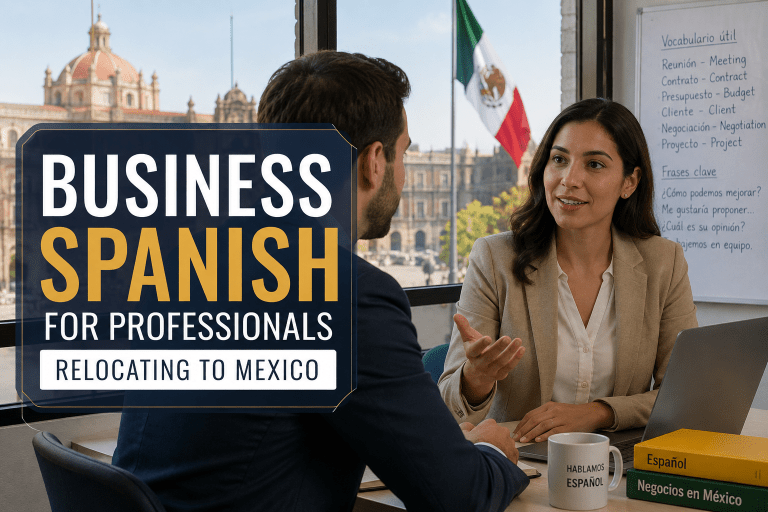
Relocating to Mexico for work can be an exciting opportunity. You may be starting a new position, opening a business, joining an international team, or transferring to a Mexican office. But there is one part of the move that can make a surprisingly big difference in how quickly you settle in: learning Business Spanish.
You can manage many aspects of professional life in Mexico with English, particularly in international companies and larger business environments. However, being able to communicate in Spanish can help you build stronger relationships, understand workplace culture, handle everyday situations, and feel more comfortable outside the office.
For professionals, learning Spanish is not simply about memorizing vocabulary or completing grammar exercises. You need to know how to introduce yourself professionally, participate in meetings, communicate with colleagues, make small talk, understand local expressions, and handle practical situations with confidence.
That is where a Spanish immersion program can make a meaningful difference.
If you are preparing to relocate, choosing between online lessons and Spanish immersion classes in Mexico is worth considering carefully. An immersive environment allows you to learn Spanish while experiencing the culture and situations in which you will actually use it.
Why Is Spanish Important for Professionals Moving to Mexico?
Spanish can play a much bigger role in your professional life than simply helping you communicate with coworkers.
When you relocate, your first challenges may happen outside the workplace. You may need to speak with a landlord, arrange utilities, visit a bank, communicate with a taxi driver, order food, meet neighbors, or deal with local services.
Once you become more comfortable, Spanish can also help you develop professional relationships.
For example, imagine joining a meeting where your Mexican colleagues switch between English and Spanish. You may understand the formal business discussion, but you could miss the informal conversations before and after the meeting. Those seemingly small interactions can be important for building trust.
Learning Spanish helps you participate rather than simply observe.
It also demonstrates that you are making an effort to understand the country where you are living and working.
What Is Business Spanish?
Business Spanish is not a completely separate language. Instead, it refers to the vocabulary, expressions, communication styles, and cultural understanding that professionals need in workplace situations.
Depending on your profession, you may need Spanish for:
- Meetings and presentations
- Emails and professional correspondence
- Client communication
- Negotiations
- Networking
- Workplace conversations
- Phone and video calls
- Customer service
- Business travel
- Presentations and public speaking
- Managing employees or teams
- Everyday interactions outside the workplace
For example, knowing how to say “Nice to meet you” is useful, but a professional relocating to Mexico may also need to know how to introduce their role, explain a project, ask for clarification during a meeting, or politely disagree with a colleague.
These skills develop through repeated use—not simply through studying vocabulary lists.
Who Should Consider a Spanish Immersion Program?
A language immersion in Mexico experience can be particularly valuable for professionals who expect to use Spanish regularly after relocating.
You may benefit from immersion if you are:
-
Moving to Mexico for a New Job
If your employer is transferring you to Mexico, an immersion program can help you adjust before or shortly after your relocation.
You can develop practical communication skills while becoming familiar with Mexican culture and everyday interactions.
-
Managing a Team in Mexico
Managers often need to communicate with employees in a variety of situations. While your company may operate primarily in English, Spanish can help you establish more personal and effective relationships with your team.
-
Working With Mexican Clients or Partners
Professionals who regularly interact with Mexican customers, suppliers, vendors, or business partners can benefit from understanding both the language and cultural context behind business communication.
-
Entrepreneurs Relocating to Mexico
If you are moving to Mexico to start or expand a business, Spanish can make many everyday tasks easier.
From speaking with local service providers to networking and understanding customers, language skills can become a practical business asset.
-
Professionals Working in International Companies
Even if your workplace uses English as its primary corporate language, Spanish can help you participate more fully in the local office environment.
It can also make social interactions with colleagues much easier.
-
Healthcare, Education, Tourism, and Other Client-Facing Professionals
Professionals who interact directly with the public may find Spanish especially important.
The ability to communicate clearly and naturally with local people can improve both professional interactions and everyday experiences.
Why Choose Immersion Instead of Only Online Spanish Classes?
Online Spanish classes can be convenient. You can study from home, fit lessons around your schedule, and access courses from almost anywhere.
But relocation changes the learning equation.
If you are moving to Mexico, you are not learning Spanish simply to pass a test. You are learning it because you expect to live and work in a Spanish-speaking environment.
That is one of the strongest arguments for choosing intensive Spanish immersion programs.
In an immersion environment, Spanish does not stop when your class ends.
You may study a particular expression in the morning and use it later at a restaurant. You might practice asking questions in class and then use those skills while speaking with someone in a local shop.
The language becomes connected to real experiences.
That connection can make learning more memorable and practical.
How Immersion Helps Professionals Learn More Naturally
A good immersion Spanish program combines structured instruction with opportunities to use Spanish in authentic situations.
This is particularly useful for professionals because workplace communication requires more than knowing grammar.
You need to develop several skills at the same time:
Listening: Understanding different speaking speeds, accents, and expressions.
Speaking: Expressing your ideas clearly without constantly translating from your native language.
Vocabulary: Learning words that are relevant to your professional and personal life.
Cultural understanding: Recognizing how communication styles can differ between cultures.
Confidence: Becoming comfortable speaking even when your Spanish is not perfect.
The goal is not to produce flawless Spanish from your first day.
The goal is to gradually become someone who can function comfortably in Spanish.
What Should Professionals Learn Before Relocating?
You do not need to become fluent before arriving in Mexico. Instead, concentrate on language that will help you function during your first few weeks.
Start with practical areas such as:
- Introducing yourself
- Explaining your profession
- Asking for directions
- Making appointments
- Ordering food
- Shopping
- Discussing schedules
- Talking about transportation
- Asking for clarification
- Understanding numbers and prices
- Making polite requests
Then build toward professional communication.
Useful areas include:
- Job titles and departments
- Meetings
- Deadlines
- Projects
- Responsibilities
- Customer relationships
- Negotiations
- Presentations
- Scheduling
- Workplace etiquette
A structured Spanish language program in Mexico can help you develop these skills progressively rather than trying to learn everything at once.
Why Cultural Understanding Matters in Mexican Business
Language and culture are closely connected.
A professional can have excellent grammar and still misunderstand a conversation because they do not understand the cultural context.
Mexican workplace communication may involve relationship-building, politeness, greetings, social conversation, and other elements that can feel different from what you are accustomed to.
For someone relocating permanently, learning these cultural patterns can make the transition much smoother.
This is another reason learning Spanish abroad in Mexico can be so valuable.
You are not studying Mexican Spanish in isolation. You are experiencing it in the environment where it is spoken.
Why Puebla Can Be a Practical Place to Learn Spanish
Choosing the right location matters when you are comparing Spanish schools in Mexico.
Puebla offers an environment where students can combine formal Spanish instruction with opportunities to experience Mexican culture and everyday communication.
For professionals, this combination can be particularly useful. You can study during structured classes while also hearing and using Spanish in restaurants, shops, cultural activities, and other daily situations.
This creates a bridge between the classroom and real life.
For someone preparing to relocate, that bridge is important.
What Should You Look for in a Spanish School?
Not all language programs are designed in the same way.
If your goal is to prepare for professional life in Mexico, look for a school that offers:
- Structured levels of instruction
- Experienced teachers
- Conversation practice
- Small-group interaction
- Cultural activities
- Real-world communication opportunities
- A clear progression from beginner to advanced levels
- Instruction based on recognized language-learning frameworks
The Spanish Institute has provided intensive immersion programs in Mexico for more than 35 years, welcoming students from more than 72 countries.
Its program follows the Common European Framework of Reference (CEFR) and ACTFL guidelines, with eight levels designed as three-week intensive immersion stages.
Students can choose to attend one level or continue through multiple levels depending on their goals and schedule.
The program also emphasizes communication. Formal classes develop comprehension, linguistics, reading, writing, and language structure, while conversation provides opportunities to actually use Spanish.
That balance is especially valuable for professionals who need Spanish to work in the real world.
How Long Does It Take to Learn Spanish for Work?
There is no single answer.
Your progress depends on your starting level, the amount of time you dedicate to learning, how frequently you speak Spanish, and how much exposure you receive outside class.
Someone who studies occasionally online will have a very different experience from someone participating in an intensive immersion program and using Spanish throughout the day.
The important thing is to set realistic goals.
For example, your first goal may be to introduce yourself and handle everyday transactions. Later, you might aim to participate comfortably in workplace conversations. Eventually, you may want to negotiate, present, or manage professional relationships entirely in Spanish.
Immersion can help you move through these stages by giving you frequent opportunities to practice.
Tips for Professionals Preparing to Relocate
Before moving to Mexico, consider these practical steps:
Start with everyday Spanish. You will use it immediately after arriving.
Learn vocabulary related to your profession. Create a list of common terms you expect to hear at work.
Practice listening. Real conversations do not always sound like textbook exercises.
Do not wait for perfect Spanish. Mistakes are a normal part of becoming comfortable with a new language.
Learn Mexican expressions. Regional vocabulary and expressions will make everyday communication easier.
Use Spanish outside class. Ordering lunch, asking questions, shopping, and speaking with local residents all become learning opportunities.
Keep a notebook. Write down useful expressions you hear during the day and ask your teacher about them.
Most importantly, treat your relocation as part of the learning experience.
Final Thoughts: Make Spanish Part of Your Professional Life
Relocating to Mexico is about more than changing your office address. It means adapting to a new environment, developing relationships, understanding a different culture, and becoming comfortable with everyday life.
Spanish can make every part of that transition easier.
While online classes can be a useful starting point, professionals who plan to live and work in Mexico may benefit from experiencing Spanish in the environment where they will actually use it.
A Spanish immersion program gives you the opportunity to learn in a structured setting while practicing communication beyond the classroom. You can build vocabulary, improve listening and speak skills, learn about Mexican culture, and gradually develop the confidence to communicate naturally.
If your goal is to learn Spanish in Mexico and use it as part of your professional and personal life, immersion can turn Spanish from a subject you study into a skill you actually live.
For a professional preparing for a new chapter in Mexico, that difference can be significant.
Frequently Asked Questions About Business Spanish in Mexico
Do I need to speak Spanish before relocating to Mexico for work?
No. You can begin as a beginner. However, learning some practical Spanish before or immediately after relocating can make your transition easier and help you communicate more confidently.
Is business Spanish different from regular Spanish?
Business Spanish uses the same fundamental language, but professionals need additional vocabulary and communication skills related to meetings, presentations, negotiations, clients, workplace relationships, and professional etiquette.
Are Spanish immersion programs suitable for working professionals?
Yes. Intensive programs can be particularly useful for professionals because they combine structured learning with practical communication. Depending on the program schedule, students can choose an appropriate level and duration.
Can I learn Spanish fast through immersion?
Immersion can accelerate exposure and practice because Spanish becomes part of your daily environment. However, your progress will still depend on your starting level, study habits, practice, and willingness to communicate.
Is Mexico a good place to learn Spanish?
Yes. Learning Spanish in Mexico allows you to combine formal instruction with everyday opportunities to hear and use the language. For people planning to live or work in Mexico, this real-world exposure can be especially valuable.
What is the best way to learn Spanish before moving to Mexico?
A combination of structured instruction and practical exposure is a strong approach. Online study can provide flexibility, while an intensive immersion experience in Mexico can help you develop real-world communication skills before settling into your professional life.